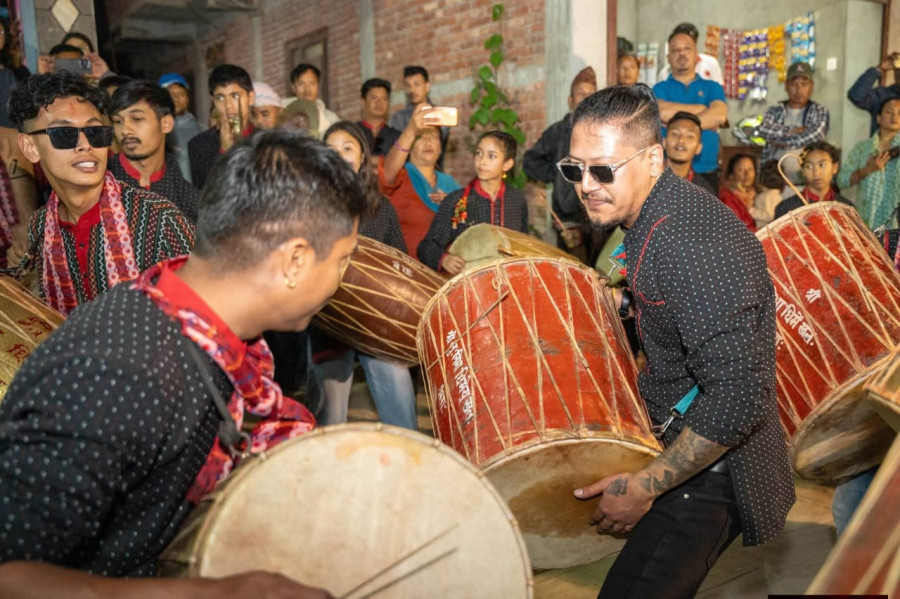
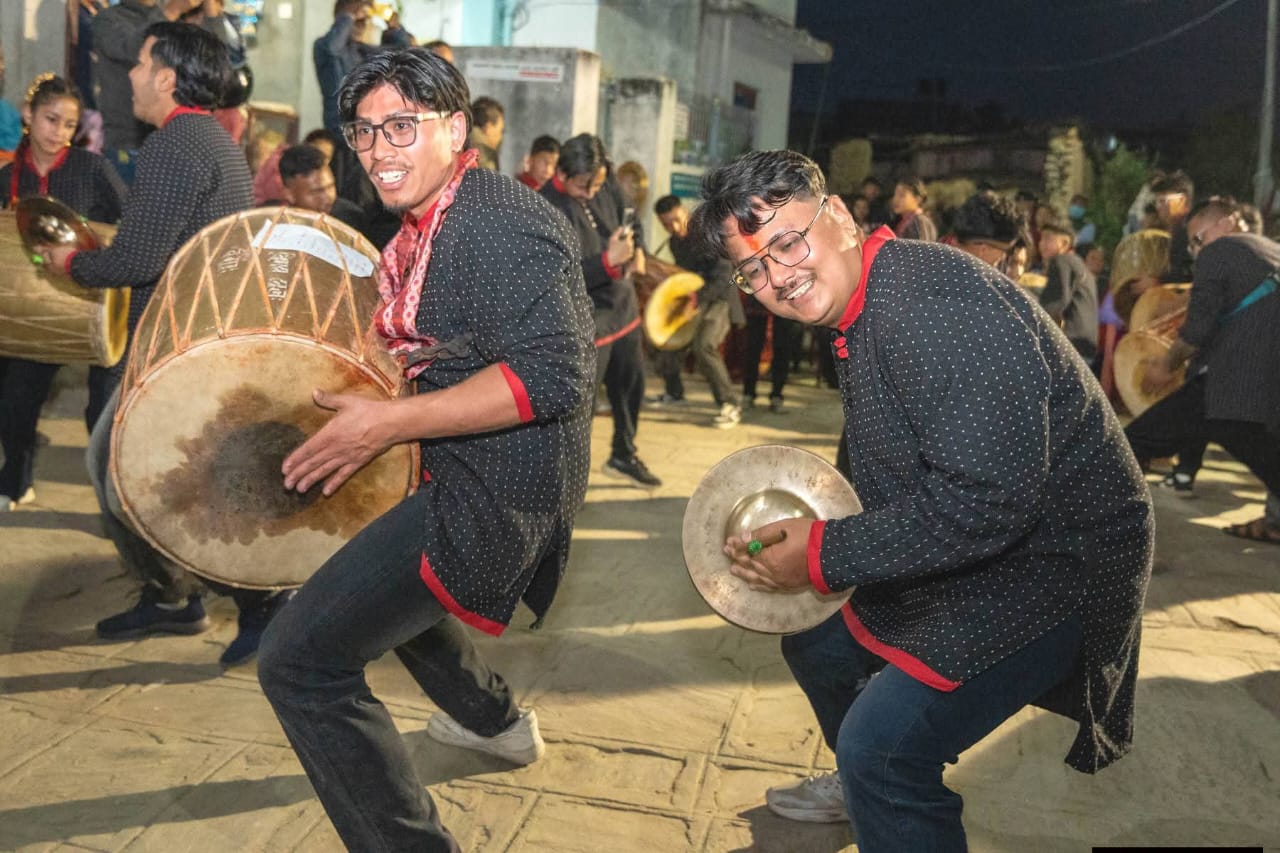
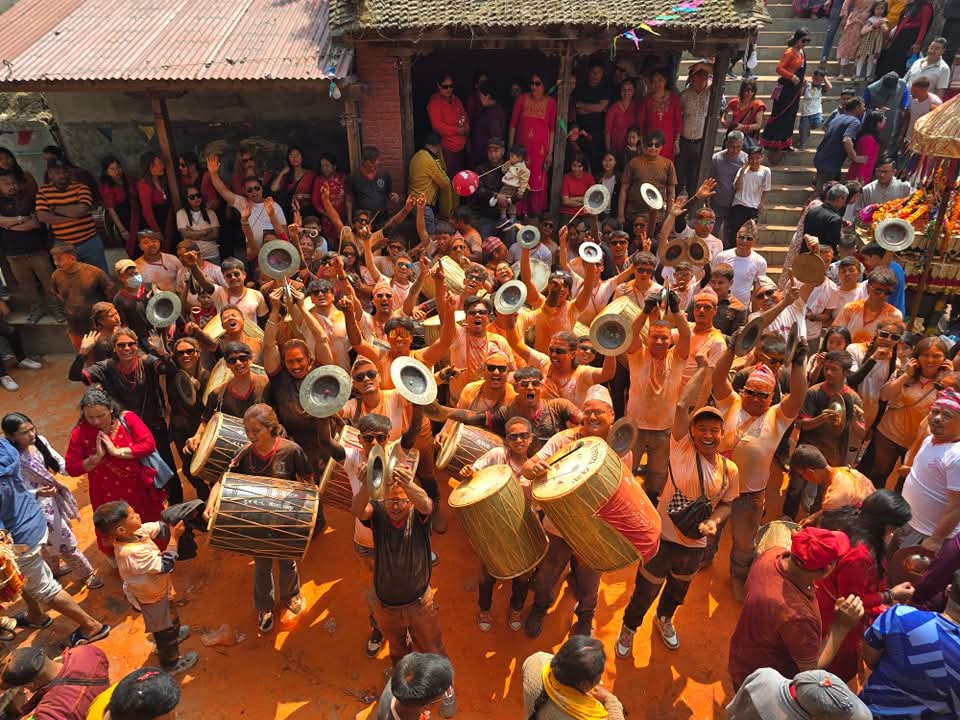
From jatras to weddings, the traditional Newa drum continues to echo across Kathmandu, carried forward by youth, women, and cultural groups. Photos: Provided to the Post
If you ever stumble upon a mass in a jatra, a thunderous beat that repeats itself demands immediate attention. This festive beat is produced by the dhime, a traditional Newa baja.
The sonorous sound of the dhime evidences the large structure of this musical instrument. Dhime’s long, cylindrical shape has a diameter of about 40-50 inches and a length of 17-21 inches. The drum structure is generally made up of wood and even brass. The leathering of it is done using either dried cow or goat skin. Intense sun or water exposure can damage this instrument.
Along with the Dhime, the Bhusyah (an idiophone, a musical instrument that produces sound by its own vibration) is generally played. In performances or on special occasions, other instruments—tabla, khee, dholak, and flute—are paired to create a vibrant musical ensemble.
The left side of the instrument is called mankah, and the right membrane is nasah. The dhime stick that is used to strike the nasah part of the instrument is known as the chatacha.
Youth participation in dhime khalas—the groups that play the dhime baja—is increasing, reflecting a growing effort to preserve traditional Newa instruments and revive cultural identity.
Ravi Sundar Shrestha, the chairperson of Luniva Dhime Khala from Bhaktapur, shares his perspective on the relevance of dhime baja. The group’s name, ‘Lu’, refers to gold and ‘niva’ means ‘sunlight rays’. This khala has been operating for decades; Shrestha’s family has also been involved in playing the dhime, which inspired him to learn it despite the limited resources available to him.
Youth participation in dhime khalas is increasing, reflecting a growing effort to preserve traditional Newa instruments.
Before starting the main taal of dhime, there is another beat called the ‘Dewa Taal’ that is played each time before the actual performance begins.
“What makes the dhime different from other kinds of musical instruments is that when played in a crowd, the loudest sound will be of this instrument. This does not come from simply knowing how to play it; it requires significant strength to hold it,” says Shrestha.
According to him, most events do not even begin without this instrument, including Bratabandha, Krishna Janmashtami, Jatras and others. One recent change, however, is that people have started playing the dhime at weddings as well. Shrestha describes this as a new trend in society.
The dhime is played in honour of Nasa Dya (also known as Nateshwor), the god of music and dance.
Shrestha says, “We have been taught that playing the dhime baja pleases Nasa Dya. But one belief about the deity was that women were not allowed to worship this god, so playing the dhime was not encouraged among women.”
However, in Luniva Khala, he says he has seen women’s participation increase, despite a belief widely held when he was a child. So far, Luniva Khala has won several competitions. Last year, the group secured first place in the Bagmati Province Dhime Baja competition.
To promote this enthusiasm, the government has been hosting such competitions, awarding winners based on beats, clear dhime tunes and timing. With cash prizes and tokens as incentives, the hype and competitive spirit among khalas are growing.
Chandra Govinda Maharjan, the guru of Brahmayani Dhime Khala, highlights another significance of the dhime baja.
“Dhime was not only played during festive times but also before starting any auspicious tasks,” he says. “I have seen it performed when a road was being built and even when the construction of a bridge was about to begin. In the Newa community, dhime baja signifies a good omen.”
For Maharjan, teaching the beats and rhythms of the dhime baja is more about passing on the musical heritage of the Newa community than making a profit. “Most gurus teach without expecting monetary benefits. We may receive guru bhet—an offering given out of respect to teachers, but the intention of Brahmayani Dhime Khala was never money,” Maharjan clarifies.
Traditionally, dhime baja education has been linked to guthis that work to preserve culture. However, institution-based learning has also emerged in some places, which Maharjan sees as an opportunity to expand dhime baja education.
He believes, “Learning from institutions can be effective as the materials and resources are more structured and proper, which makes it easier for students to understand the way Dhime works.”
However, institutionalised learning also has its downsides. While theoretical knowledge may be easier to teach in schools, playing an instrument in groups is more effective for long-term understanding. Such communal learning usually happens within guthi groups, where students play the dhime during jatras and festivals—an experience often absent in music institutions.
The instrument is also becoming more inclusive, reaching people beyond the Newa community. Pragati Bhattarai, 19, is half Newa through her maternal side. Growing up in a Brahmin household did not stop her from learning the dhime, an instrument that represents the cultural identity of the other side of her family.
She claims, “In Shweta Bhairav Khala from Brahma Tole, people from all castes and ethnic communities are welcomed to learn playing Dhime.”
Bhattarai believes that encouraging diversity in playing the instrument helps preserve not only its Newa essence but also raises the profile of Nepal’s traditional musical instruments on a broader scale.
From religious festivals to the growing participation of youth and women, dhime baja has become a strong expression of the Newa community’s identity and heritage. As Guthis continues to promote and popularise the instrument, dhime baja—with its striking sound—remains a powerful symbol of Nepal’s musical identity.




 19.27°C Kathmandu