Meet the Nepalis who are running around the world — literally
Before Kathmandu wakes up, five men are already on the road. Their goal: run every major marathon on earth. Dharma Maharjan Photo; Courtesy of Dharma Maharjan
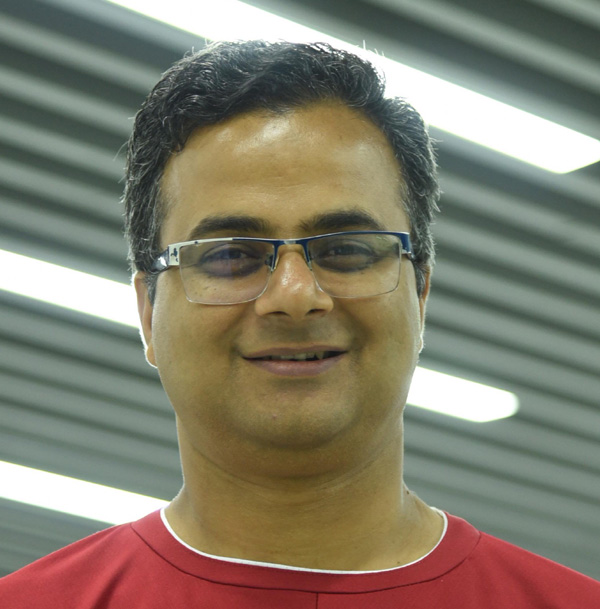
Every morning before the city wakes, Sanjiv Aryal runs a loop through Maharajgunj and out toward Chabahil. He has been doing this for nine years, ever since he collided with Ramkrishna Maharjan on a stretch of pavement near Panipokhari predawn. Back then, Aryal was running to lose weight. Maharjan, who was already well into his fifth decade of competitive running, barely broke stride.
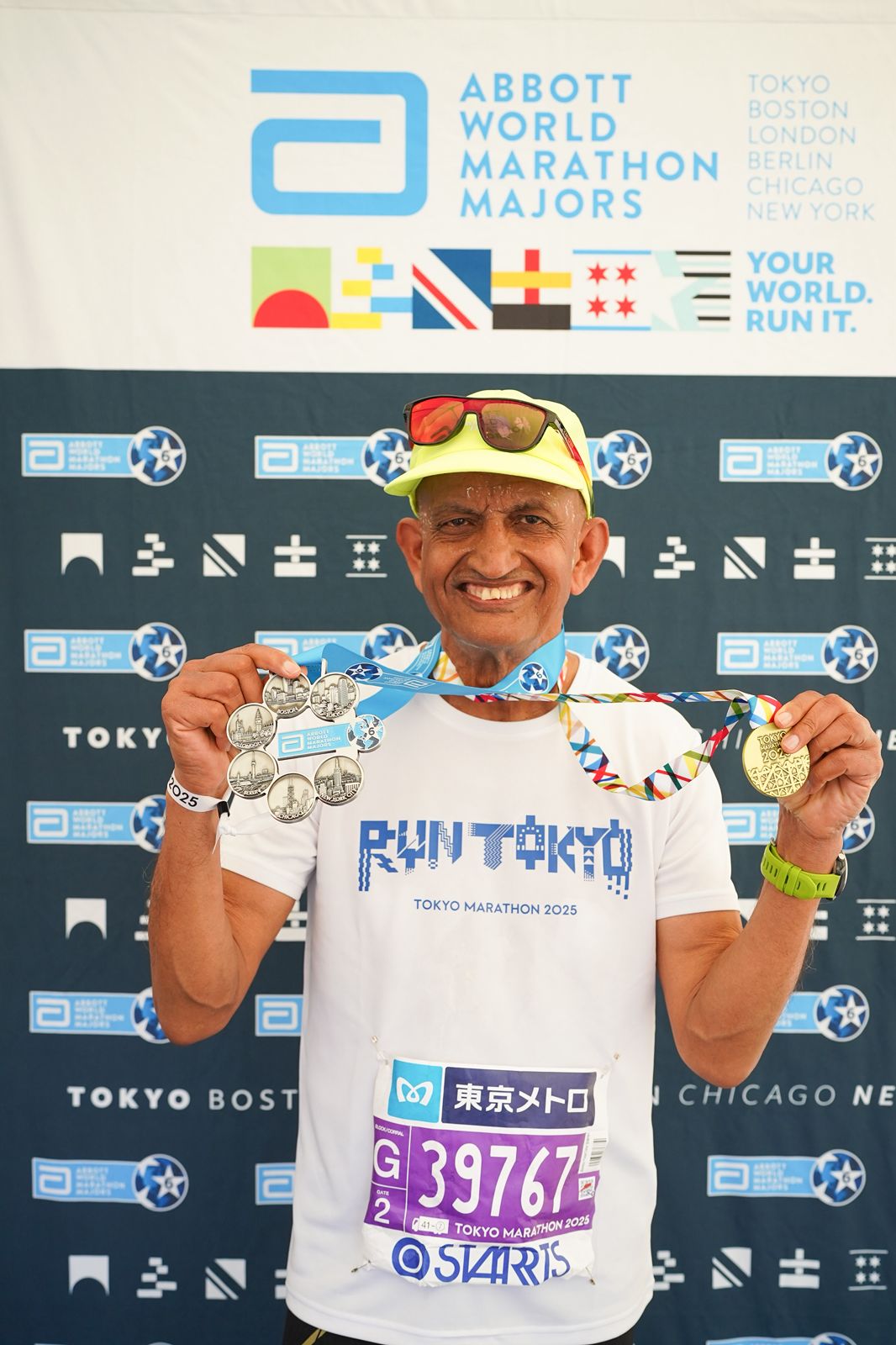
That chance encounter reshaped Aryal’s life, he says. The 45-year-old cargo trader now logs 80 kilometres a week, training for something called the World Marathon Majors — the six most prestigious road races on the planet: Tokyo, London, Boston, Chicago, New York, and Berlin. Runners in the circuit know them as the Golden Six, the equivalent of tennis grand slams.
Aryal and Maharjan form the core of a small but serious running cohort from Kathmandu that has been quietly conquering the circuit. Their group includes Shambhu Prasad Dahal, a recently retired corporate executive; Sushil Kumar Shrestha, a civil engineer; and Dharma Maharjan, a veteran competitor now based partly in India.
Between them, they have crossed finish lines on multiple continents, navigated visa denials and immigration holdups, and spent the equivalent of several hundred thousand rupees per race to pursue a sport that barely registers in Nepal’s sporting culture.
One of the runners, Shambhu Prasad Dahal, says he once drew up a preliminary plan for an internationally accredited marathon in Kathmandu. When he estimated the total cost at around Rs 40 million, and realised he couldn’t be sure the event could be sustained year after year, he walked away from it.
“In Tokyo, the prime minister himself is involved in making the marathon a success,” he says. “We’re not there yet, but a Kathmandu Marathon would be the cheapest of any international races, and it would bring an enormous boost to sports tourism.”
The 70-year-old who refuses to slow down
Ramkrishna Maharjan, 70, shows no sign of stopping. He first raced internationally in 1981, when he ran the 1,500 metres at the International Youth Track and Field Championship in the Soviet Union — finishing in 4 minutes 19 seconds. He has since run 25 marathons around the world: Bangkok, Lyon, Gold Coast, New Zealand, Canada, Venice, and all six majors.
Ramkrishna Maharjan Photo: Courtesy of Ramkrishna Maharjan
He completed the Golden Six in 2023 with the London Marathon, having begun the circuit in Boston in 2008. He has no interest in repeating any of them. He is looking for new destinations.
At his traditional Newari restaurant, Harati, in Sorhakhutte, Maharjan avoids outside food. He credits his ability to run without visible decline to a steadfast diet and training discipline. He says he also runs to make a point: that in Nepal, where the social consensus tends to regard anyone over 40 as past their prime, competitive distance running in your seventh decade is a provocation.
“After 40, you need to become healthier, not give up,” he says.
A “fun runner” who finished five Majors
It may sound like a crazy idea, but Aryal runs marathons for fun. He ran his first marathon in 2017 in Tokyo through a charity entry. He has now completed five of the six majors — he is desperate to run the Boston Marathon. But getting into Boston, the most selective race on the circuit, requires a qualifying time, not just a ballot draw or a charity donation. Aryal says he is working hard to meet those standards.
Sanjiv Aryal Photo: Courtesy of Sanjiv Aryal
The registration process for the other Majors, he explains, is itself a lottery. The London Marathon alone attracts 1.4 to 1.5 million applicants, of whom around 19,000 to 20,000 are selected by ballot, for a total field of roughly 50,000. Registration fees can reach $250 per race. Runners who miss the ballot can pay for official tour packages or buy their way in through charity.
The infrastructure problems in Nepal keep coming up in conversations between these runners. In every city that hosts a major, Aryal notes, roads are fully closed for the duration of the event — up to seven or eight hours. Spectators line the course. In Kathmandu, by contrast, runners share the road with traffic even on race day.
“You’re always worried that a vehicle is going to hit you,” he says.
The engineer with a 2:48 Berlin split
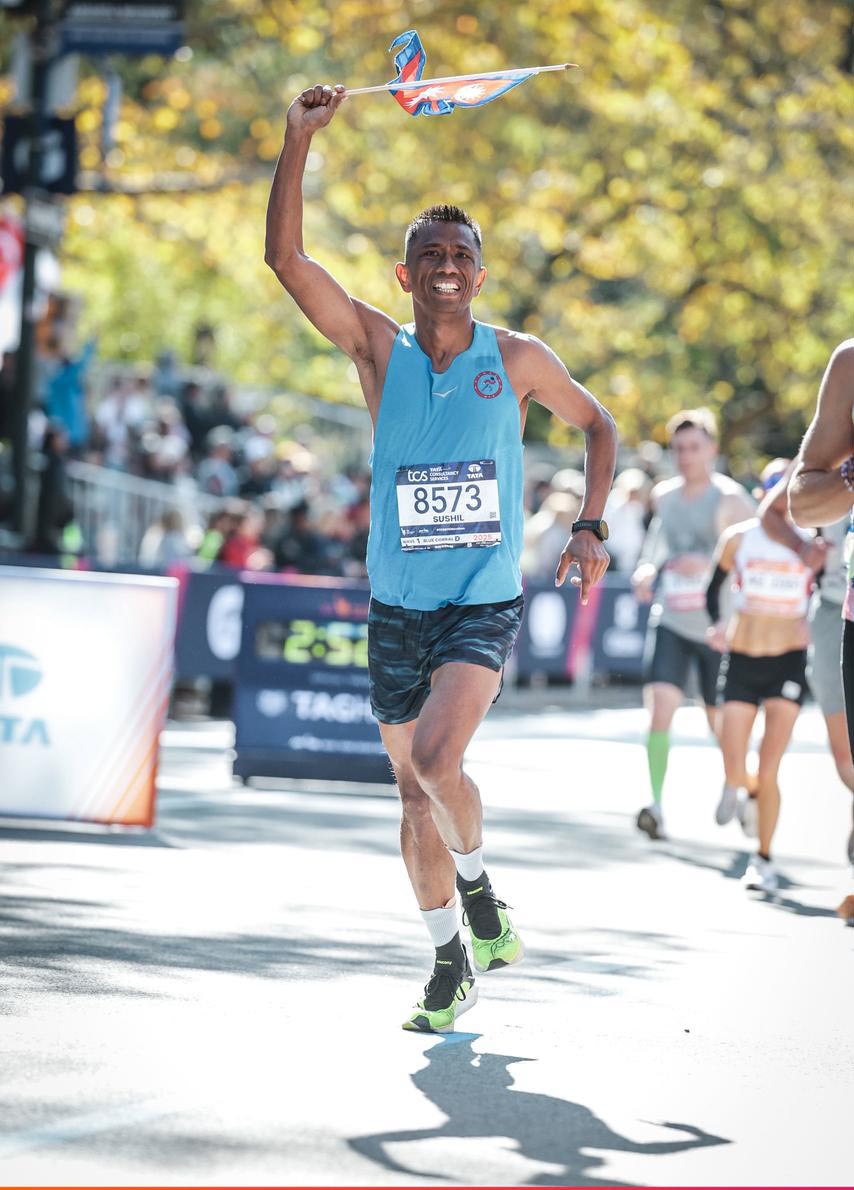
46-year-old Shrestha started running only after the Covid-19 pandemic. He had played basketball, football, and gymnastics through school and college, and had even owned a franchise — Mahendranagar United in the Dhangadhi Premier League. When the lockdowns started, he became obsessed with distance running.
“Marathon addiction had taken hold of so many people around me,” he says. “It didn't spare me either. If I miss a session because of heavy rain, the whole day feels hollow.”
Sushil Kumar Shrestha Photo: Courtesy of Sushil Kumar Shrestha
Shrestha starts his runs before 5 a.m. During his first year of marathon racing, he ran London in 3 hours 6 minutes, then Berlin in 2 hours 48 minutes — fast enough to qualify for Boston and Chicago on time, and to earn a spot in the world age-group championship at the Cape Town Marathon in his 45-50 bracket.
At the Pokhara Marathon earlier this year, he finished second in the 45-and-older category in 2 hours 58 minutes, just behind former army runner Rewat Dahal, who won in 2 hours 57 minutes. He says his ankles and knees give him chronic trouble, often requiring one to two months of recovery. “My bones are already old,” he says. But he runs through it anyway.
From a corporate tie to a green t-shirt
Shambhu Prasad Dahal spent 24 years at Sipradi Group, rising to chief executive before stepping down in 2016. He is now 64 and has completed all six majors — plus Mumbai and Cape Town, making him the most well-travelled marathon runner in the group.
He came back to running in 2018 after reading about Natarajan Chandrasekaran, the managing director and CEO of Tata Sons, who started his running at 4 a.m.
“I thought that if he could do it, so can I,” Dahal says. He had run as a student in Sankhuwasabha and later during college in Kathmandu. He stopped entirely when he went to India for further studies and didn’t return to the sport for nearly four decades.
Shambhu Prasad Dahal Photo: Courtesy of Shambhu Prasad Dahal
He spent the first two years building a base, guided by running podcasts and books. The Everest Marathon in 2022 took him more than nine hours. The Jumla-Rara Ultra — 49 kilometres through mountainous terrain — took 12 hours and 50 minutes, from 7 a.m. to 8 p.m., sustained by flatbreads and boiled potatoes along the route.
When he tried to enter the Mumbai Marathon, he submitted his Pokhara time as a qualifier and was told Nepali races do not carry international recognition. He eventually ran the Mumbai 10K through charity connections.
Determined to improve, he overhauled his training — reading the work of American coach Floris Gierman and paying $400 for a lifetime subscription to his podcast and online program. The results followed. London: 5 hours 11 minutes. Berlin: 5 hours 23 minutes. New York: 4 hours 44 minutes. Chicago: 4 hours 33 minutes — a minute inside his target, achieved without once looking at his watch.
“I’d heard motivational speakers talk about the power of the mind,” he says. “In Chicago, I experienced it.”
The runner who was stopped at the border
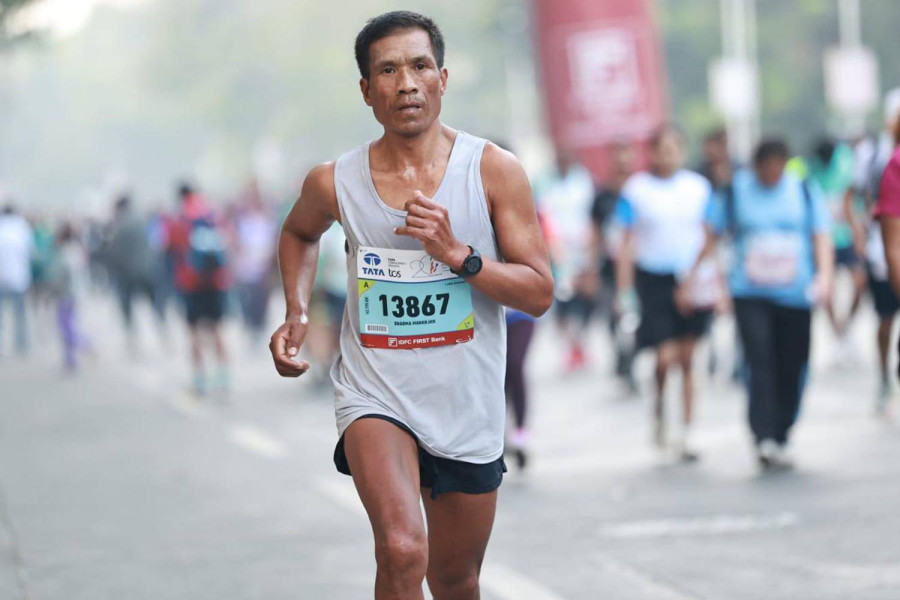
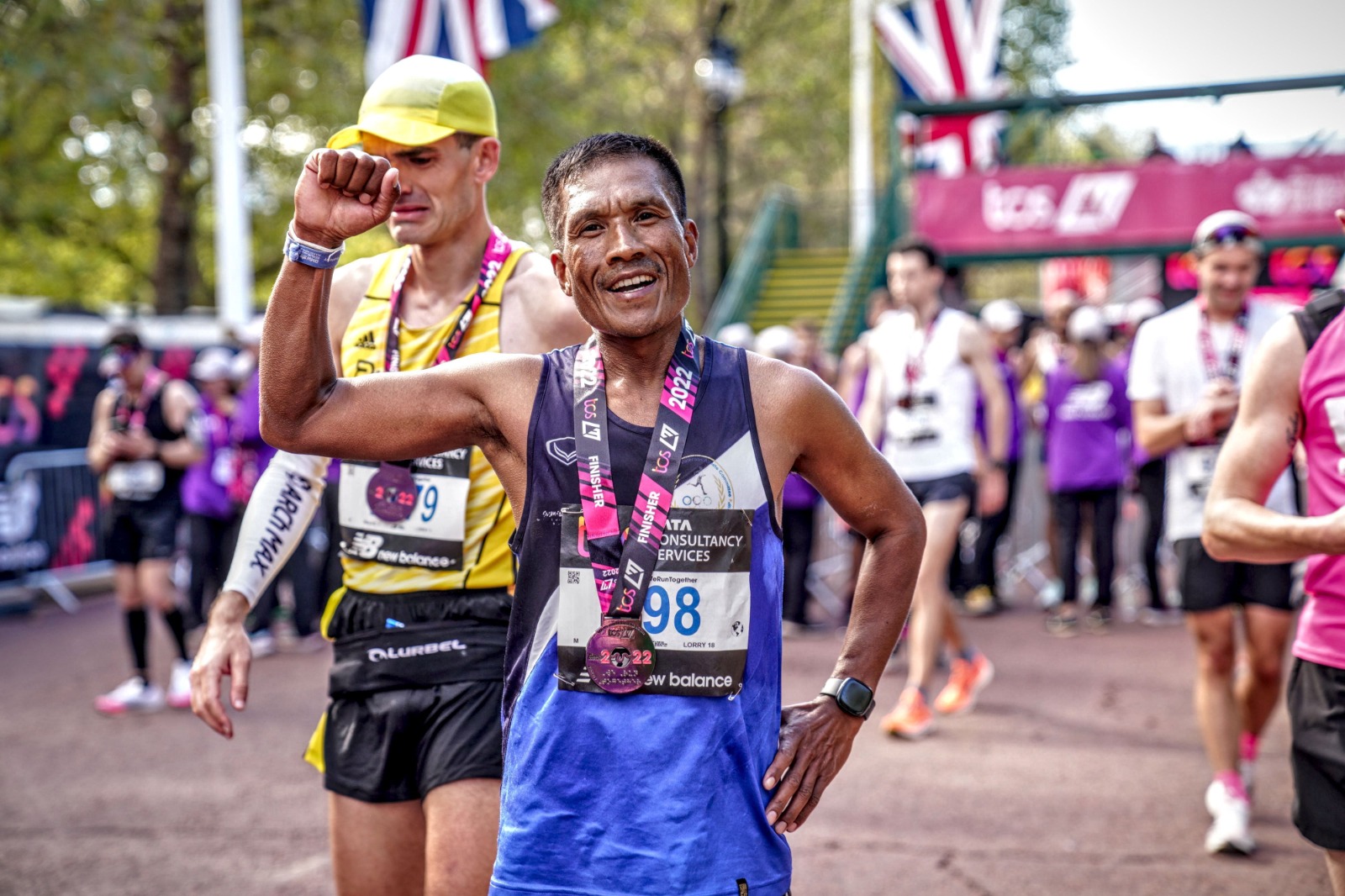
53-year-old Dharma Maharjan has been running international marathons since 2015. As a child in Kirtipur, he would run laps around the Bagbhairav temple — 108 circuits was the religious requirement on a festival day. He was 40 when he started running competitive races.
He has completed four of the six Majors — Boston, Berlin, London, Tokyo — but Chicago and New York have eluded him, not for lack of qualification but because of a harder problem: a visa.
Dharma Maharjan Photo: Courtesy of Dharma Maharjan
In 2022, he was stopped at Chicago O’Hare airport by immigration officials. He had spent four or five months in the United States after the Boston Marathon, training with friends. When he tried to return to Chicago and New York — two races scheduled a month apart, with $2,500 on him — immigration officers told him the money was insufficient to cover a month of food and accommodation. He was sent back.
He found out he had been featured on a giant digital billboard on a building in Chicago, advertising the marathon. A friend saw it and called him in tears. Dharma was in Nepal when he heard the news. He never got to run the race.
“I’m also racing through these challenges,” he says.
In India, where he has spent more time recently, he has won the Mumbai Marathon twice in the 50-and-older age group, with a personal best of under 2 hours 50 minutes. He claims to be the first Nepali to complete the Tata Slam — four Indian road races in a single year, ranked cumulatively. Although Maharjan’s entry into running came late, he says he has no plans to hang up his running shoes anytime soon.
“My life responsibilities didn’t let me start earlier,” he says. “I haven’t stopped since I started running competitively.”




 21.42°C Kathmandu