Bardiya tests synthetic scent barriers to deter big cats from settlements
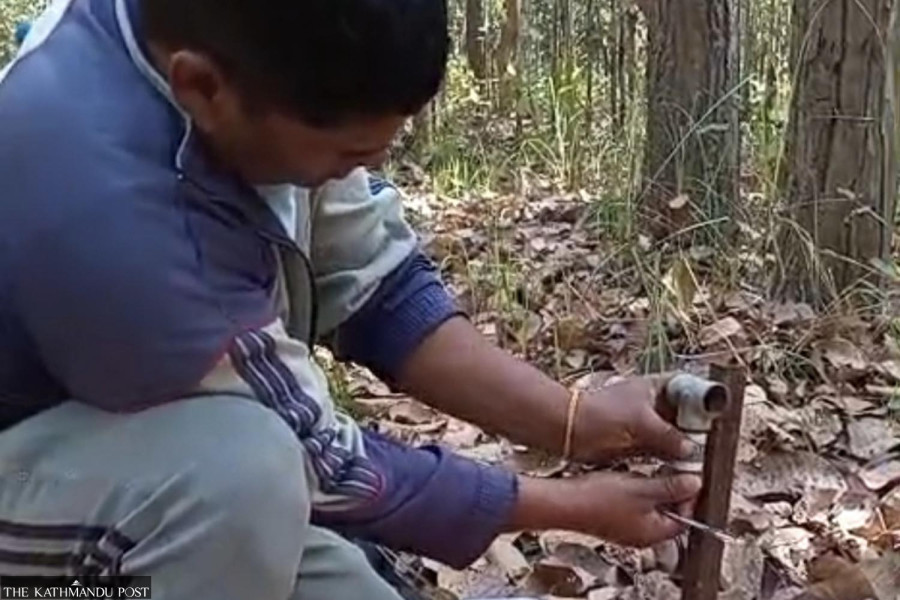
Initiative comes amid growing fear among local residents over frequent leopard attacks. An official installing olfactory deterrants and camera traps at Khata biocorridor, recently. Post Photo
In a pioneering attempt to mitigate rising human-wildlife conflict, conservation authorities in Bardia have begun field-testing a synthetic chemical designed to repel leopards and tigers from human settlements. The trial, currently focused within the Khata Bio-corridor, utilises a lab-developed scent that mimics the smell of tiger urine.
Tigers are known to be fiercely territorial, marking their boundaries with urine to signal to other predators that a specific area is occupied. Conservationists hope that by deploying this synthetic scent in the forest edges, leopards and tigers will perceive the area as another tiger’s territory and avoid entering.
The initiative comes amid growing fear among local residents, who complain that leopard attacks have made daily life increasingly risky. People are reluctant to step outside at night, and even daytime farm work has become a source of anxiety. Children are not allowed to walk alone, even during the day.
According to Shiva Bahadur KC, information officer of the Division Forest Office in Bardiya, wildlife attacks have claimed 11 lives in the district since the start of the current fiscal year in mid-July, 2025. Of these, eight deaths were caused by leopards, two by tigers and one by an elephant. At least 16 people have been injured in leopard attacks alone.
The figures show a worrying trend. In the fiscal year 2021-22, leopard attacks killed two people and injured two others. In 2024-25, the toll rose to four deaths and 13 injuries. According to conservationists, the increasing human-animal conflict reflects growing pressure on wildlife habitats and closer contact between animals and humans.
Responding to growing fear among locals, authorities have installed chemical dispensers and motion-trigger cameras at 30 strategic locations along the Khata Bio-corridor, a 24-km pathway along the shared border of Bardiya National Park in Nepal and Katarniaghat Wildlife Sanctuary in India.
According to Bijayaraj Subedi, chief of the Division Forest Office, this year’s effort follows a preliminary five-month trial conducted last year with ten different chemical variations. "We found that five out of the ten compounds were particularly effective. During those observations, leopards and wild boars fled immediately upon sensing the smell,” said Subedi. “However, tigers behaved differently, approaching close to the scent-marked spots before turning back.”
The five most successful formulas, labelled Compound-1 through Compound-5, are now being re-tested over a four-month period. The chemicals, which have previously seen success in South Africa, are being monitored closely to see how they perform in the specific climate of the Tarai.
"The chemical is kept in T-shaped pipes. A single application maintains its potency for about a month," said Bharat Bhatta, programme manager of the Tarai Arc Landscape (TAL) programme in Kohalpur. This initiative is a collaborative effort between TAL, the Division Forest Office, and the Khata Community Forest Coordination Committee.
After the four-month testing period, samples and data will be sent abroad for analysis. If proven effective, officials say the chemicals could offer a relatively low-cost and practical solution to prevent predators from entering villages.
The Khata Biological Corridor serves as a vital narrow strip of forest allowing the free movement of wildlife. Wildlife mobility, however, has come at a high cost to local communities. In 2022, when Bardiya National Park won the TX2 award for doubling its tiger populations since 2010, our conservation efforts were globally lauded. The national park, spreading over 968 square kilometers, is home to 125 tigers as per the 2022 tiger census.
Hari Gurung, chairman of Khata Community Forest Coordination Committee, said that the current trial began on March 28 in the bio-corridor in Madhuwan Municipality. "If these four months of testing prove successful and the product remains affordable, we plan to use it to safeguard human settlements,” said Gurung.




 24.2°C Kathmandu