Tiger conservation leaves families on forest fringes in peril
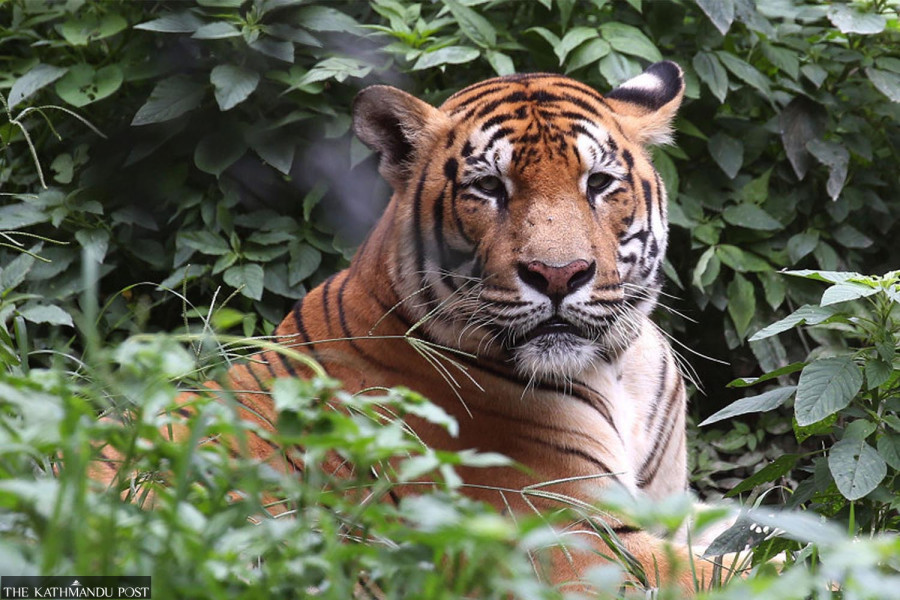
Between physical disability and the crushing weight of debt, survivors of tiger attacks in Banke and Bardiya are left to fend for themselves. Nepal nearly tripled its wild tiger population—from 121 in 2010 to 355 in 2022. Post file photo
Pushpa Tamang, aged 42, sits on the narrow porch of her home in Gabhar settlement in ward 1 of Rapti Sonari Rural Municipality, Banke. A red shawl is wrapped tightly around her head. To a casual observer, she appears healthy, a woman resting in the afternoon sun. But the exterior is a mask for a shattered internal reality.
In June 2019, Pushpa entered Bhawani Community Forest, just a stone's throw from her home, to cut grass for her cattle. Without warning, a Bengal tiger emerged from the undergrowth, striking her from behind. Its claws tore deep gashes into the left side of her scalp. She immediately fell unconscious. Only the desperate screams of her companions forced the big cat to retreat into the shadows of the forest. She was rushed to Kohalpur Teaching Hospital. It took sixty stitches to put her head back together.
“I might look fine on the outside, but only I know the agony I carry within,” says Pushpa, her voice steady but thin. “I survived the attack, but because of the lack of money, surviving life has become a real struggle.”
As Nepal garners international acclaim for nearly tripling its wild tiger population—from 121 in 2010 to 355 in 2022— the impoverished communities living on the fringes of the national parks in Banke and Bardiya districts are paying the price in blood and bankruptcy. They are caught in a double bind: lifelong physical disability and a mountain of debt accrued from medical bills that the government’s relief mechanisms fail to cover.
As per the existing legal provisions, the process for securing relief is long and bureaucratic. While the Government presents its tiger conservation programmes as major achievements on the international forum, the impoverished residents living on the forest’s edge are the ones paying the direct price for the very success.
Rising ledger of debt
The initial three days of Pushpa’s emergency treatment cost Rs50,000—a fortune for a family living on the edge of subsistence. It was only the beginning. Now, she suffers from chronic headaches, paralysis in her left arm and leg, and frequent bouts of unconsciousness. She cannot be left alone; she loses track of time while cooking and becomes disoriented during simple tasks.
Her husband Mitra Lal, aged 45, has seen his life grind to a halt. A former migrant worker who sought employment in Malaysia and Qatar to provide for his family, he was forced to return home to become her full-time carer. Though a skilled furniture maker, his work is sporadic because he cannot leave his wife’s side for long. He shoulders the weight of three children, elderly parents, and a sick wife. “I have the skills in my hands, but I cannot go to work,” complains Mitra Lal. “Right now, we don’t even have the money to buy her basic medicine.”
Pushpa’s medical regimen costs about Rs 3,500 a month, with another Rs 1,500 spent on transportation to the hospital. Because she suffers from extreme temperature sensitivity, the family must keep ice at home year-round, adding to their expenses. To keep her alive, they have borrowed from various cooperatives, and their debt now exceeds Rs 700,000. Their only assets are a modest house built on unregistered land and a small plot of four katthas of land.
“I saved my life from the tiger’s mouth. But living like this is no different from being dead,” laments Pushpa.
Pattern of terror
Pushpa’s story is echoed across the Tarai. In Bardiya, Juna Chaudhary of Barbardiya Municipality-10 still feels a jolt of terror whenever she steps into a field. Five years ago, while harvesting rice in broad daylight, a tiger mauled her. “It happened in an instant. I was bathed in blood from head to toe,” she recalls the tragic incident.
Juna spent 15 days in the hospital. Her medical bills have surpassed Rs 350,000, yet her hand remains partially paralysed. Her husband, a policeman, struggles to support their family of four on a modest salary. After a grueling bureaucratic process, she received Rs 135,000 in relief from the Bardiya National Park—not even half of what she spent to stay alive.
The human-wildlife conflict is rife in the region in recent years. The government’s revised Guidelines for Distribution of Relief against Wildlife Damage 2023 stipulates that the family of a person killed by a wild animal receives Rs 1 million. For those with permanent disabilities, the payout is Rs 500,000, while the seriously injured can claim up to Rs 200,000.
However, these figures are often dwarfed by the reality of private hospital bills and long-term rehabilitation. Furthermore, the process to claim this pittance is a bureaucratic labyrinth that can take months, if not years, to navigate.
The red tape of relief
Shankar Prasad Gupta, chief of the Division Forest Office in Banke, explains that the process begins with a police report and a ward office recommendation within 35 days of the incident. This is followed by a doctor’s prescription and a formal application to the Sub-Division Forest Office.
The path of the paperwork is exhaustive—from the Sub-Division to the Division Office, then to a specially formed committee, then to the Ministry of Forests and Environment, and finally to the Department of National Parks and Wildlife Conservation. Once approved, the funds move back down through the Ministry to the Division Forest Office’s account before finally reaching the victim.
“The money eventually arrives, but the process is painfully slow,” admits Gupta. He notes that Division Forest Offices do not have an autonomous relief fund; every rupee must be requisitioned from the central ministry. “It would be much more efficient if the funds were managed at the district level,” he suggests.
Sushil Subedi, information officer at the Banke Division Forest Office, acknowledges that despite policy updates, the relief is fundamentally insufficient. “The amount does not meet the victims' actual needs,” he says.
Success at a cost, 35 people attacked in eight years
Nepal has been lauded globally for its conservation efforts. Banke is now home to 25 tigers, while Bardiya boasts 125. As per its commitment to the Global Tiger Recovery Plan (TX2), which was endorsed by 13 countries that are home to wild tigers, during the 2010 Saint Petersburg Declaration on Tiger Conservation, Nepal successfully tripled the tiger population.
But as the tiger population grows, so does the frequency of human-tiger conflict. In Bardiya National Park alone, 35 people were attacked by tigers between 2016 and 2024. A report from the park indicates that in the first four years of that period, 16 people were attacked, resulting in six deaths. In the fiscal year of 2022-23, 10 people were attacked, and six lost their lives.
Ajit Tumbahamphe, head of the National Trust for Nature Conservation in Bardiya, says the increase in attacks is a ‘challenge to conservation.’ “Tigers do not naturally want to attack humans. But in specific circumstances, as their numbers grow, the risk of encounters increases,” he says.
Others are more critical. Krishna Shah, a nature guide and survivor of a tiger attack himself, believes the government was unprepared for its own success. “We enthusiastically increased the tiger population, but we never assessed the potential consequences,” says Shah, who was attacked in 2016 while guiding a Dutch tourist in Bardiya. “The 1973 Wildlife Act is outdated. How can a law half a century old address today’s complexities?”
Habitat versus livelihood
The lives of those people living near the protected areas and community forests are inextricably linked to the forest. They enter the woods for fodder, firewood and wild vegetables—not by choice, but by necessity. Analysis of the attacks shows that women and those working alone in the buffer zones are the most vulnerable.
Conservationist Ashish Chaudhary argues that the focus must shift from merely increasing numbers to improving habitats. This includes creating more grasslands and artificial ponds deep within the forest to keep predators away from human settlements. Experts estimate that a single tiger requires approximately four square kilometres of territory, including five hectares of grassland and a dedicated watering hole, costing roughly Rs 1.8 to 2 million to maintain artificial ponds and grasslands.
“The forest is the wildlife’s home. We need separate paths for humans and animals. We need fences in high-risk zones,” says Chaudhary.
There have long been calls for programmes to reduce forest dependency among those living in high-risk zones. However, residents argue that government agencies lack a sense of urgency, seemingly satisfied that because relief for deaths and medical coverage for the injured are already available, no further action is required.
Local government: initiative by some, many remain silent
While the federal government remains slow to act, some local units have stepped in, though their efforts are uneven. Madhuwan Municipality in Bardiya has allocated Rs 5 million to its disaster fund, providing Rs 75,000 to the families of the deceased. Similarly, Rajapur Municipality, Thakurbaba Municipality and Geruwa Rural Municipality in Bardiya have established their own relief protocols.
In contrast, Rapti Sonari Rural Municipality—the site of some of the most frequent attacks and home to Pushpa—has no such fund. Vice-chairperson Manisha Tharu explained that they have a policy against ‘double benefits,’ assuming that since the federal government provides relief, the local government need not intervene.
‘No value of human life’
Pushpa and her husband Mitra Lal hold little hope for government support. They have only one simple request: "We aren’t asking for much. Even if the state cannot provide full relief, it would be enough if the local unit provided the funds for her monthly medication." However, in Rapti Sonari Rural Municipality where Pushpa lives, no such provision exists.
When she first escaped the tiger’s jaws, Pushpa felt it was a miracle. But for her family, that moment has since proven to be the beginning of a lifetime of hardship and deprivation. "I am forced to skip meals just to afford my wife’s medicine," says Mitra Lal. "It seems that for the poor like us, life has no value at all."




 13.46°C Kathmandu