People in flood-hit Rasuwa villages call for help after supplies run out
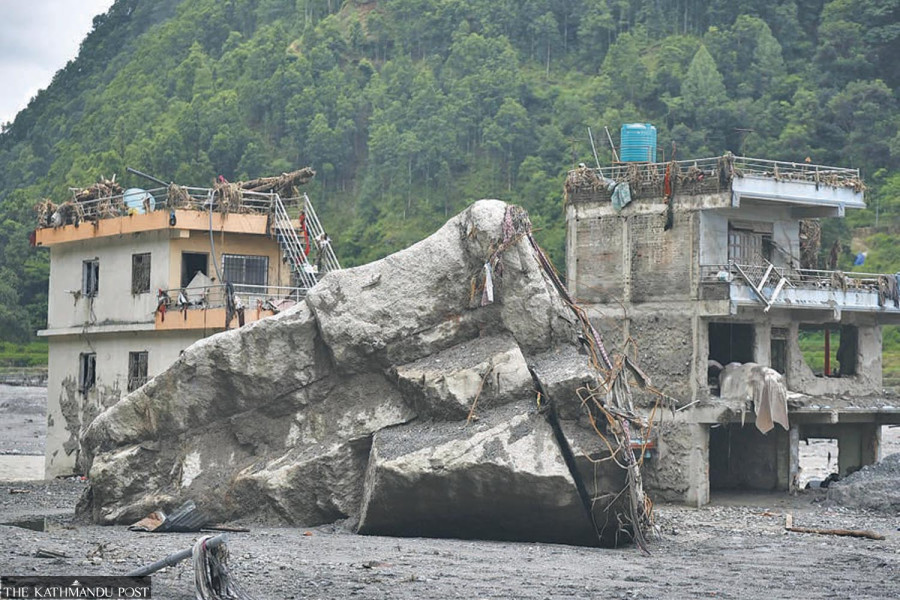
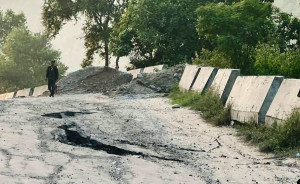
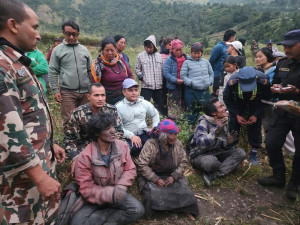
Residents of Aamachhodingmo Rural Municipality who have lost family members look up for help when they hear a helicopter fly. Their prayers mostly go unanswered. Flood-damaged houses are seen behind a massive boulder swept downstream by the August 26 Bhotekoshi and Trishuli floods at Betrawati Bazar, Nuwakot, in the aftermath of the disaster. Angad Dhakal/TKP
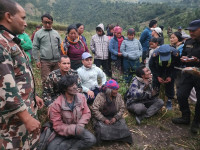
Pasang Mendo Tamang, a resident of Thulo Haku in Rasuwa, still repeatedly faints. Her 21-year-old eldest son, Binay, went missing in the August 26 Bhotekoshi flood.
“She has hardly eaten anything since. She keeps crying, and I fear she could die from the grief,” Tamang’s husband, Namsi, said in tears. “She also needs hospital care, but we are trapped here. I am afraid she might harm herself in distress.”
Aamachhodingmo is among the areas of Rasuwa worst affected by the devastating flood. The rural municipality is now completely cut off from the rest of the country. No roads and suspension bridges, nor tuin crossings link it to the outside world.
When the flood struck, Pasang’s 78-year-old father-in-law, who suffers from a heart condition, was admitted to Bir Hospital for treatment. Her husband, Namsi, had gone to the village to find money for his treatment. But after the flood washed away the roads and bridges, he became stranded there.
After being discharged from the hospital, her father-in-law and mother-in-law, who had come to care for him, took shelter with relatives in Machhegaun, Kirtipur. They are also distressed to learn that their eldest grandson is missing.
“If I don’t get there immediately, they will have trouble even getting food and a place to stay,” said Namsi. “If possible, please help rescue us from here. Food supplies have run out. There is hardly anything left to eat. Even the salt has run out, and there is nowhere to buy it.”
Of their three children, only a 13-year-old and a five-year-old remain.
Both sons of Pasang’s brother-in-law were also swept away. Her sister-in-law’s daughter is missing too. It is difficult to find a household in the village that has not lost a relative or child in the disaster.
The entire rural municipality is facing an acute shortage of essential commodities. A torrent of water and debris washed away roads connecting the rural municipality and its markets; goods have run out in small local shops, and government relief supplies have failed to reach the area.
As soon as they hear a helicopter overhead, villagers come out of their homes carrying bags, hoping to be rescued. That hope ends in disappointment.
“People from my area call and plead saying, ‘at least bring us salt and oil. We will boil potatoes and eat them,’” said rural municipality chair Buchung Tamang. “I receive hundreds of calls every day from people in the rural municipality pleading for food aid. I have no answer for them.”
Located across the Bhotekoshi river from Syaphrubesi, the rural municipality has been completely cut off since the flood struck 11 days ago. Helicopters are currently the only means of reaching the area.
People in the rural municipality are trapped. There is no place to buy, and they are cut off from markets. Patients are dying without getting medical aid. “If we cannot deliver food immediately, even potatoes will be out of stock. A famine-like situation could arise.”
Adults understand that a disaster has occurred, so they are eating whatever is available in the village. But the situation is more difficult for small children, as they demand rice for a meal.
Chairperson Tamang also complained that NGOs have refused to deliver food because the area can only be reached by helicopter and chartering one is expensive. The rural municipality does not produce enough food and is dependent on supplies from the outside. Relief food supplies previously delivered by army helicopters have already been consumed.
At least 203 people from Aamachhodingmo Rural Municipality have gone missing in the Bhotekoshi flood. Local authorities estimate that the number could rise further. The Upper Trishuli-1, Chilime and Langtang hydropower projects are located in Aamachhodingmo. Many locals employed at these projects are also believed to be missing.
The rural municipality has a population of over 7,000.
The flood has affected not only the rural municipality but the entire district. The main highway connecting Rasuwa to the rest of the country has been washed away.
More than 1,300 people, caught by the flood in Rasuwa, Nuwakot and Dhading districts, have been confirmed dead. The missing people number around 5,000. Thousands of people have been displaced as the floods washed away hundreds of houses, dozens of bridges and roads.
Local government chief Tamang said authorities are struggling to arrange tuins for immediate connection because constructing a suspension bridge or Bailey bridge could take long. But installing even a tuin takes some effort.
“We don’t even know where exactly a tuin could be installed,” he said. “There must also be a way to reach the place where it is installed. We cannot simply build a bridge anywhere over the river.”
Local representatives have also complained that because major areas of Nuwakot and Rasuwa are facing problems, the state’s entire attention is focused on those locations.
“The state seems to reach accessible places quickly. The media and organisations also get there quickly,” Tamang said. “But we in remote areas are being left without help even as we are on the verge of starvation.”
Arjun Poudel is a health reporter for The Kathmandu Post. Before joining the Post, he worked for Sagarmatha Television, Naya Patrika, Republica and The Himalayan Times.




 14.71°C Kathmandu