A community forest leads a quiet fight to protect endangered pangolins
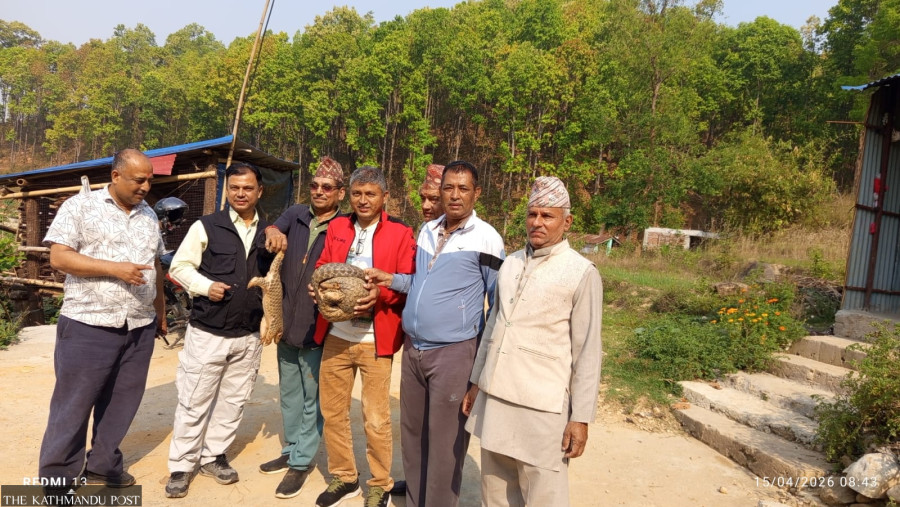
Makawanpur’s Rani Community Forest has been conserving the endangered animals since 2005. It has set aside around 20 hectares specifically for pangolins. A pangolin and its pup found in a cowshed in Makranchuli being handed over to the Rani Community Forest Users Group, recently. Manish Devkota of Makranchuli had found the animals in his cowshed. Pratap Bista/TKP
The rescue of a mother pangolin and her baby from a cowshed in Makawanpur district last week has brought fresh attention to a quiet but sustained conservation efforts led by a community forest for the past two decades.
Manish Devkota of ward 3 in Makawanpurgadhi Rural Municipality found the animals late at night on Wednesday after his dogs began barking and tried to attack them. “I woke up to the noise and saw the pangolins in the shed. The dogs were about to harm them, so I stepped in and saved them,” said Devkota. He later handed the animals over to Rani Community Forest Users Group in Chaughada in ward 6 of Hetauda Sub-Metropolitan City, in the presence of ward chief Bishnu Prasad Dahal.
According to Bhimsen Paudel, office secretary of the forest users’ group, the mother pangolin weighed around 12 kilograms and the baby about 3 kilograms. Both were released into a protected habitat after initial observation and care.
Rani Community Forest has been conserving pangolins since 2005, setting aside around 20 hectares specifically for the species. Out of its seven forest blocks, two have been designated as core conservation areas. “We currently have more than five dozen pangolins in the forest. This is the result of long-term effort and strong community involvement,” said Keshav Dhital, chairperson of the forest users’ group.
The forest has become a centre for study and observation. More than 1,000 teams from Nepal and abroad have visited to learn about pangolin conservation. Blocks five and six in the forest are maintained as protected zones, where human activity is restricted and natural food sources such as ant and termite mounds are carefully preserved.
“We also run awareness campaigns to inform people about pangolins and why they matter,” said Dhital. “Local people now report sightings and hand over the animals found in their areas instead of harming them.”
The forest group has installed information boards, pangolin statues, rescue cages, and provides treatment to injured animals. It also offers certificates and small cash rewards to those who help rescue pangolins. As a result, conservation efforts have spread beyond Rani forest. Several other community forests in Makawanpur have started similar initiatives.
Assistant Forest Officer Basanta Gautam said authorities are working to step up conservation efforts by improving knowledge of habitats and controlling illegal hunting and trade. “Protecting their habitat is just as important as protecting the animals. We are also encouraging local responsibility in conservation,” said Gautam.
Pangolins play an important role in agriculture. “An adult pangolin can eat up to 230,000 ants and termites in a day, and nearly 70 million in a year. Without them, pests would damage crops and reduce productivity. They also help improve soil quality,” said Gautam.
Despite their armour-like scales, pangolins pose no threat to humans. Instead, their burrowing behaviour helps loosen soil and improve fertility, contributing to healthier ecosystems. In Nepal, pangolins inhabit areas from the Chure hills to the Mahabharat range, up to around 3,000 metres above sea level.
Globally, eight species of pangolins exist, of which four are found in Asia. Two species—Chinese Pangolin (Manis pentadactyla), known as Kalo Salak locally, and Indian Pangolin (Manis crassicaudata), locally called Tame Salak—are found in Nepal. The Chinese Pangolin is listed as a critically endangered species, while the Indian Pangolin is listed as an endangered species in the International Union for the Conservation of Nature (IUCN)’s Red List.
In 2022, local authorities declared the pangolin the district’s flagship animal. “We want future generations to be able to see this species,” said Lalit Ghalan, chief of the District Coordination Committee.
The community-led conservation in the country has helped protect endangered wildlife, especially in areas where government resources are limited. Similar models in buffer zones and community forests have shown that local stewardship can play a vital role.
Pangolins are considered among the most heavily trafficked mammals in the world due to high demand for their scales and meat, despite the absence of proven medicinal value in the scales, which are composed of the same material as human nails.
The National Parks and Wildlife Conservation Act 1973 imposes strict penalties for killing or trading protected species, including fines up to Rs1 million and prison terms of up to 15 years. Poor enforcement of legal provisions and awareness at the community level, according to conservationists, are the major challenges for pangolin conservation in Nepal. Habitat degradation has also intensified risks. According to conservationists, forest fires, road construction, and the increasing use of chemical fertilisers and pesticides have damaged pangolin habitats.




 25.92°C Kathmandu