Madhesh crackdown on Indian-registered vehicles rattles political parties
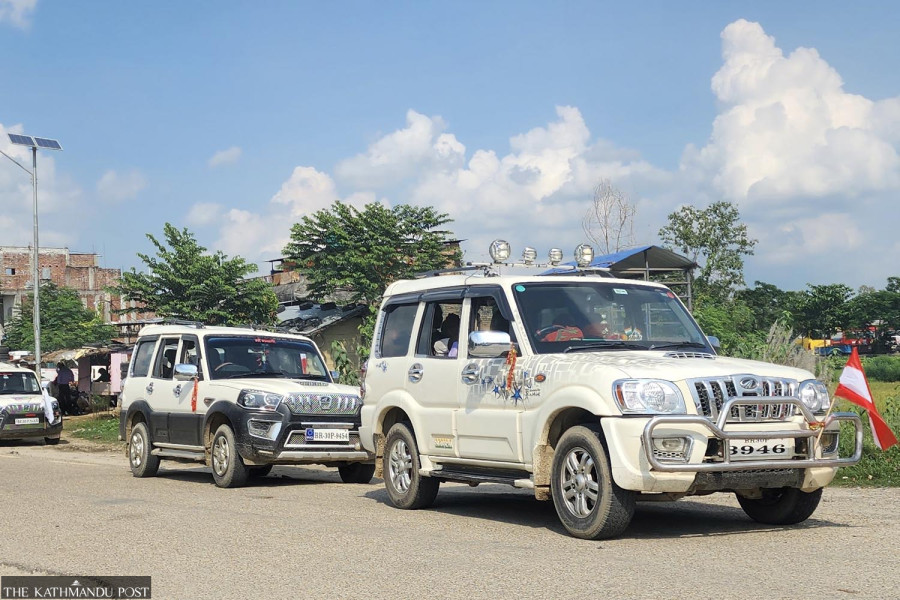
Major political parties have opposed the move and demanded free movement within 30 kilometres of the Nepal-India border.Indian-registered Mahindra Bolero cars pictured in Rautahat, in this undated photo. Post file photo
Nepal-India open border has long allowed the easy movement of Indian-registered vehicles across the Madhesh province. But in recent weeks, the growing presence of the vehicles with Indian registration on roads in the province—and a renewed crackdown by local authorities—has sparked a contentious debate over whether such mobility is a necessity or a regulatory failure.
According to provincial and local authorities, stricter monitoring has become unavoidable as the unauthorised use of Indian-registered vehicles has surged, raising concerns about security, tax evasion and legal accountability. Yet political parties and many locals argue that tightening controls risks disrupting long-standing social and economic ties across the border.
On April 12, major political parties, including the CPN-UML, Nepali Communist Party, Rastriya Prajatantra Party and the Janata Samajbadi Party, issued a joint statement opposing the restrictions of Indian-registered vehicles. They demanded that such vehicles be allowed to operate freely within a 30-kilometre radius of the border, as had been the practice in the past. The parties warned of protests if the administration proceeds with stricter enforcement.
District officials, however, insist that the move is aimed at enforcing existing laws rather than introducing new restrictions. “Vehicles entering Nepal must comply with customs rules. Driving without paying customs duties is illegal, and we are simply implementing the law,” said Ramuraj Kadariya, chief district officer of Sarlahi.
According to the Gaur Customs Office in Rautahat district, Indian-registered vehicles are required to pay a daily customs fee of Rs600 for four-wheelers, Rs400 for three-wheelers and Rs200 for motorcycles.
Chief Customs Officer Bikash Raj Rajak said that Indian vehicles travelling to nearby border markets are issued a one-day pass free of cost. “We allow Indian-registered vehicles to enter only after collecting the required customs duty at the entry point. Legally, Indian vehicles cannot be operated without paying customs charges,” said Rajak. According to him, the Indian-registered vehicles are permitted to remain in Nepal for a maximum of 30 days in a year by paying customs duties.
Despite such legal provisions, officials acknowledge widespread non-compliance. Security personnel estimate that thousands of Indian-registered vehicles are being used across Madhesh districts without paying customs duties.
“In the past, people would pay tax for a day and use the vehicle illegally for months. Even if these vehicles were caught, they often managed to get away by using political influence. That will no longer continue,” said a security officer in Rautahat, requesting anonymity.
There is no precise data on the number of such vehicles. Officials at Gaur Customs office say between 60 and 80 Indian vehicles enter Nepal daily through the Gaur checkpoint alone, but there is no system to track whether they return the same day. Security agencies estimate that more than 10,000 Indian-registered vehicles may be operating across the eight districts of Madhesh Province.
Indian-registered vehicles can still be seen concealed in interior settlements across the province, while local motor garages are reportedly filled with such vehicles kept under the pretext of repair.
Residents in border areas often purchase vehicles with Indian number plates to avoid higher customs duties, operating them either on the basis of short-term ‘day passes’ or by evading checks altogether. The practice is not limited to ordinary citizens; leaders of political parties are also known to use such vehicles. Numbers of such vehicles tend to surge during the wedding season and major festivals, nearly doubling at peak times.
During elections, most political parties in Madhesh rely heavily on Indian-registered vehicles for campaigning. According to Rautahat Chief District Officer Dinesh Sagar Bhusal, the recent tightening of regulations is primarily aimed at curbing revenue leakage and illegal activities.
“People buy vehicles across the border in the name of affordability and operate them here without paying customs duties. If an accident occurs, it creates complications in ensuring compensation. We are now moving ahead with a quiet strategy. Vehicles entering nearby markets are acceptable, but any attempt to operate beyond that without customs clearance will lead to seizure and legal action,” said Bhusal. The administration has also begun efforts to determine the actual number of Indian-registered vehicles operating within the district.
Police officials claim that Indian vehicles are sometimes used in criminal activities, including theft and drug trafficking, as tracking them becomes difficult once they leave Nepal. “We have tightened enforcement against any Indian-registered vehicles operating without customs clearance in violation of the rules. From a security perspective, regulation is essential,” said Kamal Thapa, spokesperson for the Madhesh Province Police Office in Janakpur.
The home ministry has also sought data on the number of Indian-registered vehicles operating across districts in Madhesh. Security officials say a targeted enforcement drive has been launched against vehicles that are either operating without completing customs procedures or exceeding the permitted duration of stay.
Under existing laws, vehicles found operating illegally can be seized and auctioned. Customs officials stress that such measures are not new but have rarely been enforced consistently in the past.
Because vehicles are significantly cheaper across the border, many residents of Nepal’s border districts purchase them in India. However, the vehicles are formally registered under Indian ownership, with Nepalis often buying them in the names of relatives or friends across the border.
Yogendra Yadav, a leader of the Janata Samajbadi Party Nepal and a former minister, said any measure that undermines the longstanding social and cultural ties shaped by the open border between Nepal and India would be a matter of concern.
“What is the objection if Nepalis, for affordability, buy vehicles in the names of their relatives and use them? If, in the name of tightening regulations, the government ends up straining relations between the two countries, that would not be appropriate,” said Yadav.
“Bringing such practices within a legal framework is welcome, but there is a long history of border communities benefiting from cross-border arrangements. It would be worrying if something as minor as vehicles were allowed to damage these ties.”




 16.62°C Kathmandu