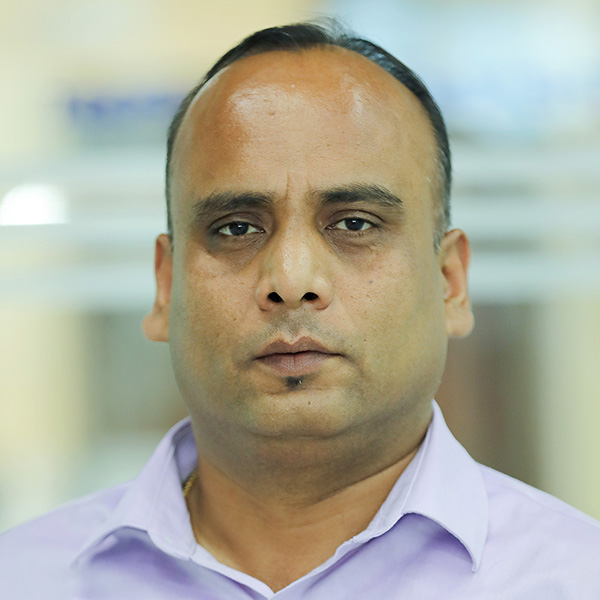
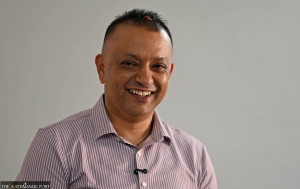
Finance Minister Swarnim Wagle takes post-disaster reconstruction, climate justice push to global forums
After talks in New Delhi, Wagle is set to raise Nepal’s reconstruction needs and climate vulnerability at upcoming meetings in Doha and Bangkok, with a US visit also being considered. RSS
Finance Minister Swarnim Wagle, who is currently in India meeting senior ministers and policymakers, is preparing for a series of international engagements in the coming weeks as Nepal steps up efforts to highlight its vulnerability to climate change and seek greater support for climate-vulnerable countries.
He will travel to Doha to attend the annual meeting of the Beijing-based Asian Infrastructure Investment Bank’s Board of Governors, scheduled for September 28 and 29, and plans to participate in the annual meetings of the International Monetary Fund and World Bank Group in Bangkok from October 12 to 18.
He told the Post that he may travel to New York and Washington, DC, to meet officials from the United Nations and World Bank, although the proposed US trip has not yet been confirmed.
At the AIIB meeting and other international engagements, Wagle plans to highlight the scale of the August 26 disaster along the Bhotekoshi-Trishuli river system and the growing costs of climate-related disasters for Nepal.
A recent scientific assessment found that climate change likely contributed to the destabilisation of the glacier and rock formation that collapsed on August 26, although it was not identified as the sole cause.
The disaster has killed at least 1,403 people and left 6,150 missing, according to government figures cited by the finance minister. A preliminary government assessment has put total damage and economic losses at Rs408 billion.
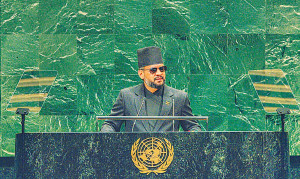
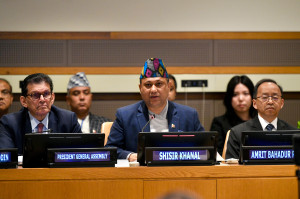
From Prime Minister Balendra Shah to Wagle and Foreign Minister Shisir Khanal, the government has made climate-related disasters a growing focus of its international diplomacy. The issue is expected to feature prominently at the 81st session of the United Nations General Assembly and in other bilateral and multilateral engagements.
“We felt it in Nepal, but the cause and the consequences are truly global and regional,” Wagle told Indian news agency ANI. “I think this needs to be appreciated much more. I think that’s one purpose of these international visits that I will be undertaking.”
Wagle said Nepal’s very low contribution to global greenhouse gas emissions contrasted sharply with the impact of climate disasters on its population.
“Our global greenhouse gas emissions are very little, but the consequences are being felt by the poor people of the country,” he said. “So, this is how we intend to build up the narrative and seek assistance as well as solidarity.”
Foreign Ministry officials said climate change, adaptation, mitigation, scientific research, early-warning systems, cooperation among mountain countries, climate justice and loss and damage would become key priorities of Nepal’s diplomacy.
“These will be the new diplomatic priorities in the days to come,” a Foreign Ministry official said. “In coordination and collaboration with other government agencies, we will lead climate negotiations and climate diplomacy.”
Wagle said the August disaster had also underscored the need for international support for Nepal’s reconstruction. He told ANI that an initial assessment put physical damage at about $2 billion, with additional economic losses of around $1 billion.
“But this is at replacement value. When we build back better, this is going to be in excess of $4.5 billion, $5 billion over several years,” he said. “This will require a lot of international solidarity, international assistance.”
In New Delhi, Wagle said his meetings with Indian Finance Minister Nirmala Sitharaman and External Affairs Minister S Jaishankar also focused on Nepal’s post-disaster reconstruction and possible Indian support.
He said his first international visit was deliberately made to India because of the two countries’ close ties and India’s assistance with rescue and relief operations after the disaster.
“Our immediate neighbours like India have stepped up as they did with the 2015 earthquake,” Wagle said. “So I think the first point was around grappling with the enormity of this humanitarian crisis, this climate disaster.”
He said the second priority was to communicate the scale of the losses and begin discussions on longer-term international support.
Wagle said the preliminary damage figures prepared by the National Disaster Risk Reduction and Management Authority had also been vetted by the World Bank.
“So it’s basically to cement some of these narratives, these threads, and begin this long process of seeking international solidarity and assistance,” he said.
Nepal is preparing to present scientific evidence and data at international forums to explain the role of climate change in the August disaster. Shah is also due to travel to New York for the UN General Assembly, where he is expected to raise the concerns of climate-vulnerable countries such as Nepal.
Anil Giri is a Chief Sub Editor covering diplomacy, international relations and national politics for The Kathmandu Post. Giri has been working as a journalist for more than two decades, contributing to numerous national and international media outlets.




 25.89°C Kathmandu