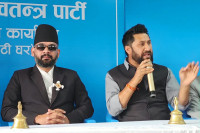
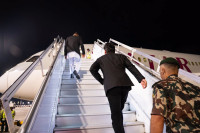
President Ram Baran Yadav is heading north later this week. An official Kathmandu announcement to this effect, when it is made, might provide the details of the programme for his weeklong visit to China, beginning March 26. But if information disseminated in Beijing on March 19—through the foreign ministry spokesperson—is to be read in the present context, it becomes clear that Nepali President will be one of 15 foreign leaders attending the Boao Forum for Asia (BFA) from March 26 to 29.
China and the world
Chinese President Xi Jinping is to be the keynote speaker on the theme of ‘Asia’s New Future: Towards the Community of Common Destiny’ at the BFA. The forum, which has become an annual event in Boao, Hainan province since 2002, was launched a year before that. Records show that those present at the 2001 inaugural event were leaders from 26 countries, including the king of Nepal, Birendra. Then Chinese President Jiang Zemin and Vice-president Hu Jintao played the role of initiators. Last year, the forum heard Chinese Premier Li Keqiang say that over 700 million people in Asia remain below the international poverty line. He underlined the relevance of the forum, the idea for which was first mooted in the late 90s by the then Filipino president and the prime ministers of Australia and Japan.
Needless to emphasise, President Xi can be expected to utilise the BFA primarily to explain his vision for his own country. And this is obviously likely to be in line with the ‘four comprehensives’—a moderately prosperous society, reform, rule of law, and party discipline—he has been spearheading since he assumed leadership in November 2012. Understandably, the Chinese President may then move on to provide a basis for his country’s interest to be a regional player in Asia. On the world stage, China appears to project itself as a country having interests in events and trends worldwide—some of which are quite disquieting. That China is a permanent member of the UN Security Council means its responsibility is as pertinent as the accountability of the four other veto-wielding members. Participating non-Asian leaders at BFA this year, including from Austria, Sweden, and Russia, are certain to attentively listen to President Xi enumerating issues of global concern.
As happens in such forums, the BFA will be a platform for invitees to interact with one another on bilateral matters. Most invited leaders can be expected to push through their agendas—for greater understanding, if nothing else—-with the Chinese leadership itself. President Joko Widodo of Indonesia and President Maithripala Sirisena of Sri Lanka are to have introductory meetings with their counterparts representing different countries. For President Yadav of Nepal, the forum is sure to be advantageous from more than one standpoint, even if he doesn’t possess executive powers. In any case, the BFA provides him with an opportunity to be introduced to a range of leaders from Asia, Africa, and Europe. Since he is being accompanied by a minister, he can expect to establish quick rapport with visiting leaders. Such contacts are made to help pave the way for subsequent follow ups.
Besides, President Yadav is likely to get considerable attention as Nepal’s head of state, because it has been in a phase of protracted transition. This may entail the President confronting unexpected as well as inconvenient queries from inquisitive politicians. After all, he is not just a ceremonial figurehead in these times of uncertainty and instability. And he has been seen taking assertive positions on several occasions. The latest surfaced on Sunday when he summoned leaders of the main political parties to his office at Sheetal Niwas for serious consultations before embarking on an important visit to the neighbourhood. There is no dispute that the existing Interim Constitution requires Yadav to act as the nation’s guardian until a permanent constitution is drawn up and issued.
The bilateral plank
“The Chinese leadership probably perceives Nepal’s President as someone who has been playing more than a ceremonial role,” says Madan Regmi of the China Study Centre. That perhaps is the reason why Yadav has been invited simultaneously to a bilateral programme. Since 2015 marks the 60th year of diplomatic relations between China and Nepal, initiatives are being taken by both sides to mark the anniversary. Foreign Minister Mahendra Pandey has just returned from Beijing where he, according to media reports, held discussions regarding an upcoming Chinese presidential visit. Meanwhile, a Chinese gesture of friendship became public on March 17 when an accord was signed in Kathmandu to substantially increase China’s annual assistance to Nepal.
At Boao, once the BFA concludes, knowledgeable sources say, Nepal’s head of state will be ushered in for first bilateral contact at the highest level. President Xi is to hold talks with his Nepali counterpart, which may cover a wide range of subjects, aimed at enhancing broader cooperation. Specific measures, if any, to add dimensions might be announced there. Since Nepal and China share a tension-free border, almost all official dialogues are directed towards augmenting mutual understanding. Beijing appreciates Nepal’s support from the time China made its entry into the UN and also during the hosting of the 2008 Olympics.
These events and the recent exchange of high-level visits recall the circumstances that led to the issuance of a joint communiqué on August 1, 1955. Five days of negotiations in Kathmandu between Chinese and Nepali delegations had resulted in a decision to have “normal diplomatic relations”. That decisive moment came after a series of contacts and correspondence between Nepal and China, which became a ‘people’s republic’ in 1949. For example, a missive that Nepal’s ambassador to India, Bijay Shumsher, sent to the then prime minister of Nepal contains references to what transpired when China’s ambassador in Delhi hurriedly came to meet him on July 2, 1953. It reflected new China’s worries about Tibet.
Changing contexts
Nepal has traditionally followed a policy of having a balanced relationship with either of its immediate neighbours to the north and south. Those watching from a distance have described this policy as a ‘strategy for survival’. Others have tried to elaborate their perceptions. Henry Kissinger, in his latest book World Order, cites Nepal as a successful case in diplomacy: “For centuries, Nepal skilfully balanced its diplomatic posture between the ruling dynasties in China and those in India—offering letters and gifts that were interpreted as tribute in China but recorded as evidence of equal exchanges in Nepal, then holding out a special tie with China as a guarantee of Nepal’s independence vis-à-vis India.”
But has present-day Nepal been able to retain and apply the skills that Kissinger is alluding to? It is difficult to answer in the affirmative with confidence. In fact, seasoned diplomat Yadunath Khanal appeared disturbed over emerging trends, as he mentioned in Nepal’s Non-Isolationist Foreign Policy, published in the year 2000: “Our relations with India and China, always difficult and taking even a more difficult turn in the nuclear age, have been made more complicated today by politicians of loose thinking and loose tongues. Their pronouncements bear no relations to their performance.”
At the end, a question arises: is there any one, just one, individual politician in Nepal who can offer a credible challenge to this observation, even today—15 years after it was made?
Adhikary is a journalist associated with the Nepal Press Institute




 16.8°C Kathmandu


.png&w=200&height=120)