Three years after Jajarkot earthquake, survivors still wait for safer homes
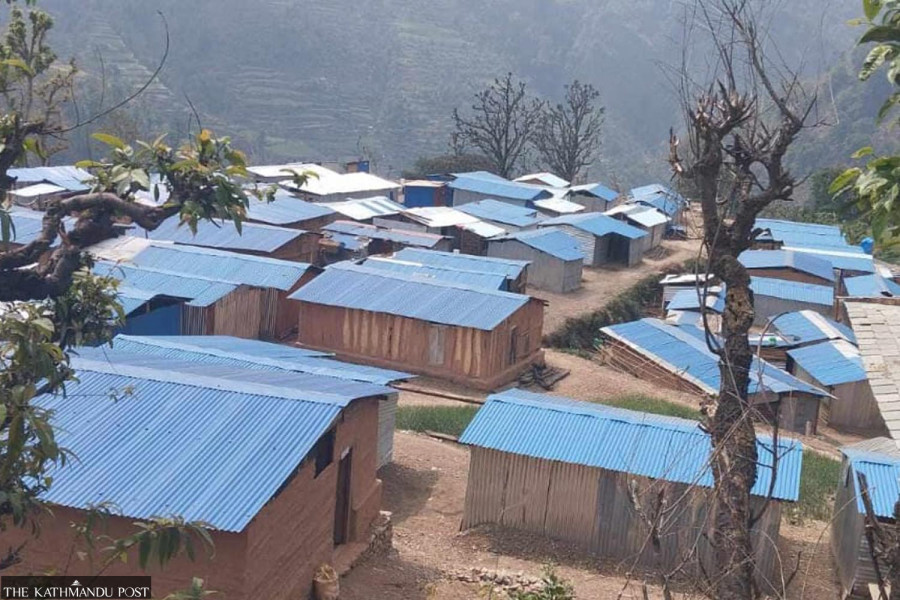
Delays in identifying beneficiaries, assessing damage and approving reconstruction grants have left thousands of families in temporary shelters, with rebuilding barely underway. Post File Photo
Three years after a powerful earthquake struck Jajarkot, thousands of families who lost their homes are still waiting for permanent housing. Many continue to live in makeshift shelters, struggling with harsh weather and uncertain prospects of rebuilding their homes.
The magnitude-6.4 earthquake struck at 11:47 pm on November 3, 2023, with its epicentre in Ramidanda village in ward 1 of Barekot Rural Municipality. It killed 154 people, including 101 in Jajarkot and 53 in neighbouring Rukum West, and injured 364 others.
According to the National Disaster Risk Reduction and Management Authority (NDRRMA), 26,557 houses were completely destroyed and another 35,455 partially damaged in the two districts. Many survivors initially spent months under tarpaulin tents before building temporary shelters. Three years on, a large number are still waiting for permanent homes.
Although the reconstruction process has moved forward, delays in identifying eligible households, assessing damage and signing grant agreements have held up the recovery.
Surya Kumari Nepali of Rawatgaun in ward 1 of Bheri Municipality said living in a temporary shelter had been extremely difficult. The tin roof becomes unbearably hot during summer, while condensation drips inside during cold weather, making it difficult even to sleep. Everyday household activities have also become challenging, she said. Other survivors have similarly complained of having to endure difficult conditions through the rainy, hot and cold seasons because they lack safe and properly built homes.
Khimraj Pun of Kalpat in ward 1 of Nalgad Municipality said he had to borrow money to build a house after the government failed to move the reconstruction process forward for two years.
“Three years have passed since the earthquake, but the government took too long to start rebuilding homes. Life in the temporary shelter became so difficult that I had to take out a loan and build a house myself,” he said.
Jajarkot Chief District Officer Nawaraj Baral attributed the delays to several factors. The government introduced the reconstruction guidelines only a year after the earthquake. Subsequent complaints from local communities during the detailed damage assessment, a shortage of personnel to evaluate damaged houses and delays by local governments in identifying eligible households further slowed the process, he said.
A Detailed Damage Assessment (DDA) conducted by the NDRRMA identified 26,989 eligible households across Jajarkot’s seven local governments. Of them, 14,245 were classified for reconstruction and 12,744 for retrofitting, or strengthening damaged houses.
But the process of formally confirming beneficiaries has remained slow. The District Disaster Management Committee has so far confirmed 4,695 beneficiaries in just three local governments: Bheri, Nalgad and Chhedagad. These include 1,303 in Bheri Municipality and 3,252 in Nalgad Municipality. Four rural municipalities—Barekot, Kushe, Shivalaya and Junichande—have yet to finalise any beneficiaries.
Households identified through the authority’s detailed damage assessment must also be formally approved by the District Disaster Management Committee before they can proceed with reconstruction.
The slow confirmation of beneficiaries has also held up grant agreements. So far, only 641 households in Bheri Municipality have completed all the required procedures and signed agreements for reconstruction.
Once a household’s damage assessment is completed, the local disaster management committee recommends it to the District Disaster Management Committee for formal confirmation as a beneficiary. Delays at the identification, agreement and reconstruction stages have left the timeline for the resettlement of affected families uncertain.
Eligible households are entitled to a total reconstruction grant of Rs400,000, disbursed in three instalments. The first instalment is Rs50,000, followed by Rs200,000 after a technical assessment. The final Rs150,000 is released after the house has been completed.
For houses designated for retrofitting, the provision is for grants of Rs50,000 for partially damaged houses and Rs100,000 for completely damaged ones, based on the DDA report.
Formal reconstruction of permanent private homes for earthquake survivors began on August 25. Member of Parliament Khadka Bahadur Budha inaugurated the process by laying the foundation stone for a house belonging to Chandre Kami in Rawatgaun, ward 1 of Bheri Municipality, under what was described as a zero-cost private housing reconstruction initiative.
According to Baral, the first instalment of reconstruction grants, totalling Rs9.4 million, has so far been deposited into the bank accounts of around 186 beneficiaries in wards 1 and 3 of Bheri Municipality. The district administration has also requested the National Disaster Risk Reduction and Management Authority to release Rs2.6 million as the first instalment for around 52 families in ward 11 of Bheri.
While the first instalments have started reaching beneficiaries in Bheri, reconstruction has yet to gather pace in other local governments.
To oversee reconstruction and rehabilitation in the earthquake-affected districts of Jajarkot, Rukum West and Salyan, the government established the District Earthquake Reconstruction and Rehabilitation Project Implementation Unit in Rimna, ward 1 of Bheri Municipality, on March 9, 2025.
Despite being tasked with overseeing reconstruction in three districts, the office remained without staff for more than a year. A staffing structure of 58 positions, including one for a divisional engineer, has recently been approved. All but one of the positions are temporary, however, and the recruitment process has yet to be completed.
Baral said reconstruction work was expected to gather momentum once the required technical personnel were in place.




 17.59°C Kathmandu