From Nepal’s floods to the world order: Reading Shah’s first UN address
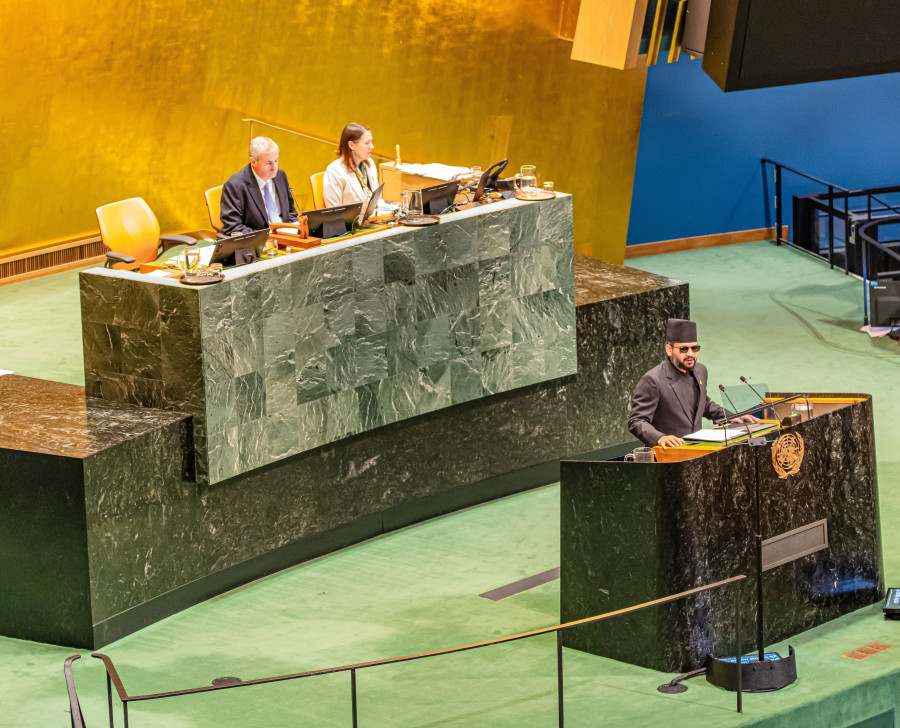
Nepal Prime Minister turns a warning from ‘roof of the world’ into a broader argument for climate justice, stronger regional cooperation and a multilateral system more responsive to vulnerable countries. Prime Minister Balendra Shah addresses the 81st session of the United Nations General Assembly. Photo: Prime Minister’s Secretariat/RSS
Prime Minister Balendra Shah used his first address to the UN General Assembly in New York to put Nepal’s recent floods at the centre of a broader argument about climate change and the international order.
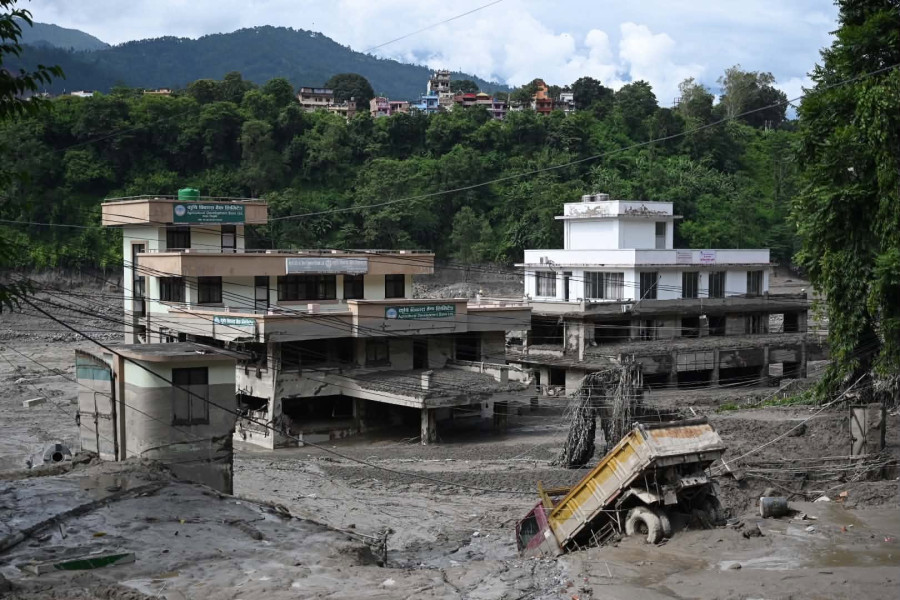
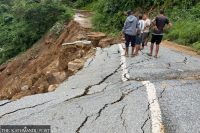
He took the podium at the 81st United Nations General Assembly and talked directly about disaster, not diplomacy. His first international appearance as head of government came hot on the heels of the Bhotekoshi floods last month, giving him a recent and deeply consequential event around which to frame his message.
“The Bhotekoshi-Trishuli disaster was not just a local tragedy, it was a warning to the world,” he said, as he posed a profound question before world leaders: “I ask you today: Have we really heard that warning?”
He took time to explain the scale of the disaster, which killed 1,453 people and left 5,550 unaccounted for, as he said: “I wish I could stand here today, simply to speak about development, democracy, peace and the hopes of a young nation.”
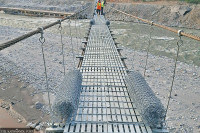
“Instead, I must speak about death and destruction of epic proportions. About families waiting for loved ones who will never come home. About communities searching through mud, rocks and water for people whose bodies may never be recovered,” he added. “About bridges, roads, schools, homes and livelihoods swept away in minutes.”
It was deliberately a stark opening. Shah was not asking the world to look at Nepal through the familiar lens of a poor, landlocked country seeking development assistance; he instead asked it to look at Nepal as an early warning system for a problem that is becoming harder to contain.
Recalling the warning issued nearly three years ago by the UN secretary general from the shadow of Mount Everest, Shah said that Nepal had heard the message, as had scientists around the world, but that political leaders had failed to translate those warnings into action “at the speed and scale that vulnerable people require.”
Shah’s speech, about which there was quite a lot of curiosity given his reluctance to make public appearances at home, came as a departure from what Nepal’s earlier prime ministers often said at the UN forum, where they largely raised issues concerning least developed countries, landlocked developing countries, Nepal’s development architecture, the peace process and human rights, among others.
Madhu Raman Acharya, Nepal’s former Permanent Representative to the United Nations, praised the speech for its focused approach.
“It's a good, impressive and impactful speech. This is not an impulse-making speech like BP Koirala delivered in 1960 at the United Nations, but one of the best among contemporary prime ministers,” Acharya said. “In previous statements, our prime ministers used to highlight and raise so many scattered issues. But this time, the prime minister focused mainly on the recent floods in Bhotekoshi and the ongoing wars in different parts of the world.”
Shah did not limit his speech to describing the tragedy; he then moved to the science behind it, saying that “a warming climate is destabilising the fragile Himalayan ecology, with melting permafrost fracturing mountain slopes and increasing the risks of ice-rock avalanches, floods and landslides.”
“The disaster unfolded across the Nepal-China border and the flood continued downstream towards India,” he added, creating the bridge to one of the more concrete proposals: a Himalayan Resilience Mechanism led by Nepal, India and China.
He proposed that the three countries share satellite data and expertise, monitor dangerous glacial lakes, strengthen joint early-warning systems and coordinate assistance when disasters strike. “Let the Himalayas become a laboratory of international cooperation rather than a frontier of fragmented information,” he said, in what came as an important shift from describing a problem to suggesting an institutional response.
Shah treaded carefully not to leave Nepal’s case at the level of vulnerability and victimhood, as he reminded the Assembly that Nepal contributes less than 0.1 percent of global greenhouse gas emissions, while its glaciers are retreating, mountain slopes are becoming unstable and rivers are becoming less predictable. Every major disaster, he said, threatens to wipe out years of development.
“For Nepal, climate catastrophe is not just a humanitarian event, but a development urgency,” he said. “We did not create this crisis. Yet we are paying a colossal price for it,” he added, making his argument about climate justice much sharper.
He invoked the established principle of common but differentiated responsibilities and respective capabilities, arguing that countries that have historically contributed more to climate change and those with greater capacity to respond must do more.
“Climate justice cannot just remain a beautiful phrase in a United Nations document,” he said.
His demand was not limited to more climate finance. He argued specifically against a system in which vulnerable countries are repeatedly pushed towards more borrowing to repair climate-related destruction.
“When a climate-driven disaster destroys the infrastructure of a poor country, the answer cannot simply be another mega loan or a patchwork of small grants,” he said, calling for adequate grant-based support and describing existing mechanisms, including the Loss and Damage Fund and the Global Environment Fund, as inadequate.
While some took issue with Shah’s speech delivery and a lack of confidence, others stressed that content mattered.
Writer Kanak Mani Dixit said that the content mattered more than the style.
“It’s the content that matters, and PM Balendra Shah’s speech was well crafted,” Dixit wrote on X. He said Shah had centred the Rasuwa disaster and its climate-related causes and ramifications.
“Calling for India and China to collaborate is something that had to be said from the global pulpit. He did not go through a laundry list of international issues, as tends to be the case, but stayed focused,” Dixit wrote.
After setting the recent Nepal disaster as the premise to draw the world’s attention, Shah urged the Assembly to note six words: “Relief, rehabilitation and reconstruction” and “responsibility, reparation and resilience.”
“The first three are what we need after a disaster,” he said. “And the second three are what we need to ensure that disaster does not become a permanent condition.”
Shah used the Bhotekoshi-Trishuli floods not simply as a national tragedy, but as evidence of how climate change is turning Himalayan hazards into a wider threat to lives, livelihoods and development. Post file photo
From here on, he moved beyond Nepal’s floods and climate change and posed a larger question: “What kind of world order do we want?”
Shifting from glaciers and floods, he invoked the UN’s founding promise that sovereignty would matter, international law would matter, human dignity would matter and that weaker countries would not simply have to accept what powerful countries decided. He made his argument broader than climate justice, making a case for a different understanding of security itself, drawing on the UNDP’s 1994 Human Development Report and its concept of human insecurity—how security, in that formulation, is about people rather than territories, and about development rather than arms.
He then brought his argument down to the level of everyday life in Nepal—a farmer not getting fertiliser on time, a highway project lacking bitumen, families facing shortages of cooking fuel.
“We have built a world with flawless logistics for war and broken logistics for food,” he said, perhaps the most striking line of the entire address.
The current UNGA is being held under the theme of “Restoring Trust,” against a backdrop of ongoing wars and conflicts, including Russia’s invasion of Ukraine, US attacks on Iran and Israel’s ongoing military operations in Gaza.
Shah, in his speech, contrasted the movement of missiles, rifles and ammunition across borders with the difficulty faced by an ordinary farmer trying to obtain fertiliser or fuel or access market prices.
“A world that can deliver a weapon anywhere in seventy-two hours has no excuse for leaving a farmer without means for a decent livelihood,” he said.
That argument was no longer simply about climate, but about what the international system chooses to prioritise—and who pays when the system fails. Widening the circle further, Shah said Nepal was not alone in facing these pressures, naming Bangladesh, Bhutan, India, the Maldives, Pakistan and Sri Lanka, arguing that countries across the region were being hit by a climate they did not warm and by wars they did not start.
The broader political message running beneath the speech was: Nepal’s vulnerabilities cannot be separated from the structures of the international system in which it operates.
Suhasini Haidar, diplomatic editor of The Hindu, took note.
“At UNGA, Nepal PM Shah speaks up for all of South Asia that has been ‘hit by a climate we didn’t warm and again hit by wars we did not start’,” Haidar wrote on X.
Touching on multilateralism, an issue that has come under increasing debate in recent years, Shah did not present it as the problem but rather as the answer.
“This is why we continue to believe in multilateralism,” he said, arguing for a United Nations in which the presence of small and poor countries is genuinely felt and where they can work together towards just outcomes.
He connected his international message with the domestic political change he represents — as the leader of a new government and as the youngest prime minister to address the Assembly.
At home, he said, the government wants to build a system that delivers jobs, social protection and a fair chance for Nepalis to thrive at home. Abroad, he wants a system that gives vulnerable countries greater capacity to protect themselves from climate shocks and a greater voice in decisions that affect them.
Completing his speech in less than 15 minutes, the time allotted for world leaders, Shah returned to where he had begun: the warning from the Himalayas.
“When the next warning comes from the rooftop of the world,” Shah said, “let us be ready to hear and ready to act.”
Shah’s speech generated quite a few reactions at home.
Gopal Bahadur Thapa, a former Foreign Ministry official, praised Shah’s speech, saying he spoke in plain language with a powerful message to the world community.
“The address was not embellished with flowery words. It was simple, straightforward and yet surgical,” Thapa said. “He said everything that required to be said, in the Balen-like way.”
Purna Silwal, a retired major general of the Nepal Army, said the speech could have been strengthened by highlighting Nepal’s contribution to international peace and security.
“Had thirty seconds been allocated for highlighting Nepal’s contribution to international peace and security as a top troop- and police-contributing country, it would have been the cherry on top,” Silwal said.
Journalist Ramesh Bhusal, who has extensively covered climate change, however, had a different take.
He was critical of both the content and delivery.
“As soon as I woke up, I watched the Prime Minister’s speech at the United Nations. I had high expectations, but it felt quite amateurish,” Bhusal wrote on social media. “I didn’t know whether it was because there was no proper writer or because he didn’t believe in the speech himself. Both the delivery and the content were equally weak,” he said.
Anil Giri is a Chief Sub Editor covering diplomacy, international relations and national politics for The Kathmandu Post. Giri has been working as a journalist for more than two decades, contributing to numerous national and international media outlets.




 16.84°C Kathmandu