Guterres recalls Nepal glacier warning as climate risks grow
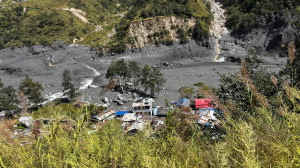
The UN chief said the impacts of climate change are arriving sooner and hitting harder, calling for more adaptation finance and a stronger Loss and Damage Fund as Nepal seeks international support after the August floods. Photo: UN
UN Secretary-General Antonio Guterres recalled his warning about Nepal’s rapidly melting glaciers on Tuesday, saying the climate impacts he had cautioned about during his 2023 visit to the Himalayas were now arriving sooner and hitting harder.
“Three years ago, in the mountains of Nepal, I sounded the alarm on accelerating glacier melt, warning that the rooftops of the world are caving in,” Guterres told the opening of the 81st session of the UN General Assembly in New York.
“Some dismissed it all as overstating dangers,” he said. “But as tragic events have shown, impacts are arriving sooner, hitting harder, and spreading further than many anticipated.”
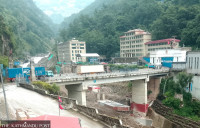
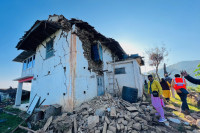
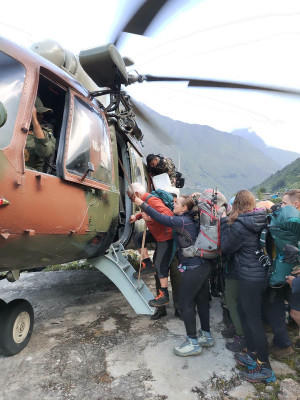
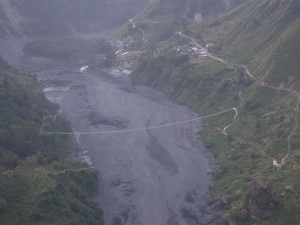
Guterres did not specifically refer to the August 26 Bhotekoshi disaster in his speech. But his remarks came less than a month after an ice-rock collapse near Nepal’s border with China triggered a devastating flood that killed more than 1,400 people and left more than 5,000 missing. A recent scientific assessment found that human-caused warming likely increased the risk of the conditions that contributed to the disaster.
Nepal has been seeking to use the disaster to press its case for climate justice, arguing that countries that have contributed relatively little to global greenhouse gas emissions are bearing some of the most severe consequences of a warming planet. The UN has also described the August disaster as a stark illustration of the losses and damage facing climate-vulnerable countries.
Guterres placed climate change among what he described as the four great “power tests” facing humanity, alongside war and peace, inequality and artificial intelligence.
“In many ways, it’s the most profound intergenerational power imbalance of all,” he said. “One generation consuming the future of the next. One group profiting, while those least responsible suffer first and worst.”
He warned that the world was facing a near-certain breach of the 1.5-degree Celsius temperature limit and said a “supersized El Niño” was adding to the risks.
But the UN chief also argued that the transition to clean energy offered an opportunity to rebalance global power. He called on governments to adopt national plans to move away from fossil fuels in line with the 1.5-degree goal, while protecting affected workers and communities.
“Those who polluted the most and profited the most must do far more to repair the damage they caused,” Guterres said. “Polluters must pay.”
For countries such as Nepal, however, the most immediate issue is adaptation and the financing needed to cope with increasingly severe climate impacts.
“Developed countries must respect their commitments,” Guterres said. “They must triple adaptation finance and make the loss and damage fund work at scale.”
He described the resources currently available through the Loss and Damage Fund as “ridiculously small”.
Nepal has been pushing for greater international support for climate-vulnerable countries following the Bhotekoshi disaster. Prime Minister Balendra Shah is expected to highlight Nepal’s climate vulnerability and seek international support during his address to the General Assembly on Thursday.
Guterres also warned that efforts to secure critical minerals needed for the clean-energy transition should not reproduce the inequalities of the fossil-fuel era.
“We must also ensure that the mining of critical minerals does not dig deeper into the inequalities of the past,” he said. “Producing countries and affected communities must retain a far greater share of the value created from their resources.”
The UN chief first raised the alarm over Nepal’s glaciers during his October 2023 visit to the Everest region, when he warned that the “rooftops of the world are caving in”. He said then that Nepal’s glaciers were melting at an accelerating rate and warned of the consequences for communities and major river systems downstream.
Guterres’ latest remarks came as Nepal seeks to turn the devastation from the August disaster into a broader international push for climate justice, adaptation funding and support for rebuilding vulnerable infrastructure.




 24.19°C Kathmandu