



 20.56°C Kathmandu
Wed, Oct 14, 2026
National
Expressway deadline extended for third time as project nears a decade with half the work unfinished
The 70.97-kilometre national project, being constructed by the Nepali Army, is progressing slowly, leading to significant cost overruns.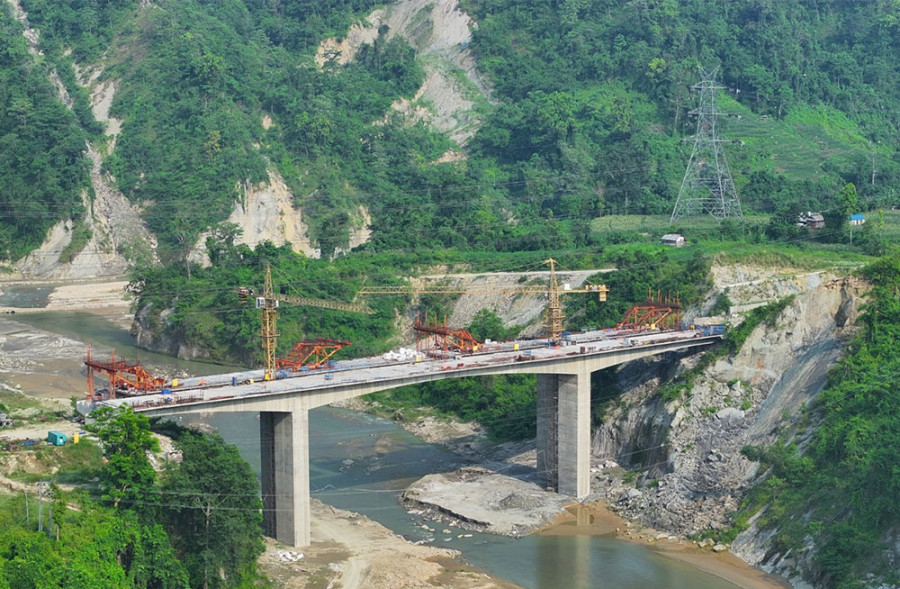
bookmark![]()
The expressway has been divided into 13 construction packages. The Khokana-Dukuchhap section is package 11, while packages 8 and 9 were further split into sections A and B. The road measures 9 km in Lalitpur, 4.6 km in Kathmandu, 49.77 km in Makawanpur and 7.6 km in Bara. Photo: Courtesy of Nepali Army ![]()
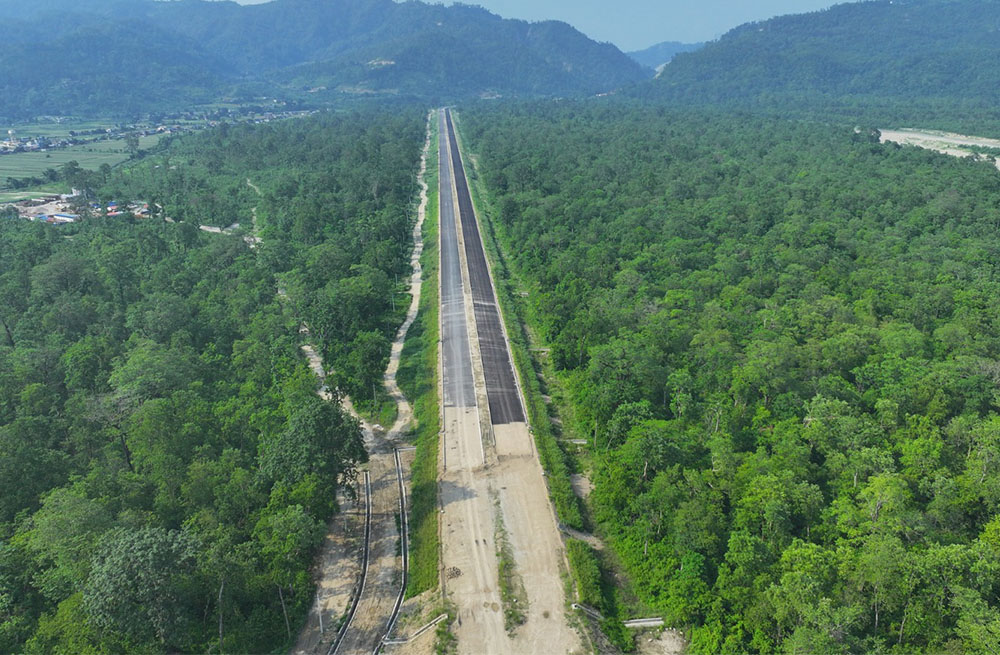
The army opened the track between 2010 and 2012, spending about Rs940 million, and handed it back to the government. Photo: Courtesy of Nepali Army
Bimal Khatiwada
Published at : September 23, 2026
Updated at : September 23, 2026 22:06
Kathmandu
Had the Kathmandu-Tarai/Madhesh Expressway been completed within its original schedule, Kathmandu would have had a direct alternative route to the plains when floods and landslides disrupted its main road links.
Instead, the 70.977-kilometre National Pride Project is approaching a decade under construction by the Nepali Army, with physical progress only around half complete. The delay has left the capital dependent on the Prithvi Highway, Tribhuvan Highway and Kanti Lokpath, all of which become vulnerable to landslides and congestion during disasters.
Supplies in Kathmandu have yet to ease since the August 26 Bhotekoshi floods severed the Prithvi Highway link at Krishnabhir for more than two weeks. When the main artery to Kathmandu was blocked for both passenger and cargo traffic, the remaining links to the Valley saw congestion while large carriers like gas bullets could not move uphill from the plains. This created a cooking gas shortage for the millions residing in Kathmandu Valley.
The Fast Track is linked to the country’s economic prosperity, so it should be completed as quickly as possible, said Bhawani Rana, former president of the Federation of Nepalese Chambers of Commerce and Industry.
“If it had been completed, there would have been fewer problems in the capital during emergencies. It would have made travel and business easier and reduced the cost of transporting daily essentials.”
Rana said the expressway could also benefit tourism by making travel between Kathmandu and the southern plains faster.
The Cabinet decided on May 4, 2017 to assign construction management of the project to the Nepali Army, and the Ministry of Physical Infrastructure and Transport (now Ministry of Infrastructure Development) formally handed it over on August 11 that year. The army was initially expected to complete the project within four years. The deadline was later extended to December 2024 and then to April 2027. The deadline has now been extended for a third time, until April 2030.
The physical progress of the much-awaited project is reported at 50.02 percent.
Defence Ministry spokesperson Baburam Bhandari said the Cabinet had approved another extension until April 2030. “The work has to be completed within this period,” said Bhandari. “The extension was decided because the project could not be completed on time due to problems including the dispute in Khokana.”
Elsewhere too, construction is still progressing slower than expected. Arjun Jung Thapa, a member of the National Planning Commission and former director general of the Department of Roads, said the army’s limited experience with complex road construction was a factor behind the slow pace.
“I am not saying the Department of Roads has all the experience needed for such a project,” said Thapa. “It too has limited experience with large and specialised bridges, while its experience with tunnels is only developing. But the army had even less experience in these areas.”
He also pointed to weaknesses in project management. “Even if the Department of Roads had built the Fast Track, it would have taken time; the department would not have performed a miracle,” said Thapa. “But the army was well experienced neither in project management nor in the technical aspects involved. The lack of both contributed to the delay.”
Thapa said the government should have created a mechanism to resolve administrative and local problems quickly instead of leaving the army to seek decisions through several layers of administration.
“If the whole government machinery had worked together to resolve problems during construction, the Fast Track could have been completed by now,” he said. “It would have reduced traffic pressure on the Prithvi Highway through Nagdhunga by 25 to 30 percent.”
Thapa also criticised the pace of budget allocation. “If a Rs200 billion project is to be completed in four years, Rs50 billion has to be allocated every year,” said Thapa. “Instead, only Rs10 billion to Rs15 billion was being allocated annually.”
The project’s estimated cost, including VAT, is Rs211.93 billion.
Khokana dispute lingers
The 6.5-kilometre Khokana-Dukuchhap section remains the biggest obstacle. Issues include land acquisition, the location of the starting point and arrangements for traffic movement.
The project says 136 ropanis of private land have been valued but have yet to be acquired, while 14 ropanis of Guthi land are also unsettled. Another 165 ropanis is yet to be valued.
Residents of Khokana have long opposed concentrating major infrastructure projects in the area, arguing that the expressway, Outer Ring Road, proposed smart city and other projects could damage the local archaeological and cultural heritage.
The residents of Khokana and Bungamati in Lalitpur objected to land acquisition, compensation and the possible displacement of communities. They also questioned why several major projects were being concentrated in the historic settlement.
Thapa said he was working with local residents to address the dispute. “I have been given responsibility by Infrastructure Development Minister Sunil Lamsal to work on resolving this issue, and I have been talking to the local people,” he said.
“Their main concerns are that compensation is inadequate and that several projects have been concentrated in the same place.”
Guthi land posed a separate problem because compensation could not simply be paid to individual landholders, Thapa explained.
“The government needs to take a special decision on Guthi land because the compensation goes to the Guthi rather than the individual,” said Thapa. “The locals are not against development. They are asking for minor realignments so that such land can be avoided. The road can be taken towards the stream.”
Recent government efforts have tried to bypass the Khokana entry point. In February, then-prime minister Sushila Karki directed officials to pursue an alternative approach, including a shift to Pharsidol. In July, the government said it would proceed with the Pharsidol-Dukuchhap section by revising the detailed project report to accommodate two bridges, while leaving the disputed 3.3-kilometre starting section unresolved.
The revised DPR awaits a Cabinet decision. The army has maintained that Khokana remains the official starting point and that no final decision has been made to change it. A technical study by experts from the Pulchowk Engineering College and the Department of Roads examined alternative starting points. It was submitted to the government in 2024, but no final decision followed.
How the project began
According to the Department of Roads, the initial design for the expressway was prepared by the Nepal Engineering Consultancy in 2002-03. The army was later assigned to open the track while plans for a construction contract were being considered.
The army opened the track between 2010 and 2012, spending about Rs940 million, and handed it back to the government. Construction, however, did not immediately proceed.
During the government led by Sushil Koirala, there was an attempt to award the project to the Indian company IL&FS, which had prepared a DPR. A former government secretary told Kantipur that geopolitical considerations involving India and China were among the factors surrounding the eventual decision to place project management under the army.
A former project chief said delayed approval of the DPR was another major reason for the slow start. “The project was also delayed by problems related to the felling of trees at the construction site and compensation,” he said. “It is now easier to move the work forward, and if the government makes prompt decisions on the unresolved issues, there should be no more delays.”
How the project is being built
The expressway has been divided into 13 construction packages. The Khokana-Dukuchhap section is package 11, while packages 8 and 9 were further split into sections A and B. The road measures 9 km in Lalitpur, 4.6 km in Kathmandu, 49.77 km in Makawanpur and 7.6 km in Bara.
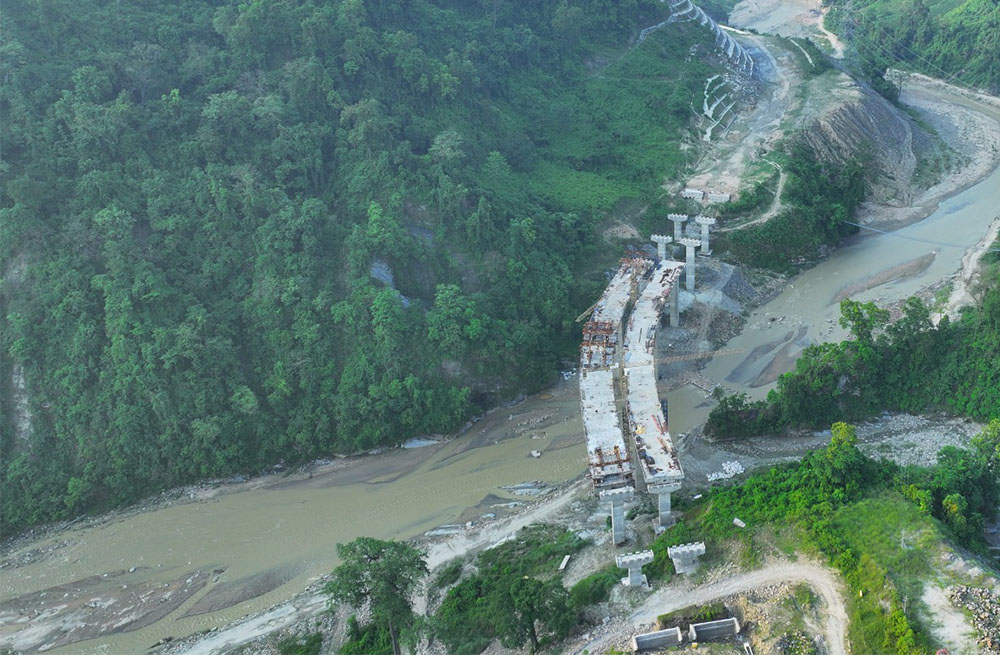
Of the 89 planned bridges, contracts have been awarded for 85. Five have been completed, while the four bridges in the Khokana section have yet to enter the contracting process. Some bridges rise more than 80 metres.
The project also involves seven tunnels with a combined length of about 11.2 km. Finishing work is under way inside the Dhedre and Lendanda tunnels. Dhedre is 1,691 metres long and Lendanda 1,623 metres. The Mahadevatar tunnel in Makawanpur is 3,455 metres long. Work is on in other tunnels as well.
Army spokesperson Rajaram Basnet said several factors had delayed the project. “Khokana is one problem,” he said. “Then there are issues concerning land compensation, the right of way and tree felling.”
According to him, the Covid pandemic also disrupted construction, while the October 2024 floods damaged parts of the Sisneri section in Makwanpur.
Why the Fast Track matters
Former secretary Tulasi Sitaula said the road could change travel patterns between Kathmandu and the Tarai. “People could travel to Tarai districts in the morning and return in the evening,” he said. “They would not have to depend on air travel. At present, even travelling to places such as Kakadbhitta or Biratnagar requires setting aside an entire day. The Fast Track could reduce that to half a day.”
He said the expressway could help decentralise settlements and strengthen links between Kathmandu and other cities. “We need an alternative route into the Capital,” said Sitaula.
“Disasters at different times have shown why such a route is necessary. The Fast Track is currently the alternative reliable route under construction, so it should be completed and brought into operation as soon as possible.”
The expressway is also expected to reduce the time and cost of transporting goods from the southern border to Kathmandu. Birgunj-Raxaul is Nepal’s largest import gateway, and a significant share of goods entering through the border is consumed in Kathmandu.
At present, freight traffic from Birgunj to Kathmandu passes through Pathlaiya, Hetauda, Narayanghat and Mugling, a route that extends unusually long and can be disrupted by congestion and landslides.
Initial projections estimated that about 5,000 vehicles would use the expressway daily, with annual fuel savings of around Rs10 billion and vehicle maintenance savings of Rs15 billion. The project is also viewed as strategically important because it could improve connectivity between India and China via Nepal and support access to the proposed Nijgadh international airport in Bara.
Most Read from National

Flood sweeps away houses, bridges in Gorkha
Torrent of black mud and rocks engulfs settlements along Budhigandaki

From blankets to handmade dolls, two foreign women bring comfort to flood survivors

Budhi Gandaki flood washes away three bridges in Gorkha
British Gurkha veterans issue ultimatum to Nepal government over long-standing grievances
Editor's Picks

Constitutional Bench caught in seniority, ‘pick and choose’ dispute

A Dom boy’s long road to becoming a doctor
From blankets to handmade dolls, two foreign women bring comfort to flood survivors

News Analysis: When institutional defence exposes institutional fault lines

It’s a bird … it’s a plane … it’s the Indian ambassador’s farewell tweets
E-PAPER | October 14, 2026

×