Govt to bypass Khokana deadlock to push ahead with Kathmandu-Tarai Expressway
Officials split the disputed 6.5km stretch into separate contract packages and revise the project design to construct two bridges between Farsidol and Dukuchhap. The deadline has been pushed to mid-April 2027, but officials say a further three-year extension is likely. Post File Photo
The government is preparing to push ahead with construction on the Farsidol-Dukuchhap section of the Kathmandu-Tarai Expressway, while leaving unresolved a long-standing dispute over the first 3.3 kilometres of the project at Khokana in Lalitpur.
The plan involves revising the project’s Detailed Project Report (DPR) for a 3.2-kilometre stretch between Farsidol and Dukuchhap to accommodate the construction of two bridges.
Construction has remained stalled on the 6.5-kilometre Khokana section for years because of unresolved disputes over land acquisition and local opposition. Rather than waiting indefinitely for the issue to be settled, the government has decided to proceed with work on the adjoining section. To do so, the revised DPR, currently held by the Ministry of Defence, must be forwarded to the Office of the Prime Minister and Council of Ministers for approval.
After years of failing to resolve the Khokana impasse, then prime minister Sushila Karki on February 17 directed officials to pursue an alternative approach. Under the revised plan, two bridges will be built on the Farsidol-Dukuchhap section, while a toll plaza will be constructed at Farsidol, about 3.3 kilometres beyond Khokana.
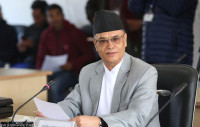
Kedarnath Sharma, secretary at the Ministry of Defence, said a proposal to approve the revised DPR, including the bridge construction, had been submitted during Karki’s tenure but was returned without a decision.
“The starting point of the expressway has not changed,” Sharma said. “It remains exactly where it was identified in the original DPR.”
He said discussions on the revised design for the Dukuchhap-Farsidol section would continue before the proposal is sent back to the Cabinet. He acknowledged that there have been repeated calls to relocate the project’s starting point.
Eight years after the Nepali Army assumed responsibility for managing the project, the dispute surrounding the Khokana section remains unresolved.
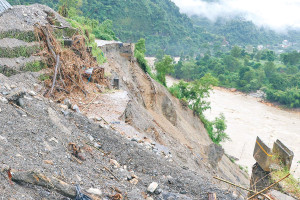
According to military officials, a large landslide-prone area lies below Dukuchhap. The original DPR proposed building the road through the slope, but subsequent geological studies concluded that such construction could destabilise the surrounding settlement. Engineers have therefore redesigned the alignment to cross the Bagmati river via a bridge approximately 500 metres long.
“The bridge requires less land acquisition and eliminates the need for costly landslide mitigation measures,” a military source said. “The revised DPR includes two bridges in the Dukuchhap area.”
Once the revised DPR receives Cabinet approval, the Army plans to begin the procurement process.
The Cabinet assigned responsibility for managing the expressway to the Nepali Army on May 4, 2017. The then Ministry of Physical Infrastructure and Transport formally handed over the project to the Army on August 11 that year. The 70.977-kilometre expressway has since been implemented under military management.
When the Army took over, the project was scheduled for completion by mid-December 2024. After missing that deadline, the completion target was extended until mid-April 2027.
The Army has argued that construction could not begin immediately because DPR approval was delayed. Work on the DPR began on October 2, 2018, and was completed on February 2, 2019. The Cabinet approved it on August 18, 2019. The DPR was subsequently revised twice, first in August 2023 and again in October 2024.
Residents have long opposed plans to simultaneously develop the expressway, the Outer Ring Road and a proposed smart city in the Khokana area, arguing that the combined projects would irreparably damage the area’s archaeological sites, cultural heritage and traditional settlements.
The expressway has been divided into 13 construction packages. Arjun Jung Thapa, a member of the National Planning Commission, said the Khokana section would now be split into two separate contract packages until local disputes are resolved.
“One package will cover the Dukuchhap-Farsidol section, while another will extend from Farsidol to Khokana,” Thapa said. “The Kathmandu-Tarai Expressway Project sought Cabinet approval through the Ministry of Defence. The Cabinet requested the opinion of the Ministry of Infrastructure Development, which has already endorsed the proposal.”
He said the alignment through Dukuchhap has been modified to minimise damage to local communities, responding to concerns raised by residents.
“The 6.5-kilometre disputed stretch has been divided only to ensure that work does not come to a complete halt,” Thapa said. “Construction can continue up to Farsidol, and once work begins, it will also increase pressure on those obstructing the project.”
Despite the revised completion deadline of mid-April 2027, officials acknowledge that finishing the expressway within the current timeframe is highly unlikely. Stakeholder agencies have recommended extending the deadline by at least three more years.
Physical progress on the project currently stands at 48.12 percent.
Brigadier General Rajaram Basnet, spokesperson for the Nepali Army, said there had been no decision to alter the project’s starting point and that only the DPR for the Dukuchhap-Farsidol section was being revised.
A technical study examining alternative starting points was completed in March 2024 by experts from the Pulchowk Engineering Campus and the Department of Roads and submitted to the Ministries of Defence, Physical Infrastructure, and Transport after nine months of work.
The report concluded that Khokana remains the most suitable starting point. However, no decision has been taken on its recommendations.
One alternative proposes building a bridge over the Bagmati river to avoid the Sikali Ghat area, although the study warns that such a route could create significant social and cultural impacts.
Another option recommends shifting the starting point to Bungamati and constructing a four-lane corridor road, which would require acquiring new land along the right bank of the Bagmati River while avoiding the Sikali Ghat area.
The study also suggests that, if Bungamati becomes the starting point, two-lane roads could be built on both banks of the Bagmati river, although additional land acquisition would be required on the left bank.
A further alternative proposes beginning the expressway at Dukuchhap and using the river’s right bank, with limited land acquisition. None of these options has progressed beyond the study stage.
“The starting point has not been changed, and no decision has been made,” Basnet said. “Several alternatives have been studied. After further discussions, the government will decide which option is the most appropriate.”
Including VAT, the total estimated cost of the expressway stands at Rs211.93 billion, of which Rs82.97 billion has already been spent.




 21.39°C Kathmandu