A timber bridge reopens route to Upper Manang after three weeks
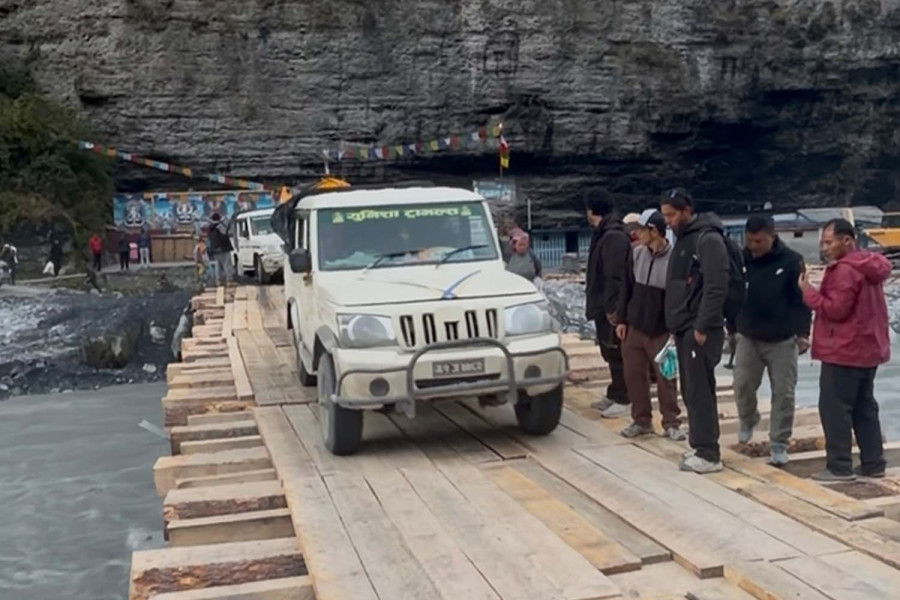
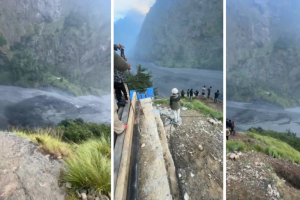
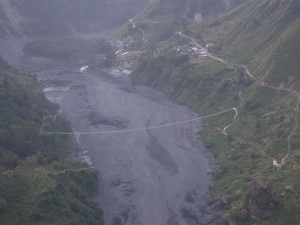
A wooden deck laid over the steel girders of a submerged bridge has restored access for jeeps and motorcycles, but heavier vehicles remain barred. A temporary wooden deck has been laid over the steel girders of the existing truss bridge in Chame, allowing light vehicles to cross the river again. Aash Gurung/TKP
A road linking Upper Manang with the district headquarters of Chame reopened on Tuesday evening, three weeks after floods on September 25-26 cut off access by submerging a motorable bridge over the Marsyangdi river.
A temporary wooden deck has been laid over the steel girders of the existing truss bridge in Chame, allowing light vehicles to cross the river again.
Floods and landslides in the Ghatte Khola had carried rocks, gravel, sand and other debris into the Marsyangdi river, obstructing its flow and raising the water level until the bridge connecting Upper Manang was submerged. For three weeks, the district administration, security agencies, local governments and other government and non-government organisations tried to clear the debris beneath the bridge and restore the river’s flow, but without success.
Authorities eventually opted to build an alternative crossing by laying timber over the bridge’s upper steel girders.
Chame Rural Municipality arranged the timber, while the Nepali Army, Armed Police Force, Nepal Police and local residents helped construct the temporary structure, which spans about 35 metres, according to the Manang district administration.
With the wooden deck in place, jeeps and motorcycles that had been unable to cross for three weeks have resumed journeys across the Marsyangdi.
Mukti Prasad Khanal, chief district officer of Manang, said the alternative crossing was built on the decision of the district security committee after efforts to clear the river channel beneath the bridge failed.
Only light vehicles, including jeeps and motorcycles, are being allowed to use the temporary bridge. Larger vehicles remain prohibited.
“We could not restore the flow beneath the bridge, so we have temporarily laid timber over the existing steel structure,” Khanal said. “This arrangement will remain in place until Dashain is over. We will then resume efforts to clear the river channel.”
With the Dashain festival underway and tourist movement expected to increase, the temporary bridge has restored road access to Upper Manang for the time being, he said.
Authorities had initially discussed using explosives to clear the obstruction and release the backed-up water. The plan was later abandoned after officials determined that there was no lake to drain, but rather a large accumulation of debris, and that blasting could damage nearby houses.
Officials then tried to remove the material using as many as four machines a day. But the debris, which included rocks, gravel and sand, had piled up to the level of the bridge, making it difficult to restore the river’s flow, Khanal said.
Lokendra Bahadur Ghale, chair of Chame Rural Municipality, said vehicles and some tourists who had been stranded in Upper Manang were able to return after the temporary bridge was completed. Some government employees had also been unable to reach their offices, while the supply of food and other goods to Upper Manang had come to a halt.
Residents and tourists had begun crossing the submerged bridge by walking along its exposed steel girders, despite the risks. The temporary structure was built to make the crossing safer, Ghale said.
“After the bridge was closed, people began risking their lives by walking along the steel girders to cross the river. We built the alternative crossing after concerns arose over the safety of residents and tourists,” he said. “Although the bridge was submerged, we concluded that its structure had not suffered major damage, so we laid timber over it and reopened the crossing.”
The same bridge was submerged during floods in 2021. The disaster also swept away a suspension bridge connecting the two sides of Chame Bazaar. It took about a month of effort to restore the Marsyangdi to its original course, Ghale said.
“The bridge was submerged then, too. A change in the river’s course flooded houses on the opposite bank and swept away some structures,” he said. “This time, the problem became more complicated after a steep stream carried landslide debris into the Marsyangdi and blocked its flow.”
After the motorable bridge became impassable, authorities opened an alternative route via Mada, behind the Nepali Army barracks, across a suspension bridge over the Marsyangdi and out towards Talekhu. But that route was also considered risky, prompting residents and tourists to cross along the steel girders of the submerged bridge.
The Manang district administration said vehicle movement had now resumed from Besisahar to Upper Manang following the construction of the temporary crossing in Chame.
Temporary bridges have also been built at several locations where steep streams around Chame washed away sections of road. Timber and electricity poles have been used for some of these crossings. As water levels in the streams have fallen, larger vehicles have begun crossing some stretches directly through the riverbeds.
Although the Chame-Bhratang road section had reopened earlier, the inability to cross the Marsyangdi at Chame had left Upper Manang cut off by road.
The district administration said vehicles were now able to travel along the approximately 61.5-kilometre Besisahar-Chame road and the roughly 36-kilometre Chame-Manang-Khangsar road.




 20.39°C Kathmandu
.jpg)