New hybrid maize variety ‘Saugat’ promises relief for farmers facing extreme weather
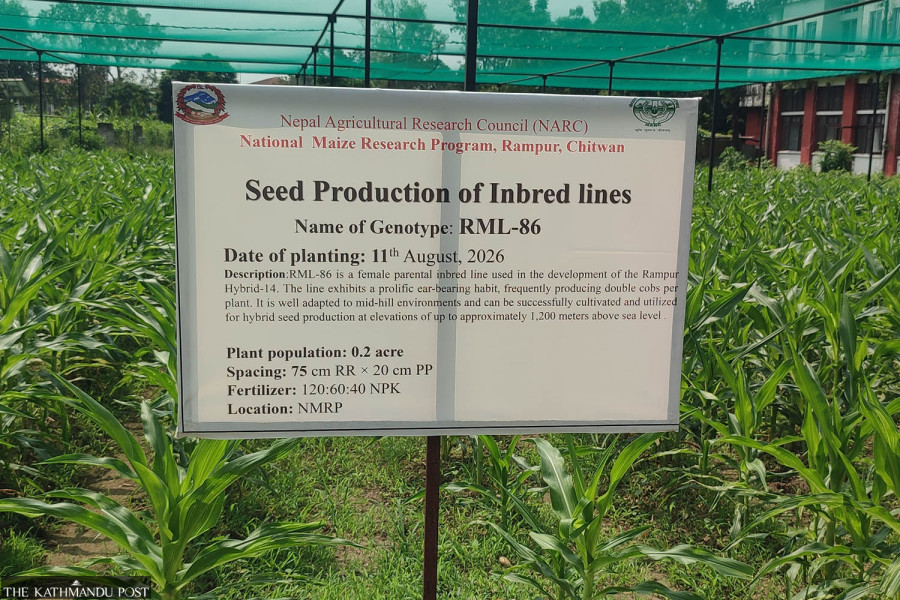
The variety is on the verge of official certification and release after nearly 11 years of rigorous multi-stage field trials and continuous testing. A trial field for a hybrid maize variety in Rampur. Ramesh Kumar Paudel/TKP
Agricultural scientists at the National Maize Research Programme in Rampur, Chitwan, have developed a new hybrid maize seed capable of withstanding extreme drought, erratic rainfall and prolonged waterlogging.
Named ‘Saugat’—which literally means a gift in Nepali—the new variety is expected to restore farmers’ trust in domestically produced high-yielding seeds and curb the country’s reliance on imported hybrids. The variety, currently coded as CAH-1511, is on the verge of official certification and release after nearly 11 years of rigorous multi-stage field trials and continuous testing.
Tirthraj Rijal, senior scientist and chief of the Rampur research facility, said they began working on this candidate line in 2015 using parental lines sourced from the Asian regional office of the International Maize and Wheat Improvement Centre in Hyderabad, India. “Developing a stable and resilient standard crop variety requires extensive field testing,” he said. “Initial performance trials alone take two full years, followed by five consecutive testing phases. Once we confirm genetic stability, we evaluate performance and satisfaction directly in farmers’ fields.”
Following encouraging feedback from agricultural groups, research stations, and farmers across various regions, the station submitted the candidate profile to the Seed Quality Control Centre in Lalitpur.
“After resolving technical queries during preliminary discussions, the formal proposal moves to the National Seed Board for final registration,” said Rijal. “Once approved, ‘Saugat’ will officially become the 11th hybrid maize variety fully developed and registered in Nepal. We expect the formal release process to conclude by mid-November.”
Once registered, the Rampur programme will supply parent seeds—comprising male and female inbred lines—to registered commercial seed companies and agricultural cooperatives. These seed producers will then cross the parental lines to produce hybrid seeds for commercial distribution to local farmers.
The defining characteristic of ‘Saugat’ is its high yield potential alongside strong climate adaptability. According to Rijal, standard field trials show an average production of nine tonnes per hectare, with optimal crop management reaching up to 12 tonnes per hectare. While earlier domestic varieties like Rampur Hybrid-8 and Rampur Hybrid-12 yield over nine tonnes, ‘Saugat’ offers superior tolerance to field submergence and moisture stress.
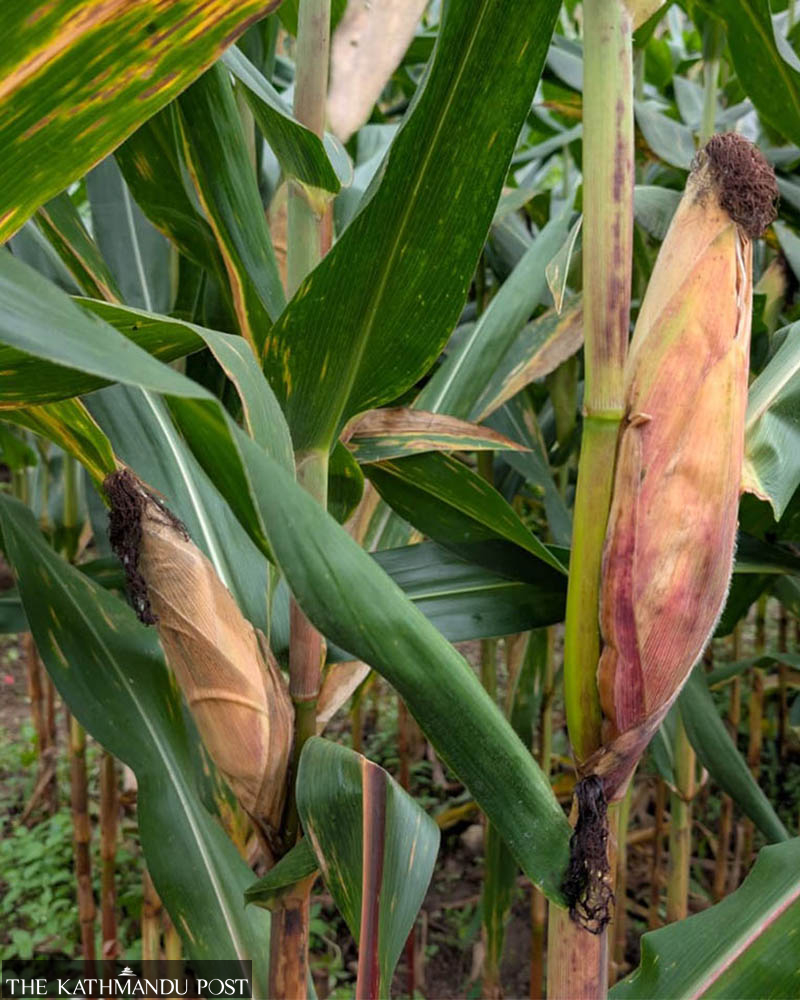
Ears of ‘Saugat’ hybrid corn. Ramesh Kumar Paudel/TKP
“The ears are well-formed with uniform yellow kernels,” said Rijal. “Crucially, the stalks remain green even when the grain matures, allowing farmers to harvest healthy green fodder for livestock. Given current climate shifts bringing unseasonal heavy downpours and extended dry spells, ‘Saugat’ is bred to handle both extremes. It can survive in flooded fields submerged for up to 48 hours without losing productivity.”
Seed growers who participated in preliminary field trials have reported strong results. Tuknarayan Poudel, an agro-entrepreneur operating Agro Nine Company, cultivated CAH-1511 across ten kattha (around 0.33 hectares) of land at Beluwa in Chitwan, as part of participatory evaluation trials.
“The overall performance exceeded expectations,” Paudel observed. “The yield was higher than Rampur-10, currently one of the most popular Nepali hybrids among local growers. During dry periods, maize plants often fail to form full grains on the cob, but this variety showed minimal cob fertilisation failure. It gained immediate approval during local field inspections.”
Nepal developed its first hybrid maize variety, named 'Gaurav', 23 years ago in 2003 for the fertile Tarai and Inner Tarai plains. The most recent recommendation came four years ago with Rampur Hybrid-16.
Maize remains one of the country’s vital staple crops. According to Rijal, maize is cultivated across approximately 950,000 hectares of land. National production totals around 3.25 million tonnes annually, with an average yield of 3.5 tonnes per hectare. However, commercial demand for hybrid maize seed stands at roughly 4,000 tonnes per year, whereas domestic production yields merely 185 tonnes annually, leaving a massive structural deficit met by costly foreign imports.
Why are hybrid seeds developed?
Explaining the scientific mechanism behind hybrid development, Ram Prasad Mainali, senior scientist overseeing plant breeding and genetics at Rampur, noted that hybrid seeds are developed by crossing two distinct, genetically pure inbred parent lines to achieve heterosis, or hybrid vigour.
“Hybrid seeds deliver strong resistance against common diseases and pests, possess uniform growth traits, and offer significantly higher yields,” said Mainali. “Every plant produces uniform ears that mature simultaneously. Farmers overwhelmingly prefer hybrid seeds because of their reliable productivity and physical uniformity.”
Although farmers cannot save hybrid seeds for subsequent planting cycles—as saved seeds lose their vigour and segregate into variable traits—the substantial yield advantage encourages farmers to purchase fresh seeds every season.
To date, Nepal’s national research framework has released 41 maize varieties, including 31 open-pollinated varieties and 10 hybrids. Unlike hybrids, seeds from open-pollinated varieties can be saved and reused for three to four consecutive seasons without significant yield decline.
The demand for hybrid maize seed is high, which has driven up imports in the country. Rijal said that multinational companies have registered 97 hybrid maize varieties.
Researchers remain optimistic that the release of ‘Saugat’ will offer competitive domestic alternatives, encouraging local commercial multiplication while safeguarding smallholder farmers against climate hazards.




 16.84°C Kathmandu
1.jpg)