Poor rains, poor harvests drive Sudurpaschim Dalits from their villages
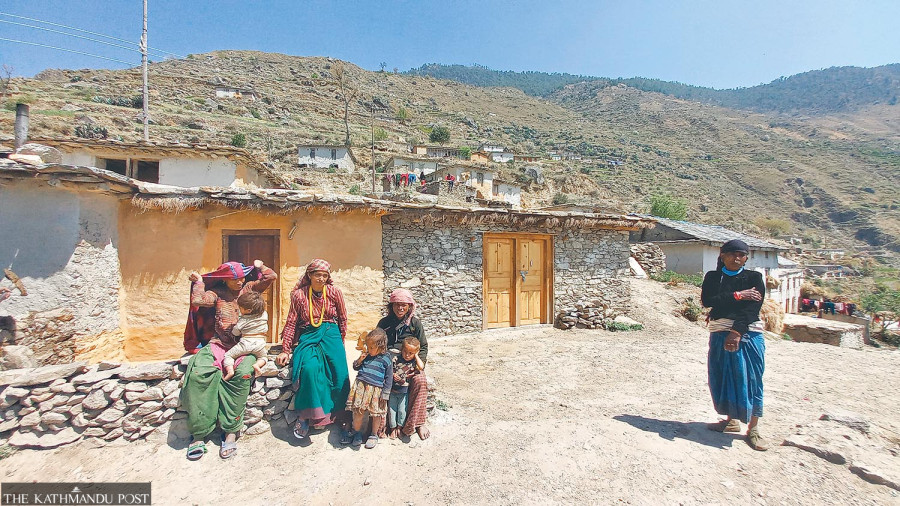
Crop failures and landslides are driving families to India and elsewhere, and in the process migration is eroding the traditions, skills and community ties that sustained their villages.Mothers in Muktikot village in Swamikartik Khapar Rural Municipality, Bajura with their malnourished children. Basant Pratap Singh/TKP
Pyaru Sarki of Kailas in Jayaprithvi Municipality spends his days shaping leather fittings for threshing equipment, sieves, and plough harnesses used by local farmers. In return, he receives khalo—a socio-economic tradition in which Dalit communities are handed out grains twice a year for their labours. On his small plot of terrace land, he also grows wheat, barley, millet, and paddy. Two decades ago, his own harvest sustained his family for about two months, while the khalo grain fed all eight members for the rest of the year. Day labour in his spare time covered their clothing and household essentials.
“We used to harvest six to seven sacks of grain from our own field, and another 15 to 20 sacks came through khalo,” said Pyaru, 76. “Now, the same field that once yielded five sacks does not produce even one. When the crops fail entirely, how can others afford to share their harvest with us?”
With traditional farming and artisanal work no longer providing enough to live on, Pyaru’s sons, daughters-in-law, and grandchildren have all migrated to India in search of manual work. His sons repeatedly pressure him to join them in India, but he refuses to leave his ancestral home. “I have spent my entire life here through joy and hardship. I don’t want to spend my final years on foreign soil,” he said.
Pyaru feels increasingly isolated, not only within his own household but across the settlement. “Drought, floods, and landslides have tormented everyone to the point of despair,” he said. “Out of 18 Sarki families in this village, 15 have already locked up their homes and left. In the few remaining houses, only one or two elderly people like me are left behind.”
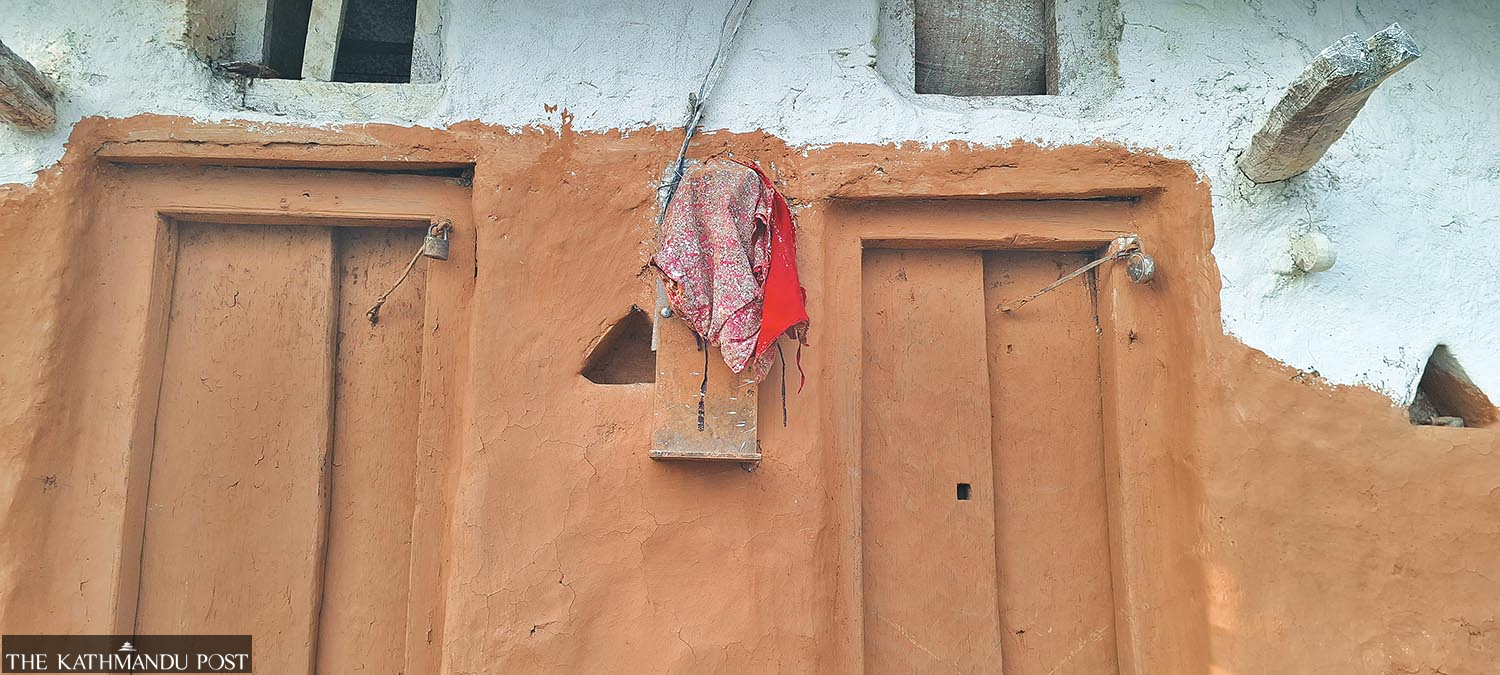
Across the wider village, home to 45 Dalit families belonging to the Kami, Damai, Sarki, and Okheda caste groups, padlock chains secure the doors of 30 homes, while some others prepare to abandon the village.
Local Dalit leader Puran Kami says persistent winter droughts and monsoon landslides have pushed residents past their breaking point. A journey through the Dalit settlements of Bajhang, a hill district of Sudurpaschim Province, reveals empty mud-and-stone houses with weed-covered entrances. Deprived of human upkeep, many dwellings have collapsed into ruins.
In the hills of Sudurpashchim, where irrigation infrastructure is virtually non-existent, agriculture depends heavily on rainfall. Repeated winter droughts have triggered a sharp drop in crop yields and forced Dalit communities to escape the compound trap of environmental disruption and entrenched caste discrimination.
Meteorological records show that the region’s acute water scarcity stems from changing precipitation patterns. According to Sudarshan Humagain, a meteorologist at the Department of Hydrology and Meteorology, the western territory historically received higher winter rainfall than other parts of the country due to the influence of the westerlies. While the national average for winter rainfall stands at 60 millimetres, Sudurpashchim Province historically recorded an average of 140 millimetres. However, this trend has registered a steady decline since 1991.
Department records indicate that during the winter of 2006, rainfall plunged to a record low of 7.1 millimetres. The shortfall has intensified in recent years, with the region recording just 13.1 millimetres of winter precipitation in 2024 and 12.9 millimetres in 2023. Meteorologists track winter rainfall from December through February. Over the past 16 years, winter precipitation has decreased more than average except in only five seasons: 2012–13, 2014–15, 2018–19, 2019–20, and 2021–22.
Comparing recent decades with the baseline period of 1981-1991, meteorologists note a steep downturn in winter moisture. Humagain explained that Sudurpashchim and Karnali provinces suffer from dual vulnerabilities. The monsoon, originating in the Bay of Bengal, enters Nepal from the east and weakens significantly by the time it reaches the far-western hills. Historically, winter rain systems driven by Mediterranean westerlies compensated for the region’s poor monsoon.
“Even if summer rains were light, abundant winter precipitation kept the region from drying out,” said Humagain. “Data from the past three decades show a severe decline in winter rain. When both summer and winter rains fail, prolonged drought is inevitable.”
The Second National Climate Change Survey 2022, published by the National Statistics Office, confirms these observations, with 65.4 percent of respondents nationwide reporting severe impacts from drought.
According to the National Census in 2021, a total of 5,664 Dalit households comprising 29,403 individuals live across the 12 local units of Bajhang. While male literacy among Dalits in the district stands at 75.2 percent, female literacy drops to 41.7 percent. A comprehensive district profile compiled by the District Development Committee reveals that 1,683 Dalit families are completely landless, while 1,063 families lack proper housing. Furthermore, 1,322 Dalit households reside on steep, unstable slopes vulnerable to landslides.
Only 2.43 percent of Dalit households in Bajhang produce enough food on their own land to last a full year. For 73.66 percent of families, home-grown produce lasts less than three months. District Land Revenue Office figures show that 2,848 Dalits in Bajhang have been officially identified as freed Haliyas(bonded ploughmen; agricultural labourers). Yet, many continue to plough land for non-Dalit landlords to service old debts.
Extensive field surveys conducted across Bajhang reveal the scale of displacement. In a sample survey of 31 Dalit settlements across 12 local units covering 1,870 households, a total of 1,049 families—nearly 57 percent—had left their villages for good. A total of 277 dwellings, or roughly 15 percent, were found uninhabitable, with collapsed roofs, crumbling mud-and-stone walls, and rotted timber frames.
“Our village once had 10 Agri (Dalit) families, but only two remain today,” said Prakash Okheda, an executive committee member of Masta Rural Municipality and a resident of Dungrakot. “When people abandon a home, it decays rapidly. Within a year or two, the roof caves in.”
Out of 61 Agri and Okheda families in Prakash’s village, 35 have migrated. In the 26 remaining homes, most are guarded by one or two elderly residents. “Dalits here do not own irrigated fields like the higher-caste residents,” said Prakash. “We rely entirely on rain. With winter rains disappearing, fields that once yielded 10 to 15 sacks of grain now yield barely one or two. How can anyone survive on that?”
Similar conditions prevail across neighbouring districts in Sudurpashchim. In Darchula, Daniram Tiruwa, district chairperson of the Freed Haliya Society, said migration has stripped whole villages of working-age adults. “Only families with members in government service, teaching, military, or police remain behind. There is neither viable farming nor local employment,” said Daniram. In his home village of Uku in ward 6 of Malikarjun Rural Municipality, only 30 to 40 Dalit families remain out of 195 original households.
In Dadeldhura, at ward 1 of Ganyapdhura Rural Municipality, official records list 25 Dalit families in Bhita village, but a visit to the village found only two households still residing there. In Doti district, major Dalit settlements like Kaphallekhi, Techhada, Mudabhara, and Salgaun more than half their homes are padlocked.
Adhiraj BC, a Dalit rights activist in Doti, attributed the desertion to drying water sources. “As irrigation sources dried up, tenant farmers and smallholders could no longer sustain themselves,” said Adhiraj. At Pulbazar in ward 3 and 4 of Dipayal Silgadhi Municipality where 31 Badi families once lived, only 11 remain. “Without enough agricultural produce or local work, people see no option except crossing the border,” he said.
In Achham district, Dalit activist Arjun Tamrakar reported that at Bayalpata in ward 8 of Sanphebagar Municipality, the number of Dalit households has plummeted from 350 a few years ago to just 85 now.
According to the 2021 census, 57,059 Dalit families live across the seven hill districts of Sudurpashchim, out of 269,424 total households. The census recorded that 58,611 individuals from 23,920 Dalit families were living abroad during the enumeration period. They accounted for over 35 percent of all migrants from the far-western hills, despite Dalits making up only 21 percent of total households. By comparison, 109,901 migrants came from 212,674 non-Dalit households.
Demographic experts stress that official census figures capture only a fraction of the reality. “If you visit the villages, you find that 50 to 60 percent of Dalit residents have left their ancestral lands for long periods, and in some settlements, the exodus reaches 80 to 90 percent,” said Prakash Madai, a researcher studying migration patterns in Sudurpashchim. “It represents a profound social shift.”
The emptying of Dalit settlements has severed traditional community support networks and altered age-old rites. At Simpani village in ward 5 of Patan Municipality, Baitadi, 65-year-old Lalmati Koli died on July 21. Local customs required her body to be carried to the riverbank by male relatives and cremated on a wooden pyre. However, out of 15 families in Simpani, 13 houses stood empty. The village was home to only two elderly men and three young boys. With no adults available to manage firewood or build a pyre, the five residents carried the body to the riverbed and buried it in a shallow grave. Hours later, rising floodwaters washed the body back onto the bank. Local police subsequently investigated the incident after villagers reported the uncovered remains.
Lachhi Ram Luhar, a Dalit rights advocate in Baitadi, said the population decline has also disrupted weddings and festivals. “In many villages, traditional wedding processions no longer take place because there are no adults left to join them,” he said.
Cultural traditions are disappearing alongside the communities that sustain them. Last year, during the annual festival at the Dhadhar Masta Temple in Masta Rural Municipality, event organisers planned to stage a traditional Bharte performance—which involves singing, dancing, and oral storytelling—for the visiting chief minister and other provincial officials. However, organisers could not find a single active Bharte performer in Bajhang district. They were forced to pay Rs40,000 to bring artists from Gaumul in neighbouring Bajura district.
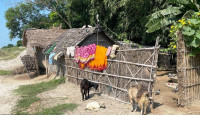
Padlocked doors in a Dalit settlement in Rakail village, Durgathali Rural Municipality, Bajhang, pictured recently. Weeds have overgrown the entrances of several empty homes in the village.
“In the past, every village had its own Bharte storytellers and traditional musicians,” said Prakash Okheda. “Now, when a wedding takes place, families must hire vehicles to transport musicians from distant villages. Soon, these arts may disappear entirely.”
Traditional metalworking, leather craft, and woodwork skills are vanishing at a similar rate. Gyan Bahadur Bohara, chairperson of Masta Rural Municipality, warned that the migration of skilled artisans threatens the local economy. “The vital contributions these communities made to rural life are crumbling,” said Bohara. “As a result, our social structure is losing its balance.”
Dharma Raj Upreti, a disaster risk management expert at the National Disaster Risk Reduction and Management Authority, emphasised that mass displacement degrades social cohesion and weakens local economic activity. “Forced mass migration carries multi-dimensional consequences,” said Upreti. "When social networks, craft traditions, and local production collapse, the economic burden falls back on the entire nation. Vulnerable groups lose what little social capital they possess.”
Residents in Bajhang cite climate disasters as the primary catalyst for migration. At Rakail village in ward 3 of Durgathali Rural Municipality, the last significant snowfall occurred in December 2011. Before that, the village routinely received three to four feet of winter snow. “Now, winter rains arrive late in February or March, long after crops planted in October and November have dried up,” said Jayabhan Parki, 58. “A little snow falls, and that melts within hours. Caught between winter droughts and summer landslides, people are fleeing.”
Deepak Sunar, head of the agriculture unit at Chhababis Pathibhera Rural Municipality and a native of Lwada village, said Dalits are disproportionately impacted by climate change compared to non-Dalits. “Dalits in these hills rely on small terrace yields for two to four months, relying on khalo grain from non-Dalit landowners for the rest of the year,” said Sunar. “When higher-caste families abandon farming or migrate to urban areas in the Tarai, khalo disappears. Non-Dalits have commercial options or capital to move, but for Dalits, the only alternative to starvation is seeking low-wage labour in India.”
Out of 85 Dalit families in Lwada, 50 have moved away.
At Muktikot village in ward 1 of Swamikartik Khapar Rural Municipality, Bajura, nearly two decades of failed rains have brought local agriculture to a complete standstill. Perched on a steep, arid ridge, the village suffers from severe malnutrition. Data from the local health office indicate that nearly 90 percent of mothers in Muktikot suffer from anaemia. Among children under five, the stunting rate stands at 55.8 percent, while 51.2 percent are underweight. Records from the Kholikot Community Health Unit show that 46 children in Muktikot have died from malnutrition-related causes since 2021, and dozens require emergency hospitalisation every year.
“Droughts used to occur once every three years, but now they strike every year,” said Dhan BK of Muktikot. “Seedlings dry up in the soil. After losing our entire crop for nearly ten consecutive years, farmers simply stopped planting.”
The shift began 15 years ago when winter snowfall ceased. “If you want to find people from Muktikot today, go to Bangalore,” said Bal Bahadur BK, a local school teacher. “You will find 30 to 40 families from our village living along a single alley there. Here, all that remains are empty stone structures and parched hills. The few who stay behind are young children and the elderly.”
At Dandakot village in ward 5 of Malikarjun Rural Municipality, Darchula, home to nearly 100 Dalit families, entire households now migrate together rather than sending individual male workers for seasonal jobs. “When whole families move, they take their children with them,” said Banshi Ram Lohar, headmaster of Balichan Basic School. “As a result, half the students who enrol in primary grades drop out before reaching the Secondary Education Examination level.”
Padma Gurung, executive director of Integrated Development Society Dadeldhura, said patterns across the region are similar. “Except for settlements near urban centres like Dadeldhura where daily wages are available, the rural hinterlands are emptying out,” said Gurung. “Dalits carry an unbearable burden of a changing climate because they lack land, savings, or alternative livelihoods.”
According to migration researcher Madai, Dalits live on marginal, disaster-prone land without ownership titles or safety nets. “When crops fail, higher-caste individuals can rely on business ventures or assets, but Dalits have only one exit route—leaving their villages,” he said.
Scientific studies indicate that climate pressure in the region will continue to escalate. Approximately 80 percent of Nepal’s annual rainfall falls during the monsoon season between June and September, while winter rains account for roughly 3 percent. Recent research demonstrates a multi-decade decline across both seasons.
Damodar Bagale, a doctoral scholar at Tribhuvan University, analysing 42 years of climate data from 1977 to 2018, concluded that drought severity will intensify in northwestern Nepal. The study found a marked rise in drought frequency since 2000, driven by declining Standardised Precipitation Index values across western weather stations.
Despite the scale of population loss, local and provincial authorities have introduced few measures to address the crisis. Prit Bahadur Bista, assistant professor of sociology at Far Western University, warned that unmitigated displacement will permanently alter the region's social structure. “When local and provincial governments remain passive in the face of such displacement, blaming the central government in Kathmandu accomplishes nothing,” said Bista. “This is a critical social issue that demands immediate policy intervention.”




 20.51°C Kathmandu