Nepal briefs diplomats on Bhotekoshi flood devastation
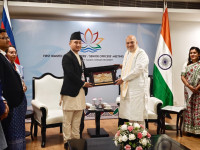
Foreign Minister Shisir Khanal updated diplomats on the devastation across five districts, describing the disaster as a “Himalayan tsunami” and highlighting international support for the response. Courtesy of Ministry of Foreign Affairs
Foreign Minister Shisir Khanal on Thursday briefed Kathmandu’s diplomatic community on the latest situation following the devastating Bhotekoshi floods, outlining the government’s search and rescue efforts, the status of foreign nationals and international assistance received by Nepal.
The briefing, held at the Ministry of Foreign Affairs, was attended by ambassadors, heads and representatives of diplomatic missions, and officials from international organisations including the World Bank, Asian Development Bank and United Nations.
Khanal updated the diplomats on the destruction caused by the catastrophic flooding of the Bhotekoshi river at Rasuwagadhi on August 26, the government’s search and rescue operations, the condition of foreign nationals affected by the disaster and international support for Nepal’s response.
He said the government’s immediate priorities were saving lives, carrying out search and rescue operations and ensuring the safety of foreign nationals.
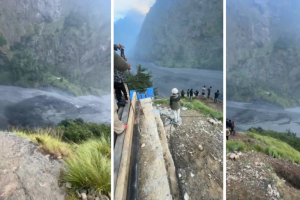
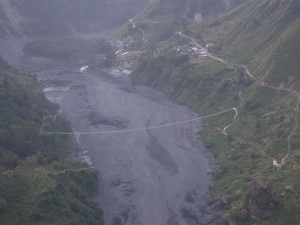
The flood struck Rasuwagadhi, on the Nepal-China border, on the morning of August 26, sending a huge volume of water, mud and debris downstream within minutes and causing widespread destruction, Khanal said.
“I would describe this catastrophic flood as a Himalayan tsunami, because we have not experienced anything like this in recent memory,” he said.
The floodwaters travelled from Rasuwa through the Trishuli river and into the Narayani river system, affecting communities and critical infrastructure across parts of Rasuwa, Nuwakot, Dhading, Gorkha and Chitwan, Khanal said.
The government is investigating the causes of the disaster and how the event unfolded, with technical experts assisting the assessment, he said.
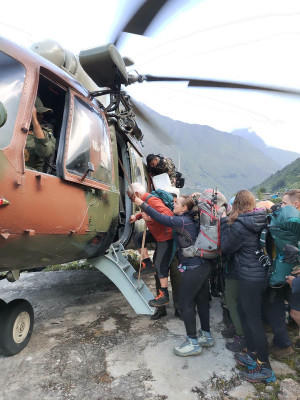
Khanal said the government had prioritised search and rescue, evacuation to safer locations, medical treatment and relief operations from the first day of the disaster.
The National Disaster Risk Reduction and Management Authority (NDRRMA) and the Cabinet convened emergency meetings immediately after the disaster, allowing the government to mobilise available national resources, he said.
More than 21,000 security personnel have been deployed for search, rescue and relief operations, according to Khanal. Personnel from the Nepali Army, Nepal Police and Armed Police Force, along with federal, provincial and local government agencies, health workers, emergency responders, volunteers and local communities, have been working continuously in the affected areas.
Khanal said the safety and welfare of foreign nationals remained a high priority for the government.
The Ministry of Foreign Affairs has been coordinating continuously with the NDRRMA, Nepal Police, the Nepal Tourism Board, Nepali diplomatic missions abroad and families of foreign nationals reported missing in the disaster, he said.
An emergency operations centre established at the Foreign Ministry, together with Nepali missions abroad, has been helping families of missing foreign nationals obtain verified information, facilitating identification procedures and arranging repatriation where necessary, Khanal said.
He thanked diplomatic missions for providing information about their nationals who remain missing, saying such information was crucial to search efforts, verification and the identification of victims.
Given the scale and complexity of the disaster, Nepal attaches great importance to solidarity and assistance from the international community, Khanal said.
He thanked India, China, South Korea, Japan, the United States, the United Arab Emirates, Qatar, Singapore, Australia, the United Kingdom, Germany, Latvia, Malaysia, Myanmar, Bhutan, Bangladesh, Pakistan, Norway, Israel, Canada, Sri Lanka, Thailand and New Zealand for their support.
He also expressed gratitude to the European Union, Asian Development Bank, World Bank, United Nations and other international organisations and partner countries for the assistance they have provided.
International support has included search and rescue expertise, equipment, logistics, medical and forensic assistance, as well as financial aid, Khanal said.
“The solidarity and assistance we have received has come in many forms: rescue expertise, equipment, logistics, health and forensic support, and financial assistance. Each of these forms of support is making a difference in the affected areas,” he said.




 15.71°C Kathmandu