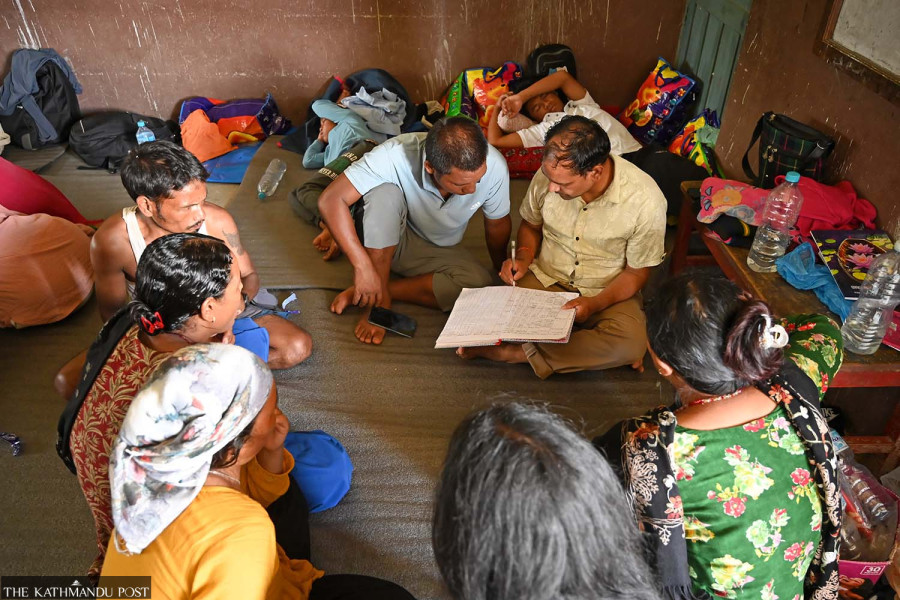
From a Rasuwa holding centre, survivors recount desperate escapes, relatives swept away and the loss of homes, villages and entire families in the Bhotekoshi disaster. Post Photo
When the flood came, Purna Bahadur Ghale had seconds to decide whether to run.
The 43-year-old executive member of Uttargaya Rural Municipality was in Shanti Bazar when the Bhotekoshi river burst through settlements in Rasuwa on August 26. Someone shouted that everyone should flee.
He ran towards his home in Khalte.
Shanti Bazar is about three kilometres from the village. But by the time Ghale reached Pahirebesi, the flood had already arrived. He barely escaped with his life.
“Seconds made the difference between life and death,” he said.
Now sheltering at the holding centre set up at Shivalaya Basic School in Laharepauwa, Ghale is struggling to comprehend what happened next. Seven members of his family are missing.
“I know neither whether they are alive nor where their bodies are,” he said. “Seven of my relatives were caught in the flood.”
Ghale fled uphill into the forest and spent two days there. On the third day, Friday, a Nepali Army helicopter rescued him and flew him to Bidur in neighbouring Nuwakot. On Sunday, he made the five-hour journey back to Uttargaya.
“Ward 1 has suffered the greatest damage,” he said. “The very people who were telling others to run to safety were themselves swept away.”
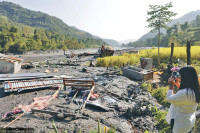
The villages of Khalte, Gogane, Tiru and Karmarang have suffered extensive human and property losses. Bodies have begun appearing along the riverbanks, many so badly damaged that they are difficult to identify.
Among Ghale's missing relatives are his 75-year-old father Subba Ghale; his 16-year-old younger son Krishna Ghale; his elder son's 24-year-old wife Suchita; his brother Bam Bahadur's 24-year-old wife Som Maya; their daughters, five-year-old Binusa and three-year-old Sunita; and his 10-year-old nephew Bikram Tamang.
The homes of the two brothers stood close to each other. His brother also ran a grocery shop in the village. According to Ghale, the flood reached Khalte at around 9:30am.
“I escaped the flood. When I first heard that it was coming, I called home and told everyone to run,” he said. “I rushed home to save my family, but I never made it there.”
From a safer location, he repeatedly tried calling home. At first, no one answered. Eventually, the phones went dead.
“I haven't slept because I don't know what happened to my family,” he said. Within moments, the settlement had been reduced to a barren riverbed.
“There was no way to get home. The roads were gone,” he said. At the time, he did not even know who among his family members had survived.
It was only after reaching Laharepauwa on Saturday that he began learning how many of his relatives had been caught in the flood.
“What can I say? I have nothing to say,” Ghale said, tears filling his eyes. “My mind is simply not working.”
Despite his own loss, Ghale was busy compiling details of those missing because of his role as a member of the rural municipality executive. By Sunday, he had counted 54 missing people.
There were 257 houses in Khalte. “Not a single house is intact,” he said. Ghale and many others in the settlement had already survived one disaster.
“We were victims of the 2015 earthquake. We survived then,” he said. “I must have gone to Singha Durbar more than a hundred times to ask the federal government to move us somewhere safer. They always said they would, but they never did.”
The families had been displaced from Gogane by the earthquake and resettled in Khalte. Now, Ghale says, the government must provide survivors with safe housing and food.
***
Twenty-six-year-old Ranjina Tamang is also sheltering at Shivalaya Basic School in Laharepauwa with her four-month-old son.
She survived the flood. So did four children who were with her. Ranjina was serving food at home when the flood came down the Bhotekoshi river.
She had fed her seven-year-old daughter and was getting the child ready for school. She was also preparing to eat before accompanying her daughter to Uttargaya School.
Then she heard it. A deafening roar. A wall of water carrying a dark mass of debris.
Panic set in.
She lifted her four-month-old baby onto her back. With her left hand, she held her seven-year-old son Arjan. With her right, she grabbed Smriti, her five-year-old niece. She pushed eight-year-old Nandika, another of her nieces, ahead of her, urging her to move faster.
“I ran into the forest with them,” Ranjina said. “The flood had already reached us. I was almost unconscious, but I somehow managed to save everyone.”
She feared throughout the climb that the baby strapped to her back might have fallen. “I was terrified that my son might have slipped off without me realising it,” she said.
None of them had shoes on their feet. Ranjina suffers from asthma, and running uphill made it even harder to breathe.
She first reached Gerkhu village and the following day walked for hours before arriving at Shivalaya Basic School in Rasuwa.
By then, she still had no idea who had survived and who had been swept away.
Her father, Som Bahadur Tamang, who worked at the Rasuwagadhi Hydropower Project, is among those missing. Her mother, Phul Maya, has collapsed from the shock and is staying in Dandagaun in Rasuwa.
“I haven't even been able to speak to my mother properly on the phone,” Ranjina said. “There is no electricity here, and we cannot even charge our phones.”
Three of her uncles, Man Bahadur, Mangale and Urla Tamang, are also missing. They worked as labourers at different hydropower projects under construction in Rasuwa.
Five members of her maternal uncle's family remain out of contact as well. “I have no clothes to wear. I have asthma and no medicine. I have a cold, and my baby has a fever,” she said. “Many people here are sick.”
***
Tarali Maya Tamang, another resident of Khalte, is living at the same holding centre.
Her eight-year-old daughter Sunita, 12-year-old son Samir, mother-in-law Lenchon and father-in-law Mingmar Ghale are all missing.
“My children were swept away on their way to school,” she said. “My in-laws were at home when the flood suddenly came and took them.”
Her elder son Ramesh survived by running to safety. Tarali Maya herself was in Khalte when the flood struck and fled into the forest. Her husband, Temba, and elder daughter, Sushina, who were in Gogane at the time, also managed to escape to safety.
“Where do we go now? What are we going to eat? We don't know anything,” she said, breaking down. “My family is gone. My home is gone. We have no food, no clothes, nothing.”
***
For Buddhi Bahadur Tamang, the disaster took his wife.
The Khalte resident, who is deaf and makes a living as a daily wage labourer, was outside his home when the flood came. He saw the water and ran. He survived, but his 43-year-old wife, Rata Kumari, could not.
His son works abroad. Because Buddhi Bahadur cannot hear, he has been unable to speak to his son on the phone. He, too, is now staying at the holding centre in Laharepauwa.
***
Twenty-seven-year-old Bam Bahadur Ghale lost almost everyone closest to him. His wife Som Maya and their daughters, Binusa and Sunita, were swept away.
“Now there is no one left in my family,” he said through tears. “I have nowhere to go. There is no home, no village, no relatives. We haven't even found the bodies of our loved ones.”
He survived because he was away from home when the flood struck.
“Now I regret not being at home,” he said. “Sometimes I think that if I had gone with my family, at least I would not have to live like this, with nothing and no one.”
Survivors in the village are now struggling even with basic necessities. Many people have been crammed into a single room. New mothers have not been receiving adequate nutritious food.
***
Forty-two-year-old Chhegu Lama had survived the 2015 earthquake. After the disaster, he and his family had moved to the Khalte riverbed settlement. This time, he lost several members of his family.
His sister Kaisang Buti, two brothers-in-law, his father Sonam, mother Yosong Maya, younger brother Ujjen Singh Tamang and nephew Dinesh are all missing.
“After the earthquake, the government told us this was not a suitable place to live and promised to move us somewhere safer,” Lama said. “But we continued living here, and now the flood has taken everything too. There is hardly anyone left in the village. What a disaster this has been.”
He is also staying at the holding centre in Laharepauwa. The full scale of the destruction is still unclear.
According to Bishwas Nepali, a resident of nearby Kalika Rural Municipality-3 and a social activist involved in relief and rehabilitation efforts, preliminary estimates suggest that around 1,000 households across different wards of Uttargaya Rural Municipality have been affected.
“I am from this area, so we are involved in rescue, relief and rehabilitation efforts and helping in whatever way we can,” he said. “But we have not yet been able to collect complete data on the number of people affected.”
Local units and civil society groups are still compiling the figures. Many survivors escaped with nothing. “They have no clothes to wear. Children have no books or exercise copies to study with,” Nepali said.
Schools are currently being used as temporary shelters, and relief supplies have only recently begun arriving. “Representatives of the rural municipality are still occupied with rescue work and managing bodies,” he said.
According to Nepali, three areas in Uttargaya have been particularly hard hit: Mailung in ward 1, Pahirebesi in ward 4 and Khalte in ward 5.
He said government relief had yet to reach some of the affected settlements, while supplies brought by organisations and individuals were being stored and distributed through the local government.
There are currently five holding centres in the area, with students, elderly people, women and men accommodated separately.
“This arrangement may work for a short time,” Nepali said. “But if people have to stay like this for too long, health problems will emerge.” The next step, he said, must be temporary resettlement.
Arjun Poudel is a health reporter for The Kathmandu Post. Before joining the Post, he worked for Sagarmatha Television, Naya Patrika, Republica and The Himalayan Times.




 18.94°C Kathmandu