Reporter’s Diary: Driving into a divided landscape
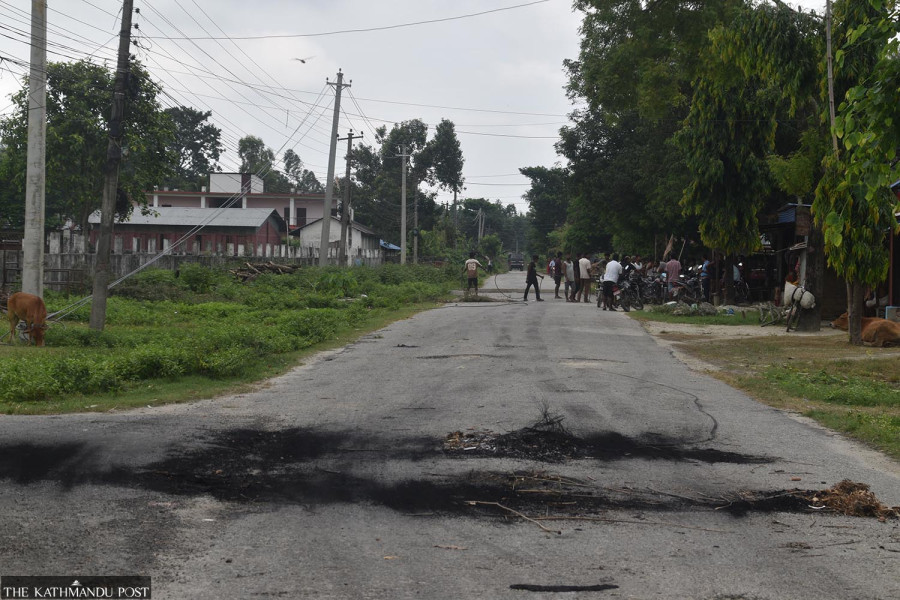
A journey to report on deadly communal violence became an account of fear, uncertainty and the difficult decisions journalists face when every choice carries consequences. Roadblock created by protesters burning tyres at Madhyaharshahi Chowk before reaching Kaptanganj. Post photo
On the morning of July 29, I flew to Biratnagar to cover what had been unfolding in Kaptanganj, Sunsari, since Sunday night. More than a straightforward reporting assignment — reaching the location, speaking with local residents, civil society members, and political party leaders — I wanted to understand how the immediate violence fit into the recurring pattern of communal tensions in the Madhesh region.
The first uncertainty emerged as soon as I reached Biratnagar.
While we were preparing to leave for Kaptanganj, my Biratnagar colleague Parbat Portel and I received unexpected news: the driver we had finalised the previous night refused to go. The driver was from the Hindu community, and he was unwilling to take the risk of driving to a village where violence had broken out, one person had died after being shot by police, a curfew was in place, and protesters were still defying prohibitory orders.
Almost every other driver we contacted also refused, citing security concerns.
It took nearly two hours to make another arrangement. This time, the driver who eventually agreed to take us was from the Muslim community.
In ordinary circumstances, this would have been an irrelevant detail. But we were travelling into a place where a dispute between two religious communities had turned violent, where people were increasingly being viewed through the lens of their religious identity.
The conflict had made even ordinary decisions — including whom to travel with — carry a new weight.
If we travelled with him, were we unnecessarily exposing him to risk? If we did not take him, would we be excluding someone who had assessed the risks and was willing to do the work simply because of his religious identity? Moreover, we had no one else prepared to accompany us into the field. His presence also meant we might be able to build trust while speaking with members of the Muslim community.
After a long period of uncertainty, we decided to inform him about the possible risks and leave the final decision to him.
As a precaution, we went to the Morang chapter of the Federation of Nepali Journalists and bought yellow fluorescent jackets marked “PRESS.” We gave one to him to wear.
The journey began.
Kaptanganj lies about 15 kilometres southwest of Biratnagar. But that short distance became unusually long for us.
It was the third morning after the violence had begun. There were obstacles all along the road. In some places, trees had been cut down and left across the road. In others, poles and wooden beams had been placed to block passage. There were places where tyres had been burned, and places where stones had been piled over the remains of burned motorcycles and vehicles. Goods from shops that had been set on fire and vandalised were scattered across the road.
Army armoured vehicles pushed through, clearing or bypassing the roadblocks.
Except for a few people slowly pushing bicycles along the road, there was almost no movement. There were no pedestrians. Houses and shops on both sides of the road were shut. Villages, towns, fields, roads, and intersections were deserted, as if the entire landscape was holding its breath.
In Chimadi village of Barju Rural Municipality, 10–15 teenagers carrying sticks and rods blocked the road. They stubbornly refused to let us pass, but scattered when they saw an army armoured vehicle approaching from Biratnagar.
Two to four kilometres ahead, at Madhyaharshahi Chowk, somewhat older men were sitting. They stopped us as well. After learning that we were journalists, they said they would allow us to proceed only after we recorded their statements.
They said they believed Hindus had always been “treated unfairly” amid the growing religious tension. They spoke with anger about the Muslim community.
At the next intersection there was another group. Then another group, and another.
Under normal circumstances, Kaptanganj is just a 25-minute drive from Biratnagar. That Wednesday, it took us nearly three hours.
When we reached the Muslim neighbourhood of Kaptanganj, residents there complained: “No journalist, civil society member, leader, or government team has come into the neighbourhood. Everyone turns back from Kaptanganj Chowk itself. We have not even been able to present our side.”
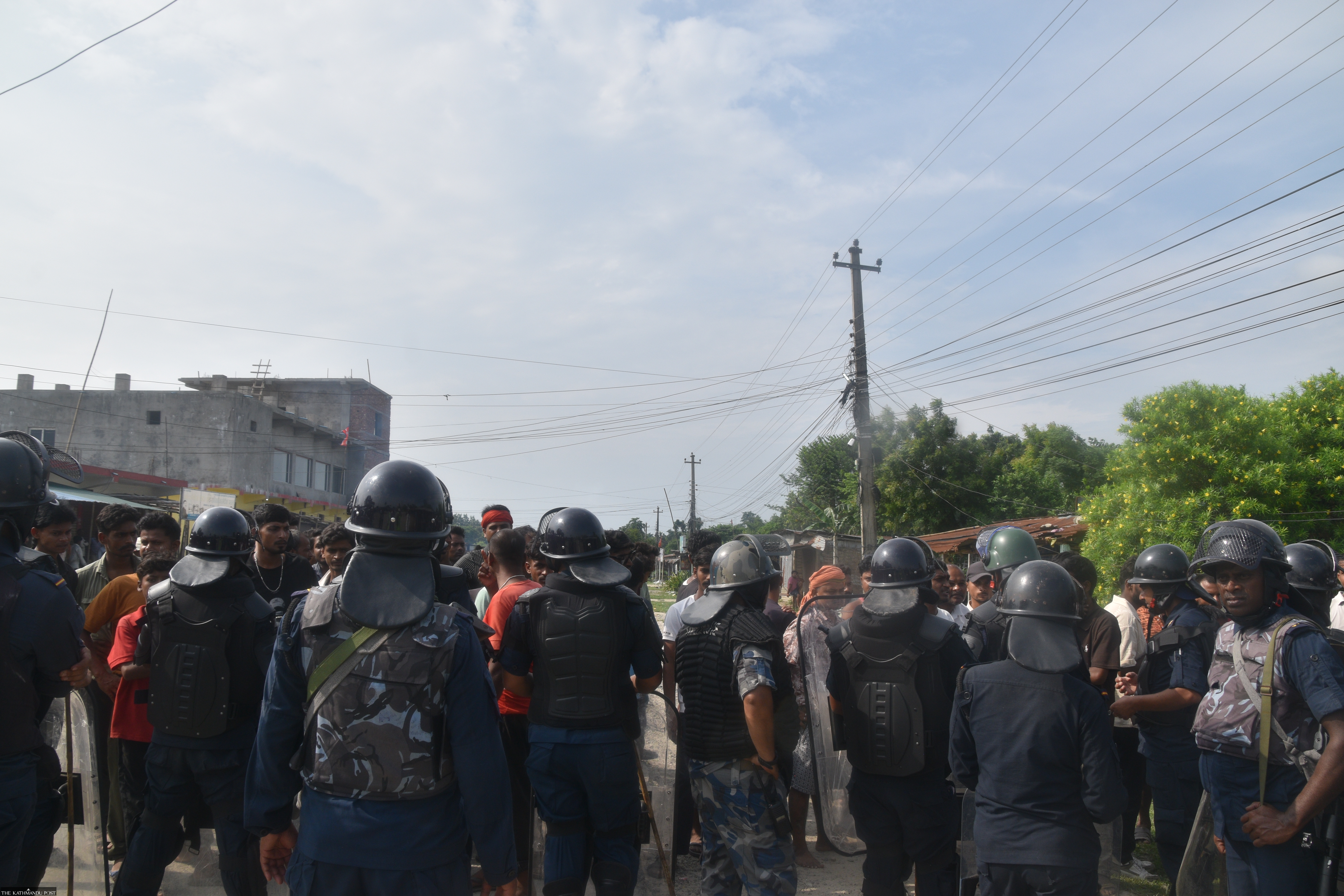
Arson and vandalism unfold in Kaptanganj in front of security personnel. Post photo
Before entering the Muslim neighbourhood, we had gone to the house of Om Prakash, about 700 metres east of Kaptanganj Chowk, and interviewed his family members. Om Prakash had been killed by police gunfire.
To reach the Muslim neighbourhood from Om Prakash’s home, we had to return to Kaptanganj Chowk and then walk about 100 metres south.
Until then, however, I had not sensed any other possible danger.
We had not asked our driver to leave the vehicle. During reporting, the two of us took turns going to different locations, while the other stayed with him, before returning to our work.
But as soon as we stepped south from Kaptanganj Chowk, some Hindu youths gathered above the road and began shouting. The shouting was directed at us for walking toward the Muslim settlement.
Despite the curfew, they burned tyres on the road directly in front of security personnel. They raised slogans.
When it was time to return, our driver did not want to go back the same way.
He suggested either going farther south and finding an exit route from there, or looking for a way out through the east-west road behind the security cordon at the intersection.
I believed I could reason with the crowd. I wanted to capture on camera the burning, slogans, and protests taking place during the curfew; speak with those involved; understand the reasons behind their anger; and find out what they wanted.
So I proposed that instead of searching for an alternative route, it would be better to do some additional reporting and return along the same road.
The driver disagreed.
Perhaps he had sensed earlier than I had that the situation had already become volatile.
We eventually agreed on a middle-ground approach: we would continue reporting for some time, and if it became impossible to pass through, we would use an alternative route.
But as soon as we returned from the Muslim neighbourhood, the crowd became more agitated. Teenagers carrying rods and sticks rushed toward the vehicle itself. Some came directly in front of it and lay down on the road.
Police stopped them from attacking us.
An attempt to get out and explain the situation did not work. No one was willing to listen to what we said or hear our questions.
We were blocked for about an hour and a half. They questioned what we had written down and what we had recorded on camera.
They tried to search the vehicle, saying there could be "something" hidden inside — weapons and money allegedly supplied from a madrasa.
We were not prepared to let them search the vehicle because we feared that our driver’s identity could become known and put him at greater risk.
The aggressive slogans targeting the Muslim community continued late into the evening.
To the north, there were three layers of security forces: first the Nepal Police, then the Armed Police Force, and finally the Nepali Army.
They prevented the crowd from breaking through the security lines and moving toward the Muslim settlement. Beyond that, however, restrictions were limited.
We continued filming those shouting aggressively in the crowd, hoping that doing so would eventually help us leave.
An elderly man who had earlier helped us reach Om Prakash’s home watched everything unfold. Eventually, he pleaded with the crowd to let us leave.
The crowd relented.
By the time we reached Biratnagar, it was already late at night.
On the way back, I apologised to the driver for not agreeing at the beginning to take the alternative route. By then, however, he had learned that every alternative route was blocked and that the only reliable way back was the same main road we were already taking.
He only gave a faint smile. I took it as his acceptance of my apology.
After returning to Biratnagar, I interviewed him at length about what had been going through his mind while all of this was happening around us.
As we parted, he said, “I live here. I don’t know what might happen again. Please don't publish this conversation.”




 13.13°C Kathmandu