AI is transforming Nepal’s workplaces. Its classrooms haven’t caught up
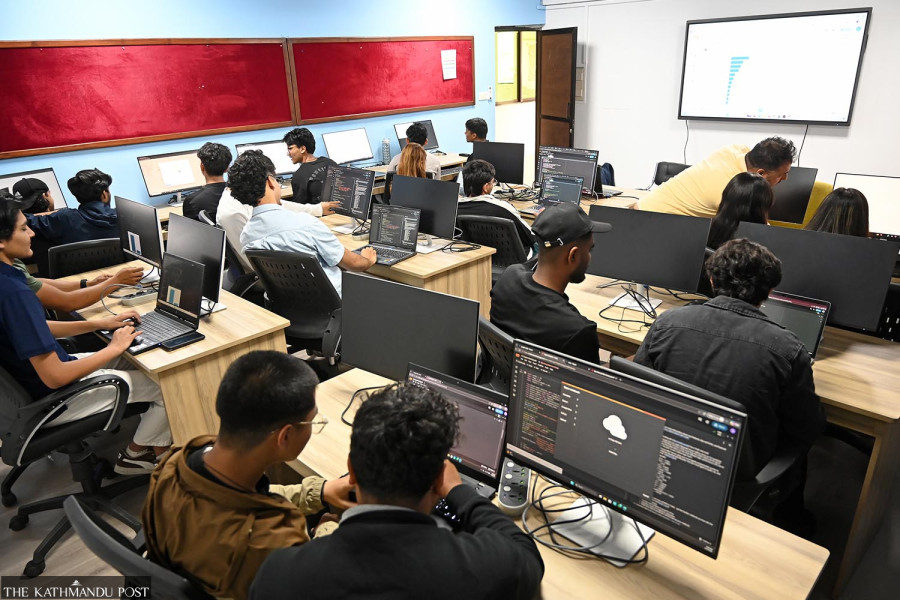
While Nepal’s software companies are retraining staff, rewriting job descriptions, and racing to stay competitive, top universities are still debating whether to let students use the tools at all. Angad Dhakal/TKP
Mamata Chaudhary has a new collaborator. The software developer at Lalitpur-based Cedar Gate Technologies now writes code alongside Amazon Q, an AI assistant built by Amazon Web Services for software development and data analysis. Cedar Gate purchased a license and rolled it out to its developers. The tool has changed how Mamata works — and, she admits, how she thinks.
“Earlier, whenever I hit a problem, I'd work through it myself, think about it from different angles,” she told the Post. “Now, the moment something new comes up, my first instinct is to ask the AI.” She no longer has to rely on colleagues or supervisors for help. But something else has shifted. “Somewhere, I feel like my ability to think things through on my own has weakened,” she said.
She has started making deliberate efforts to attempt problems herself first, and to avoid AI when there’s no urgency. But she doesn’t think the technology will ultimately displace workers. “Fewer people might do the work that many do today,” she said, “but humans will always be necessary. That's exactly why the next generation has no choice but to become AI-fluent.”
Mamata’s experience is increasingly common across Nepal’s IT sector. As AI reshapes global technology markets, the country’s software companies have accelerated adoption — changing not just how work gets done, but what skills the market rewards. Companies serving both domestic and international clients are deploying AI across operations: business strategy, cybersecurity, HR, and beyond.
Santosh Tamrakar, managing director of IMS Software, has been watching the shift in real time. “Drafting a business proposal that used to take half a day now takes ten minutes with AI,” he said. System architecture that once required two or three days of focused work can be roughed out in two minutes. IMS uses Claude for coding and Beautiful.ai for presentations. “We’re still in the early stages, but the productivity signal is hard to ignore.”
The implications for hiring are already visible. “The market is no longer just looking for people who can code,” Tamrakar said. “It wants people who can verify AI output and feed it the right data. Mid-level developers who only know how to write code face a difficult future.”
Abhay Poudel, co-founder of Gokyo Labs and treasurer of the Nepal Association for Software and IT Services Companies (NAS-IT), sees AI adoption for operational efficiency as near-universal. His own company uses AI for planning, feature development, and documentation. But he notes that new hiring across the sector has slowed, even as demand for AI-skilled workers rises. The emerging roles — AI application developer, data engineer, prompt engineer, AI consultant — require competencies that most fresh graduates don’t have.
“We hired about ten to twelve college graduates in the past year — interviewed twenty to twenty-five, took roughly half,” Poudel said. “That’s a reasonable rate. The problem is that every one of them needs four to six months of basic training before they're actually useful.”
Ankur Sharma, Innovation Director at Leapfrog Technology, puts it plainly: “In many cases, you no longer need to write code at all. Companies need people who can operate the tools — people with a software engineering foundation who can use AI to make their work better.” The problem, he said, is that graduates are entering the market trained on curricula designed before the AI wave arrived.
That mismatch has drawn the government’s attention. Nepal’s recently released “National Commitment” — a document synthesising pledges from six major political parties — includes mandatory AI literacy through Grade 12 and plans to develop a sovereign large language model. The document sets a five-year target for Nepal to become a computational power exporter and declares IT a strategic industry. Whether those ambitions hold up against ground reality in classrooms and companies is another question.
Nepal’s universities are only beginning to engage seriously with AI. Kathmandu University has established a dedicated AI department within its Computer Science and Engineering division and passed a formal policy fully embracing AI use across all schools. Purbanchal University has introduced AI as a standalone subject. Tribhuvan University — the country’s largest — has no full AI degree program, though it has incorporated AI basics across several undergraduate programs. Pulchowk Engineering Campus has taught AI-related content through its Data Science and Analytics program since 2019.
The more telling contrast is in policy. Since 2024, TU has banned AI in examinations — academic dishonesty detected in a thesis can result in cancellation. KU, meanwhile, has formally embraced AI use. One country, one generation of students, two opposing approaches.
Technology analysts say most institutions are spending more energy figuring out how to block AI than how to use it. “Our universities aren’t yet in a position to redesign assignments that account for it,” said Leapfrog’s Sharma. “Students need to be introduced to modern tools from day one.”
TU computer engineering professor Arun Timilsina, who led the introduction of AI coursework at the university, acknowledges that AI-forward teaching hasn't happened at the scale it should. He uses AI tools extensively in his own classes and sees the technology as fundamentally changing the teacher's role. “A student can now access the way MIT or Harvard teaches the same subject,” he said. “Teachers can’t just recycle old material. Both sides of the classroom need to keep updating.”
Technology analysts say most institutions are spending more energy figuring out how to block AI than how to use it. Angad Dhakal/TKP
King’s College in Kathmandu offers a BSc in Computer Science with an AI specialisation and has introduced AI at the postgraduate level. But the college head, Narottam Aryal, admits the subject hasn't truly taken root in Nepal. “It has turned everything upside down, from school to college,” he said. “How to use AI, how far to take it — curricula need to be explicit. Students’ creative capacity could quietly atrophy.”
Sarvin Sayami, head of TU’s central Department of Computer Science and Information Technology, worries that negative uses of AI outpace productive ones. “More than learning, AI seems to be used for entertainment — the misuse is widespread,” he said. “AI literacy needs to be part of the school curriculum from the beginning.”
The debate inside institutions contrasts sharply with what’s happening in the job market. Sunaina Ghimire Pandey, president of the Computer Association Nepal, sees AI making routine work — graphic design, video editing, legal drafting — markedly easier. Her company, GenTech, uses AI to accelerate developer workflows. But she doesn’t anticipate mass layoffs hitting Nepal imminently. “Right now, Nepali companies are more focused on teaching existing staff to use AI tools than on cutting headcount,” she said. “In the near future, it will reach us too — but we're not there yet.”
Internationally, the shift has been sharper. Since 2024, companies have redirected budgets freed up by layoffs into AI infrastructure. Repetitive work — data entry, customer service — has been automated, shrinking demand for human labour. Some in the industry have accused companies of using AI as a convenient cover for cuts they would have made regardless. The term gaining currency is AI-washing.
At an AI conference in India two months ago, OpenAI CEO Sam Altman addressed the phenomenon directly. “A significant number of people are engaged in AI-washing — blaming AI for layoffs that would have happened anyway,” he told CNBC-TV18. “Some jobs have genuinely been displaced by AI. Many haven’t.”
Nepal’s analysts tend toward the more measured read. IMS’s Tamrakar argues that because human judgment is still needed to verify AI output, the technology cannot simply replace people. “The focus in Nepal’s IT sector right now is less on AI-washing and more on re-skilling — training existing staff to work with AI,” he said.
The broader data suggests real pressure is building, however. The World Bank’s South Asia Development Update, released last October, found that monthly job postings for white-collar roles across the region fell 20 percent following the rise of generative AI. Seven percent of South Asian jobs face high risk from AI and automation, with those lacking college degrees and those just entering the workforce most exposed.
Shailendra Raj Giri, managing director of the job portal Mero Job and chair of the AI Association Nepal, has watched Nepal's IT hiring decline since early 2024. Demand for software developers, transcribers, translators, and content writers has dropped sharply. “Demand for work that AI can do has simply dried up,” he said. “For fresh IT graduates, the market looks almost dark right now. Companies have stopped hiring new people altogether.” Roles in product management, UI/UX design, QA/QC, cloud engineering, and network administration have held steadier — work, Giri notes, that AI hasn’t yet mastered.
AI literacy and prompt engineering have effectively become hiring prerequisites. Giri argues that Nepali graduates trail behind counterparts from India and the Philippines because colleges teach coding but not AI skills, team management, or communication. His prescription: bring working industry professionals into the classroom and redesign curricula to reflect what the workplace actually demands.
Fintech analyst Sanjib Subba sees the government's digital economy commitments as promising but incomplete. “Nepal is having the AI conversation without having the data infrastructure conversation,” he said. “We need investment in data lakes and data warehousing — the underlying AI infrastructure. The government's vision is right. But we need serious improvement in digital capability first. Innovation comes after that.” He also cautioned against short-termism: the AI advances expected by 2030–32 will render much of today's technology obsolete, and Nepal needs to plan accordingly.
While that debate continues, developers like Mamata Chaudhary have already moved on. For her, AI has lightened the load and opened new space for self-reliance. She can’t afford to wait for curricula to catch up, or for institutions to agree on what AI means for learning. The Nepali market has made its decision. The classroom, at least for now, is still deliberating.




 17.86°C Kathmandu