



 24.95°C Kathmandu
Tue, Jun 30, 2026
National
The woman rewriting the rules
Sapana Pradhan Malla’s family named her as a lament for the son they didn’t get. Today she is the most powerful judge in the country.
bookmark![]()
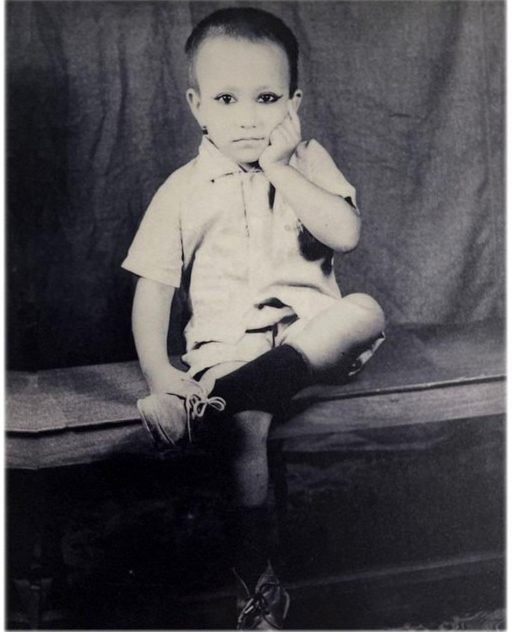
A young Sapana Pradhan. Photo: Courtesy of Sapana Pradhan Malla ![]()
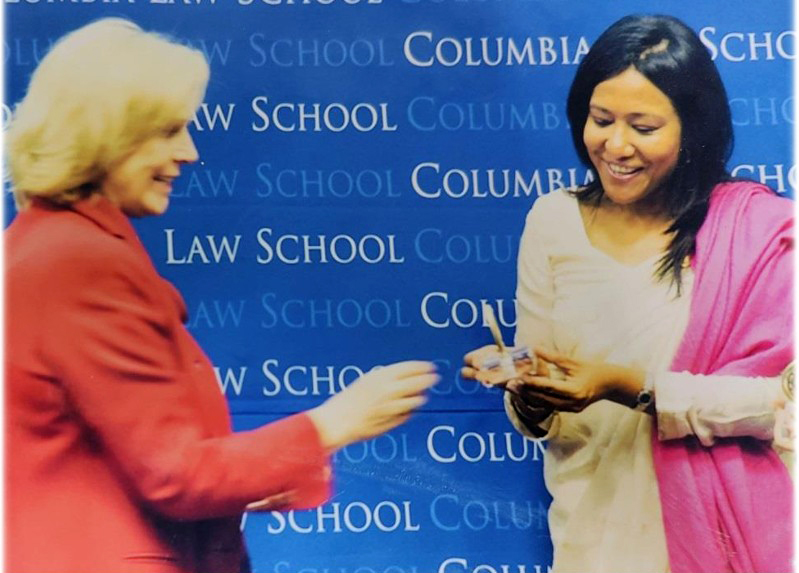
Malla at Columbia Law School. Photo: Courtesy of Sapana Pradhan Malla ![]()
Malla during her years as a pioneering advocate and human rights activist. Photo: Courtesy of Sapana Pradhan Malla ![]()
Malla (left) takes the oath of office as Supreme Court Justice. She was sworn in in August 2016. Photo: Courtesy of Sapana Pradhan Malla
Durga Dulal
Published at : April 16, 2026
Updated at : April 17, 2026 05:53
Kathmandu
Her parents named her Sapana not as a wish for her future but as a marker of their disappointment. Two daughters had already arrived in the family before her, in the village of Ramgram in Nawalparasi. By the time her mother carried a third child, the family had convinced itself that the longed-for son was finally coming. When he was not, when she was not him, they gave her the name that means the thing you want and cannot have: dream, or Sapana.
Sapana Pradhan Malla grew up knowing this. She has always seemed to find it funny, in the particular way that people find funny the things that drive them.
“That’s probably why my whole nature is a boy’s,” she said in a recent interview at her home. “I always made my gang with the boys.”
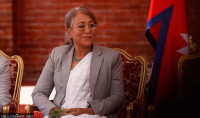
Malla is now the acting Chief Justice of Nepal's Supreme Court — the most senior judge in a country whose legal system she spent 30 years trying to reform from the outside before she was finally invited inside. The appointment came, as these things often do in Nepal, through a constitutional mechanism that is both precise and contingent: when Chief Justice Prakash Man Singh Raut retired, seniority dictated that the next in line assume the role of ka.mu., or acting, chief justice. If the tradition of appointing the most senior justice holds, Malla is the next in line. The formal process — a recommendation from the Constitutional Council, a parliamentary hearing, a presidential oath — remains incomplete, delayed by the council's unfinished composition. In the meantime, she leads. Nepal’s judiciary has had a woman at its helm only once before, when Sushila Karki became chief justice in 2016.
She was born on November 15, 1963 to Govinda Bahadur Pradhan and Radha Pradhan. If the story of her naming tells you something about the Nepal she came from, then the story of her childhood tells you something about what she decided to do about it. She was a child who did not accept instructions she found unreasonable. While the girls around her wore ghaghar and chaubandi choli, she wore t-shirts and trousers. Once, she went to a local fair in her usual clothes; someone informed her father, and when she came home, he beat her for it. That did not change how she dressed.
“Even then, I felt that I had to rebel,” she says. “I should have been able to wear what I wanted — and I did.”
The incident appears, unremarkably, in Simran Napit's biography of her, Judiciary's Dream: Sapana, as one data point among many in a childhood organised around a single principle: that the rules, if they were wrong, were there to be broken. She also noticed, early, how the women who worked in her own household were treated differently from everyone else, and she said so. She was not the kind of child who stored these observations quietly.
Malla told her family she wanted to study law — not with any particular case or injustice in mind, she has said, but just with a sense that this was the shape of her ambition. They agreed. She completed her schooling at Nepal Adarsha School in Kathmandu, then enrolled at Nepal Law Campus under Tribhuvan University, where she joined a group of seven women who moved through the programme together from the Intermediate Law years all the way through the Bachelor of Laws. Her classmate Shashi Adhikari, who later joined the campus as a professor, remembers a woman who was impossible to overlook: tall, socially magnetic, quick to befriend anyone, and equally quick, when the situation required it, to face down boys who needed facing down.
“She was equally active in academics and extracurricular activities,” Adhikari recalls. At a college oratory competition, Malla placed first and Adhikari placed second. She also danced well and received open admiration for it. She did not, despite the admiration, make romance a priority — her eye, even then, was on the career.
She was also a serious reader — not only of law but of novels, which she consumed at a pace she describes, with some amusement, as an addiction. After school ended and college began, she fell into the habit of reading two novels a week. Her first preference was Sidney Sheldon — his thrillers with their legal undercurrents, their women at the centre of the plot, heroines and villains both. She read The Other Side of Midnight, If Tomorrow Comes, Master of the Game. It was Rage of Angels — its mixture of law and love, its female lawyer protagonist navigating a world built against her — that she says pointed her toward the profession from the inside.
“It was this novel that inspired me, from somewhere deep inside, to study law and become a lawyer,” she told Kantipur. She also read Diamond Shamsher’s Seto Bagh and Basanti, the Ramayana, the Mahabharata, the Gita. The reading was voracious and undiscriminating in the best sense — she was trying to understand the world before she had the tools to change it.
The law campus library, she now says, was limited — a few books by Nepali authors, whatever notes the teachers provided, not much else. “Our only source was whatever notes the teacher gave us,” she told Kantipur. “There were some books by Nepali writers. The library had a few things, but it was restricted.”
It was only when she reached Delhi University — selected as one of four Nepali students, alongside Prakash Mani Sharma, Narayan Belbase, and Upendra Acharya — that she understood what a library could be. Walking into Delhi's stacks, seeing shelves of books by authors she had only heard of, she felt a sudden vividness: a flash of her Nepal Law Campus days and everything that had not been available to her there.
“I only understood the importance of a library after I reached Delhi University,” she told Kantipur. “Seeing their library and books, I would suddenly remember the days at Nepal Law Campus." Senior advocate Sharma, who made the journey to Delhi alongside her, remembers her academic seriousness. “She was excellent in her studies,” he said. “Going straight from Delhi and then making it all the way to America to study — that is her ability.”
Marriage arrived, as it did for women of her generation and background. By the time she finally agreed, she had been deflecting for some time, partly because the man she had quietly cared for told her that marrying him would not obstruct her studies. Ashok Bahadur Malla was from a Nawalparasi Newar family settled in Kathmandu. When she married, she moved from being her parents’ youngest daughter to being her new family's eldest daughter-in-law, a role that carries its own set of instructions. Three months later, she told her new family she was leaving for India to do a Master's degree. Her mother-in-law asked who would manage the household in her absence. Her father-in-law answered: before she came, he said, they had managed by themselves, and they would manage again. Her husband stood beside her.
“I feel that the inspiration my father-in-law gave me is the reason I have reached where I am today,” Malla told Kantipur. “Whenever something good happened to me, the first person to be happy and give me encouragement was my father-in-law.” It is the kind of tribute that contains, quietly, a whole social argument: that behind the woman who dismantled discriminatory laws was a man in her own home who never applied them.
At Delhi University, where she completed her Master’s in Law, she encountered the work of Professor Upendra Bakshi and his framework of Social Action Litigation — the argument that courts interpreting constitutional rights must play an active rather than passive role, must lean into the text rather than away from the case before them. It was, in retrospect, exactly the right idea at exactly the right moment in her formation. She returned to Kathmandu, had a son, and then left him — at eighteen months — to spend three months in Italy training in International Development Law. The picture that emerges from this period is of someone arranging and rearranging the furniture of an ordinary life in order to fit an extraordinary amount inside it.
Her first stop after returning from Italy was the chambers of senior advocate Krishna Prasad Bhandari — “Guru Dev,” as she and others called him — where she arrived, by his own account, with a quality he had not quite seen before. “When she came to me, she was very curious and had the courage to say she could do anything,” Bhandari told Kantipur. “She had a drive to make something of herself, and her knowledge of corporate law was already deep — perhaps because of what she had gained at Delhi University. I always found her someone who wanted to learn at the highest level.”
Sharma, who worked alongside her during this period, saw the same quality from a longer vantage point. “From India to Nepal, I have had the opportunity to work with her,” he said. “Throughout that time, I have only ever been impressed by her. I have always found her as a lawyer full of enthusiasm and energy — and as a judge, I have seen that she is excellent there too.”
She eventually opened her own firm, Development Law Associates, appearing in court on joint ventures, labour law, and industrial relations. “I was legal advisor to the Hotel Association of Nepal, lawyer to many of the prominent hotels, the go-to advocate for contract law,” she recalled. “I was earning significantly more than my contemporaries. My law firm was counted among the ones that were doing well.” The money was good. The reputation was growing. And it was not enough.
The shift, when it came, came from the inside, and it did not go down easily. In a society where the law had long been understood as a man’s province, a woman making forceful inroads into its most contested spaces attracted a particular kind of resistance. She was labelled an NGO-karmi — an NGO worker — the term deployed, in Nepal of that era, as a way of diminishing the seriousness of what she was doing, of suggesting that her advocacy was fashion rather than conviction. Her decision to sit in the Constituent Assembly in 2008 as a CPN-UML proportional representative added another layer to the perception — one that has never entirely dissolved. Whether her rulings from the bench reflect the law or the politics of her past is a question that often resurfaces, reliably, whenever her name enters public debate. It resurfaced most recently when she was named acting Chief Justice. Perception in Nepali society, especially for those in public life, has a long memory.
Malla is aware of all of it. During her interview with Kantipur, she addressed these episodes directly — the cases, the labels, the questions about judicial activism — and offered her own account.
She began filing public interest writs alongside colleague Meera Dhungana, targeting laws that discriminated against women. Through systematic research, she found there were 118 statutes containing provisions that treated women as legally inferior: in citizenship, in employment, in the right to work abroad. The law, she understood, was not a neutral instrument. It had been written by men, for men, calibrated to a world they intended to keep. In 1995, she and Dhungana co-founded the Forum for Women, Law and Development, which became the institutional base for what followed.
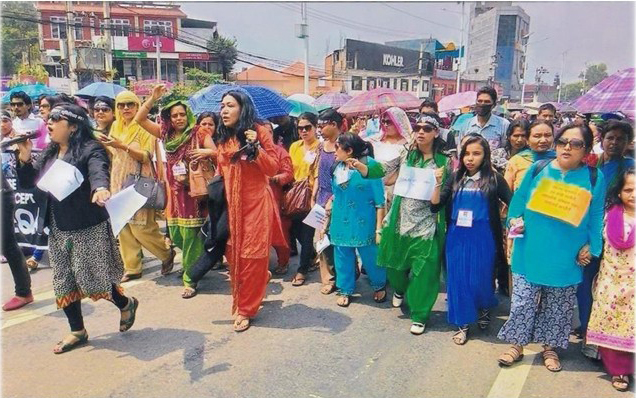
Their partnership had begun in 1993 with a writ arguing that daughters deserved equal inheritance rights — Dhungana as petitioner, Malla as the force driving it forward. More cases followed, and by 1995, they had decided that working case by case was no longer enough. “At first, we were just supporting each other’s cases,” Dhungana told Kantipur. “Then Sapana Didi said we should move forward in an organised way — and that is how FWLD was born. Looking back now, we were able to fulfil the dream we had seen at that time. Her role in that was central.” Over the years that followed, Dhungana describes herself as a fellow traveller, with Malla always out front. Even during her years in the Constituent Assembly, Malla would periodically return to provide direction. “Once she committed to something,” Dhungana told Kantipur, “she was like water — she would not stop until she had reached her destination.”
The inheritance writ resulted in a Supreme Court ruling establishing equal property rights for daughters, including married ones, with a directive to Parliament to legislate within a year. The backlash was considerable; the praise, at the time, less so. Advocate Sabin Shrestha, who worked alongside Malla at FWLD, believes that the gradual social acceptance of daughters’ property rights in Nepal today traces directly to that ruling. He also saw, up close, what drove her.
“I can never forget her dedication to work, her desire to teach others, and her ability to give encouragement and build confidence,” he told Kantipur. “That is probably what made her successful.” The office, he recalls, ran late into most nights. “When she was there, we would be in the office every day until late at night, discussing and arguing. From the cases to the respect for the work itself, she has always been my inspiration.”
Then came marital rape — an argument, in an era when domestic authority resided almost entirely with men, that rape within marriage was rape. The court agreed. The government legislated three-to-six months’ imprisonment. Malla kept going, lobbying for amendments, until the penalty was raised to five years. Dhungana, who lived through the campaign alongside her, is clear about whose persistence drove it. On both the marital rape and inheritance cases, she and Malla faced hostility that went well beyond op-ed disapproval.
“The commentary went as far as saying that after marriage, a husband would now need to do paperwork and inform Malla and Dhungana before entering his wife’s room,” Dhungana told Kantipur. “We also had to endure accusations of trying to break up families, of inciting society, of spreading negativity.” What strikes Dhungana, looking back, is not the criticism itself but Malla's response to it — or rather, the absence of one. She did not flinch. “That ability, to remain completely unshaken and bring others around to her position, is something I still admire,” Dhungana said.
Her advocacy on abortion rights brought her to the threshold of the CEDAW Committee — and then stopped her there. She ran for a seat, lost, and has reflected on the defeat with characteristic pragmatism. “At the time, we didn’t have enough time to prepare well and we lost,” she told Kantipur. “But even in that loss, there was a benefit. My candidacy became the foundation that helped Bandana Rana win later. Because I had been the first to go, the ground was already laid.” She was not, she says, discouraged. “Because it was my first participation on an international stage, I did not feel disheartened.”
She continued regardless, working through shadow reports and international networks. In September 1995, she attended the Fourth World Conference on Women in Beijing, and came back sharpened by a particular discomfort: while delegates from developed countries debated political representation and LGBTQ+ rights, the issues facing Nepali women remained achingly foundational — property, education, citizenship, the right simply to exist on equal legal ground.
Her entry into the Constituent Assembly under the UML’s proportional representation quota—as an expert rather than a party member—brought her in to help write the constitution she had spent years trying to reshape from the outside. She served on the Constitutional Committee, pressing hard for gender equality provisions, proportional representation, and the formal inclusion of women, Dalits, indigenous nationalities, and other marginalised communities in the structure of the state. The first Constituent Assembly dissolved in May 2012 without producing a constitution. She returned to practice and decided she would not serve a second term.
“I felt that politics was not my profession or my desire,” she told Kantipur. “Whatever I was able to do as an expert in the first Constituent Assembly felt sufficient for me. And so I returned myself to law.” When the constitution was finally promulgated in September 2015, the provisions she had fought for were in it: inclusivity, women's rights, and the guarantee of 33 percent representation for women in state structures. “That made me very happy,” she said. It was, in its way, a different kind of verdict — one she had argued for without being in the room when it was finally delivered.
Around this time, a friend suggested she apply to Harvard University. She worried her English was not good enough. She applied anyway. Harvard awarded her a full international fellowship, and in 2014, at fifty, she enrolled in the Master's in Public Administration program. She has described the experience with a characteristic economy: learning has no age. More concretely, she says Harvard taught her two things — how to build networks effectively, and how to negotiate. She returned to Nepal and continued working, now also as an elected member of the United Nations Committee Against Torture, serving from 2014 to 2016. The position was unpaid. It was not, she says, unimportant. “Being a special member of CAT was an extremely important learning experience, one that became valuable to me after I became a judge,” she told Kantipur. “I have been able to carry many of those lessons into my rulings. There I gained knowledge not only about crimes in developing countries but also in developed ones — how crime advances alongside development, and how it must be addressed.”
Former Chief Justices Kalyan Shrestha and Sushila Karki were among those who approached her about joining the Supreme Court bench. She recognised, she has said, that this was where she belonged. In February 2013, she received the designation of Senior Advocate; in Feburary 2017, her name was among eleven recommended for permanent appointment to the Supreme Court. A parliamentary vacancy delayed the appointment by six months. She was finally sworn in in August 2016 and took her seat on a bench she had spent years arguing for.
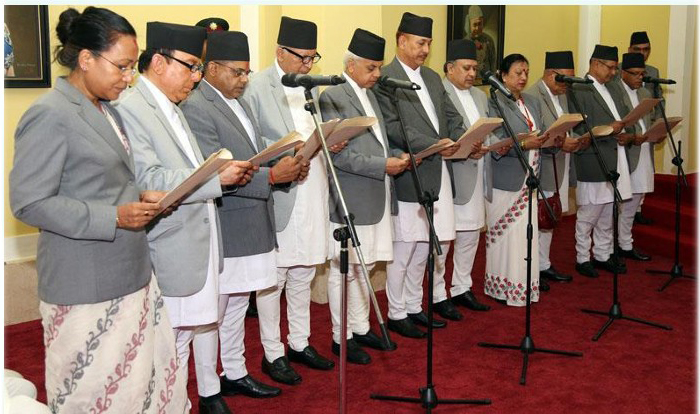
When Sushila Karki faced parliamentary scrutiny over Malla's appointment — critics questioning whether elevating a former CPN-UML proportional member amounted to bringing politics into the judiciary — Karki was unequivocal. “Sapana is a capable woman,” she told the hearing. “Whatever credit or blame comes from appointing her as a judge, I am ready to take it.”
The range of her jurisprudence since then is, her colleagues say, the thing that surprises people who expected her to adjudicate primarily on gender. Justice Abdulajeej Musalman, who has known her since her advocacy days and has sat with her on the bench, says that in practice, he has never felt she brings any single-issue orientation to the work. Her knowledge of international law, environmental law, and human rights goes genuinely deep, he says, and her insistence on writing her own judgments, on always finding the international reference, on leaving no question in a ruling that she could have answered, produces in him something he describes as enviable restlessness: why don't I do that?
“Sitting together on the bench, I found myself influenced by many aspects of her work,” he told Kantipur. “Her understanding of cases, the way she prepared to convince both sides in argument, and her habit of writing her own judgments — all of it was deeply inspiring.” Justice Srikant Poudel, who knew her before the bench, speaks of a judicial mind that grasps a case quickly and holds it completely. “I came to see her as a judge who approaches cases with clarity, who listens to every side before arriving at a decision, and who believes, fundamentally, that justice must follow a full hearing,” Poudel said. Among her notable rulings: the Fewa Lake conservation order, a decision granting voting rights to Nepalis living abroad, and a ruling invalidating the dissolution of the House of Representatives.
In 2020, she and Justice Manoj Kumar Sharma granted bail to Prithvi Malla — no relation — accused in the drunk-driving death of Leela Devkota, a forty-year-old woman who had been walking on a footpath when his car struck her. Bail was set at Rs 500,000, on grounds of health risk and COVID-19 exposure. When Prithvi subsequently left for the United States, the criticism of the bench was fierce. What Malla has said since is that the decision was narrower than its critics allowed. “There had been a compensation agreement between the victim and the accused,” she told Kantipur. “And at the time, during Covid-19, there were broader decisions being made to release detainees. This was one such order. It was misrepresented and criticised. It was not a final verdict — only an interim, procedural order.”
In a constitutional bench ruling on the appointment of 52 officials through ordinance — bypassing parliamentary hearings, under then-Prime Minister KP Sharma Oli — she wrote a concurring opinion aligning with judges who upheld the appointments. Critics called it deference to executive power.
“It was an opportunity to end the bypassing of parliamentary hearings and the misuse of ordinances,” said Balaram K.C., former justice. “The Supreme Court squandered this opportunity.”
Malla has pushed back on that characterisation. “I presented my reasoning as I saw it, in accordance with the law,” she said. “Every judge on the bench is free to express their own view, and that is what I did. This was not the first time I have written a dissenting opinion. There have been many before.” In February 2023, her bench removed conditions imposed on cricketer Sandip Lamichhane — including a prohibition on foreign travel — while he faced charges of raping a minor. He was subsequently acquitted by the High Court.
When asked how a judge holds the tension between her convictions and the cases before her, her answer is consistent. “In any case, there are two sides,” she said. “Both cannot win. The one that loses is dissatisfied — and criticism follows. I have learned to take it that way.”
Beyond all of it — the cases, the campaigns, the criticism — there is another, quieter rhythm to her life. Her office at the Supreme Court is full of plants: green things in careful pots, on every surface, as if she has decided that the environment in which justice is administered ought itself to be alive. She golfs. She goes to the gym. She cooks at home when she can. She goes back to the village for Dashain and Tihar, sits with family and relatives, and is happy there. Her colleagues speak of her saris with specific admiration, and she herself says that a sari produces a different confidence, a different presence, that other clothes do not. “Even as a judge, I am a person of this society,” she told Kantipur. “Someone's wife, someone's daughter, someone's daughter-in-law. I try to play those roles successfully, too.”
She was named for a dream that was really someone else’s disappointment. She has spent her life making that distinction irrelevant. She is now, in the formal terminology of Nepali constitutional law, ka.mu. chief justice — acting, provisional, pending the completion of a process. The word implies temporality. Malla knows the weight of what she carries does not.
Durga Dulal
Durga Dulal is a journalist associated with Kantipur Daily, covering law, justice, and constitutional affairs.

Most Read from National
NEB publishes Class 12 results, 64.13 percent secure grades
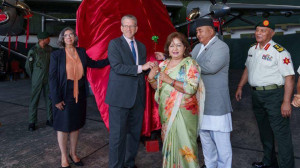
After months of debate, Nepal finally agrees to accept six US Bell helicopters
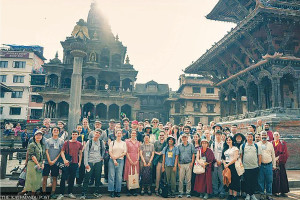
Buddhism studies drawing international students to Kathmandu
Beijing raises concerns over US initiatives in Nepal
Passport procurement under scrutiny as antigraft body arrests four
Editor's Picks
Inside the mission of Everest’s first mountain rangers

Weak arbitration defence costs government billions

Nepalis making treacherous trip to Europe through the Balkan route

Women are often at the centre of Nepali films. Why are men still telling most of their stories?
What old newspapers reveal about Kathmandu’s World Cup fever in the 80s and 90s
E-PAPER | June 30, 2026

×