High-altitude chauri festival draws crowds despite harsh conditions
The festival in remote Panchthar overcomes poor weather and access challenges, attracting record visitors and boosting local livelihoods. Laxmi Gautam/TKP
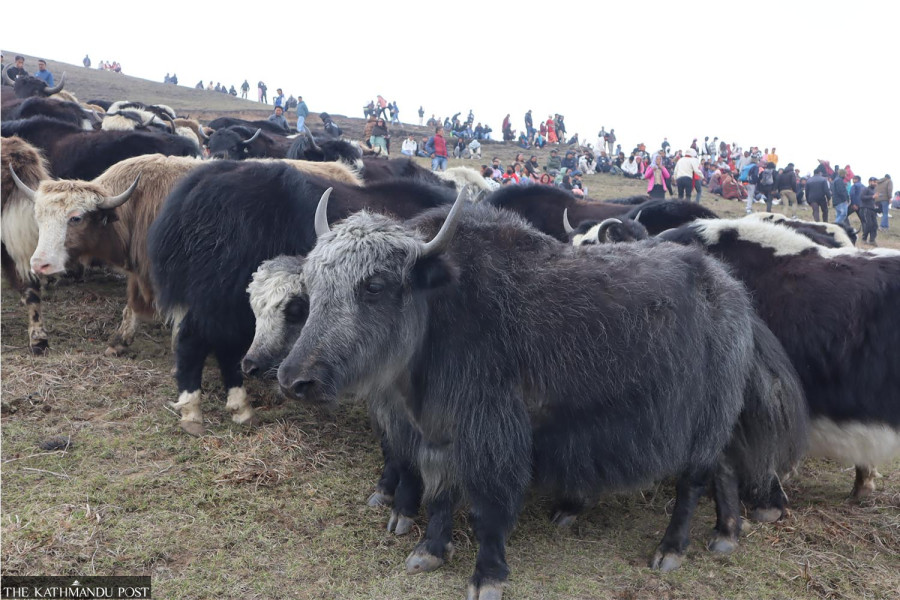
One moment, there is sunshine; the next, a blanket of ground mist. In this high-altitude wilderness, far from human settlements, hundreds of chauris—a hybrid of yak and cow—graze across open pastures. The steady clanking of the bells around their necks fills the air.
Amid shifting weather—sunshine giving way to mist, fog and rain—hundreds of tourists arrived in Charrate of Phalelung Rural Municipality-4 on April 13 to welcome the New Year 2083 the following day. Despite the adverse conditions, the Chauri Tourism Festival in this mountainous region drew a turnout beyond expectations.
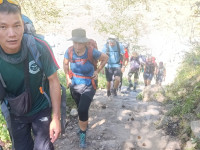
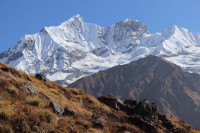
Nimesh Baidya from Damak, Jhapa, and Sudhan Rai from Dharan, Sunsari, arrived at the festival to ring in the New Year alongside 65 motorcycle riders from various parts of the country. They aimed to participate in the festival and observe the colourful chauris set against lush meadows and the Himalayan peaks to the north.
The group of youths, part of the ‘Bullet Gang’ affiliated with the bikers’ group Nepali Bullet Riders, included travellers from Pokhara, Hetauda, Sindhuli, Dharan and Butwal. Anish Chamling from Gangtok, Sikkim, in neighbouring India, also arrived alongside 40 Bullet bikes. Having reached Phalelung on April 13, riders from Nepal and India toured the Phalot and Charrate areas on April 14 before returning to their respective destinations on the morning of April 15.
Reaching Charrate, which borders West Bengal in India, takes an arduous journey. Travellers must navigate slippery trails where snow has only recently begun to melt. “Crossing the hilly and Himalayan roads was no small feat,” Baidya said. “There was still snow in some places and mud in others. At times, we wondered if we would make it. But we mustered our courage and pushed on.”
Situated at an altitude of around 3,450 metres above sea level, the region draws thousands of visitors during the Chauri Festival held around the Nepali New Year. This year marked the ninth edition of the festival, held from April 13 to April 15.
The area saw continuous snowfall until April 12, but the weather cleared from the afternoon of April 13 until the morning of April 14. However, Rai said conditions worsened again later. “Wrestling with fog, mist and rain to reach these high hills was an adventure in itself,” he said. “Driving along narrow, unpaved roads and finally arriving here felt like stepping into heaven.”
Although the road from Phidim in Panchthar to Barbanjyang is blacktopped, the route onwards through Prangbung to Charrate remains gravelled. Yet the difficult conditions did not dampen the enthusiasm of visitors. Tourists who braved the journey spent the clear morning hours watching the chauris. Niskal Chhetri, who travelled from Pokhara, said visitors took photographs with the animals, enjoyed yak rides and explored stalls featuring chauri-based products.
For organisers, managing the festival was equally challenging. This year, it snowed until the second week of April, said chauri herder Chandralal Nepal. “The road to the mountainous region was difficult, and as the weather had not fully cleared, we were uncertain how many people would turn up on New Year’s morning,” he said. “Despite these challenges, nearly double the number of tourists arrived compared to last year.”
The journey to Charrate from Phidim, the district headquarters of Panchthar, spans nearly 60 kilometres. While the section near Barbhanjyang is paved, the rest is a dirt track. With sharp bends, steep ascents and descents, and roads too narrow for two vehicles to pass each other, the journey remains risky. Nevertheless, Bir Bikram Thamsuhang, chair of Phalelung Rural Municipality, said he was excited with the turnout this year.
According to Thamsuhang, the Chauri Tourism Festival began in 2017 after chauris and their herders faced the threat of extinction. Since then, both the chauri population and the number of farmers have increased, boosting the promotion of chauri-based products.
Ram Chandra Gurung, a leading chauri farmer in Phalelung, said there were only 18 chauri sheds before the festival began. That number has now risen to 31. The chauri population, once around 200, has now exceeded 600, leading to increased exports of ghee and chhurpi, a hard cheese.
“Previously, we only made ghee and chhurpi from chauri milk; now we have started producing cheese as well,” Gurung said. Since the festival began, provincial and federal government grants have reached the chauri sheds. Farmers have had opportunities to visit sites in India and Bhutan. The Bhutanese government even gifted two yaks for breed improvement.
While Phalelung Rural Municipality is the main promoter, the festival is organised by local chauri farmers. Thamsuhang said the festival has remarkably contributed to conserving and promoting the declining chauri population. By showcasing mountain lifestyles and chauri culture to a wider audience, the event has become a milestone for tourism in Charrate.
Thousands attend the annual festival, and researchers from universities in Nepal, India and other countries have started visiting to study chauris. “This is a matter of pride for us,” Gurung said.




 19.72°C Kathmandu