At least 44 people die, and 184 people get infected with TB daily. Authorities are unaware of the whereabouts of 2,000 patients with drug-resistant TB.An untreated TB patient may infect 10 others in a year, say doctors. Shutterstock
Nepal is nowhere close to controlling tuberculosis, as 16,000 people die a year and 67,000 get infected, according to new data from the National Tuberculosis Control Centre.
The country has committed to stopping the spread of TB through the WHO END TB Strategy by 2035 and eliminating the disease by 2050.
To achieve this, the new infection rate must be brought down to 10 per 100,000 by 2035 and to 1 per 1,000,000 by 2050. Both targets seem impossible given the current infection rates.
“Ongoing infection rates of tuberculosis are too high,” says Dr Bhuwan Paudel, director at the Centre. “Despite several efforts, infection rates have not declined. Tuberculosis remains one of the major public health problems in our country, from which thousands of people get infected every year.”
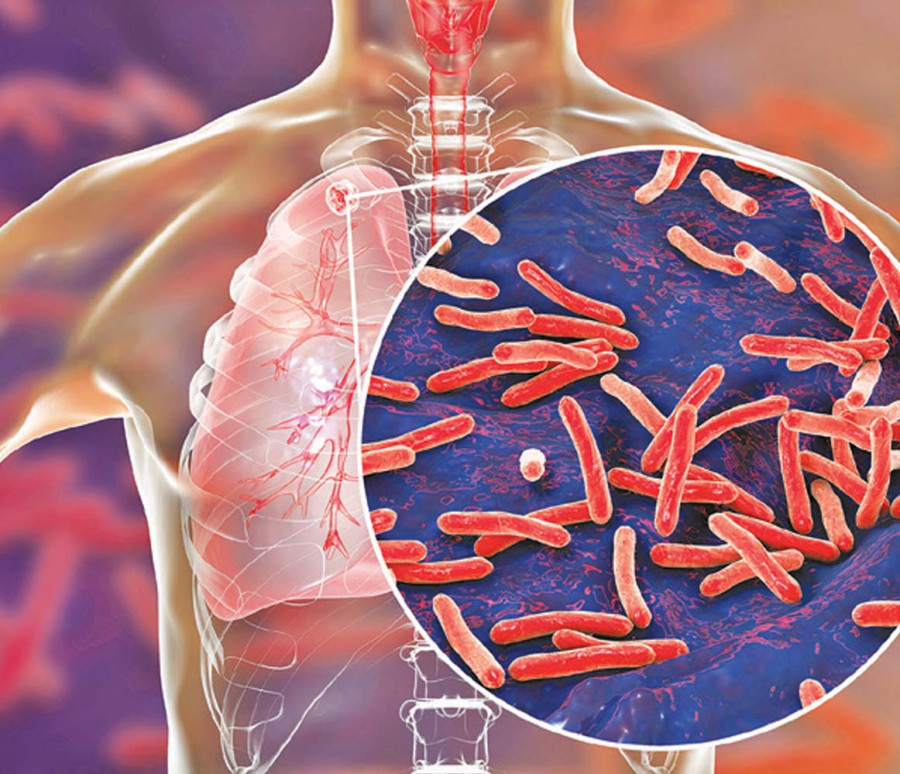
Tuberculosis, or TB, is caused by Mycobacterium tuberculosis, which most often affects the lungs. Although curable and preventable, TB kills at least 44 people a day in Nepal—or around 16,000 in a year. As many as 184 people contract the disease every day.
Data provided by the Centre on drug-resistant tuberculosis is even more alarming. Of the estimated 2400 drug-resistant TB patients in Nepal, only 419 have been receiving treatment.
Health authorities are unaware of the whereabouts of 2,000 drug-resistant TB patients, who risk spreading the drug-resistant TB in their communities.
According to the World Health Organisation’s estimate, there were 67,000 new cases of tuberculosis in the country in 2024. Of them, health authorities could identify only 39,151 patients. Thousands of undiagnosed TB patients in the community mean a heightened risk of the deadly disease spreading, health officials say.
When TB patients cough, sneeze, or spit, they emit TB germs into the air, and a person who inhales even a few of these germs can acquire the disease. This makes tuberculosis difficult to contain, experts say.
“We are unable to identify around 28,000 TB patients and around 2,000 drug-resistant TB patients,” said Dr Naveen Prakash Shah, chief consultant and chest physician serving at the Centre. “Failure to identify TB patients and patients not continuing medicines both are riskier as they unknowingly spread the disease.”
Doctors warn that if patients stop taking their medication, the drugs may no longer work.
The treatment success rate of drug-sensitive TB with the first-line TB drugs is 92 percent while the treatment success rate of multidrug-resistant TB is only 76 percent.
According to government data, Madhesh province has the highest TB case load at 25 percent, followed by Bagmati 23 percent, Lumbini 20 percent, Koshi 12 percent, Sudurpaschim 8 percent, Gandaki 7 percent, and Karnali 5 percent.
Public health experts have repeatedly warned that TB patients discontinuing their medication could lead to a major public health disaster.
Nepal started providing TB treatment some 85 years ago, but the disease remains a major public health burden. The National Prevalence Survey 2018-19, carried out with technical and financial support from the World Health Organisation, estimated 117,000 TB patients in Nepal. Officials admit that Nepal was not on track to meet the target in 2019 nor in 2026.
According to the World Health Organisation’s Global Tuberculosis Report 2021, every year 10 million people contract the disease. The UN health agency says around 1.5 million people die globally every year from TB, making it the world’s top infectious killer.




 17.29°C Kathmandu