Monsoon looms, but repairs on landslide-prone Tuinkhola slopes still pending
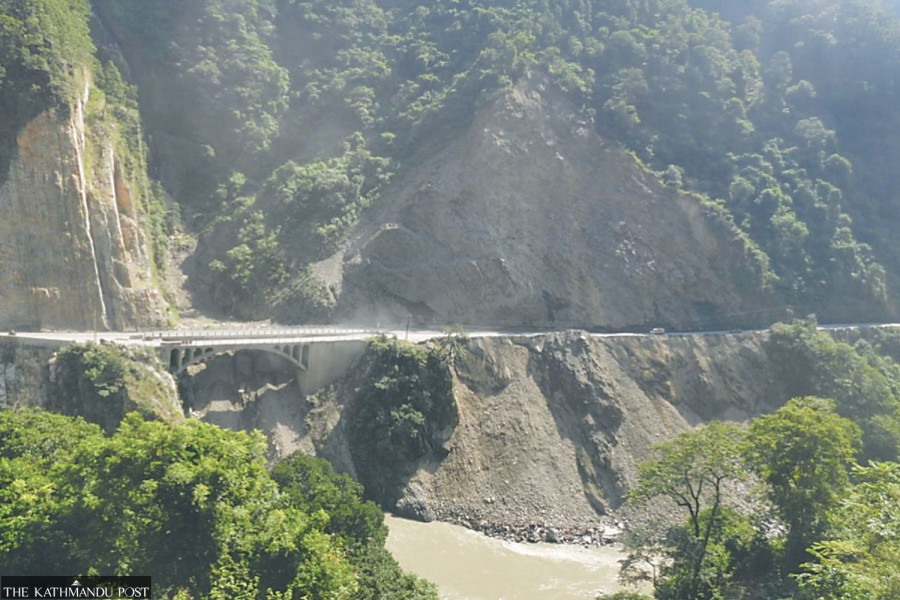
Last year, this section along the Narayanghat-Mugling road, a vital link to the Capital, was blocked for 184 hours. The landslide-prone Tuinkhola section pictured recently. A muddy Trishuli River is seen in the foreground. POST PHOTO
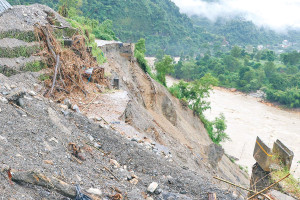
The haunting echoes of falling boulders have returned to the Tuinkhola section of the Narayanghat-Mugling road, reigniting fears of a repeat of last year’s monsoon chaos. Despite the dry winter offering a prime window for preventive engineering, the slopes remain dangerously exposed. As the pre-monsoon showers arrived here on Friday, the familiar sound of falling debris forced the Road Division Office to deploy heavy machinery to clear the tracks, signaling a grim prelude to the rainy season this year as well.
The Tuinkhola stretch, a lifeline connecting the national capital, Kathmandu, and the tourist hub of Pokhara to the rest of the country, has become a symbol of topographical fragility and administrative inertia. Last year, landslides here blocked the road for a total of 184 hours. The most severe incidents occurred in late September, when two landslides shut down the highway for 46 and 58 consecutive hours respectively, stranding thousands of passengers and crippling the national supply chain.
For local stakeholders and regular commuters, the sight of two newly installed floodlights—intended to help monitors spot falling rocks at night—is a poor substitute for structural reinforcement.
The commuters—both the passengers and transportation workers—complain that they have to risk their lives while travelling along this road section. They accuse the authorities of not paying any heed to resolve the problem.
The Road Division Office on Sunday installed two flood lights in the Tuinkhola area so the commuters can see falling rocks thus avoiding any untoward incidents. But the stakeholders complain that it is too less as a preventive measure. "The government always says the necessary budget has been allocated but where are the workers? These lights won't stop a landslide; they will only show us the rocks as they crush us,” said a truck driver commuting along the route.
Technical assessments by the Department of Roads have identified that the 165-metre-long landslide zone in Tuinkhola, reaching 105 metres up the vertical cliff, requires urgent ‘rock anchoring’ and ‘rock netting.’ These methods involve drilling steel rods into the stable bedrock and draping high-tensile wire mesh over the loose surface.
Narayan Prasad Lamichhane, chief of the Road Division Office in Bharatpur, said that while a budget of Rs 250 million has been secured for a two-year period, field operations remain stalled in paperwork. "The budget assurance from the Finance Ministry reached us in mid-January. We submitted the Master Procurement Plan in February, which is currently awaiting final approval from the Ministry," said Lamichhane. According to him, the division office would invite tender soon after the approval of the procurement plan.
The delay is particularly concerning given the timeline. Even if the tender is published this week, the legal procurement process means a contract might not be signed until May. "By the time a contractor mobilises, the monsoon will be at our doorstep," warned Arjun Ghimire, an engineer at the Road Division Office. "Before we can even start netting, we must clear the 'loose fall'—unstable debris—which requires closing the road entirely during the day. It is a race against time we are currently losing,” said Ghimire.
The Narayanghat-Mugling road is no stranger to such peril. The'unending ordeal' of this 36-kilometre stretch persists, or further worsens, even after the multi-billion rupee expansion project funded by the World Bank was completed in 2019. The hillsides remain unstable in various places along the stretch including in the Tuinkhola area. Geological experts earlier emphasised that the road's widening compromised the 'toe' of the fragile hills, making landslides an annual certainty rather than a risk.
Current data identifies 51 vulnerable spots along the Narayanghat-Mugling stretch. While Tuinkhola and Namsi are classified as 'extremely high risk,' nine locations are at high risk, 26 other locations are medium risk and 14 locations with minimal risks. Recent sightings of falling rocks near Jalbire suggest the instability is spreading.
"Every year it is the same story of 'study and wait'. The authorities wait for the winter to pass, and when the clouds gather, they start talking about tenders," said a local trader in Mugling.
It is the country’s busiest highway with more than 10,000 vehicles ply on a daily basis, including passenger buses and freight trucks. It is a vital artery connecting the national capital. Beyond the inevitable distress caused to commuters, the extended closure of such a thoroughfare adversely impacts the capital's supply system.
Landslides along this corridor are not new. After the road stretch was widened to two lanes in 2019, several sections became vulnerable to erosion and slope failures. The Tuinkhola bridge, completed in 2024, was one of 15 bridges constructed along the route to improve traffic flow. However, cutting into steep hillsides for these projects weakened slopes, triggering recurring landslides, mainly during monsoon seasons.




 19.27°C Kathmandu
1.jpg)