Settlements left vulnerable by rising leopard incursions
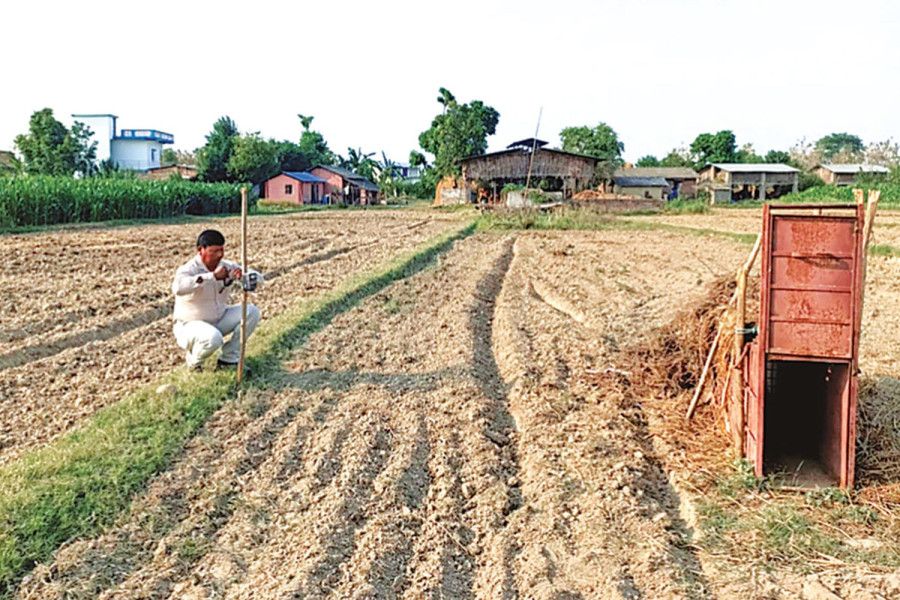
Collective anxiety shapes daily life across eight local units in Bardiya as eight people have been killed in less than a year. A cage set up to take control of leopards and a camera trap. POST FILE PHOTO: KAMAL PANTHI
In Bardiya, a western Tarai district of Lumbini Province, farmers once accustomed to solitary peace of their fields now refuse to step outside unless flanked by neighbours.
The local residents, especially in the rural areas, are in abject terror with a surge in leopard attacks that has transformed the villages into hunting grounds. Collective anxiety has reshaped daily life across the eight local units in the district.
Since the inception of the current fiscal year on July 17, 2025, eight people have been killed by leopards in Bardiya. The crisis is rife where the boundaries between the forests and human settlements have effectively vanished, leaving the local population vulnerable.
Ram Bahadur Tharu, a resident of Belbhar in Barbardiya Municipality-10, recalls a time when he walked his land alone without a second thought. “Until last year, I worked my fields alone,” said Ram Bahadur, a septuagenarian. “Now, we only go out in groups, taking turns to keep watch. I have lived seven decades, and I have never seen leopards this bold.”
Residents across wards 10 and 11 of Barbardiya are living in a state of profound terror this fiscal year as leopards have begun claiming lives in the settlements. “As soon as evening approaches, we rush indoors,” said Prem Kumari Tharu, a local. “The leopards have already taken our livestock. Now, we fear for our children. Sending them to school feels like a gamble with their lives.”
The casualties tell a grim story of a landscape turned hostile. On 24 December last year, Pabitra Dangi, aged 52, of Baidi settlement in Barbardiya-10 was killed while collecting fodder in nearby Phenapati Community Forest. Just four days earlier, Dinesh Chaudhary, aged 36, of Daphaiya village in the same ward was mauled to death near the Perehawa Community Forest. On January 20, Khidani Tharu, 62, of Barbardiya-12, was killed while harvesting mustard in her field. Gopi Tharuni, 63, of the same ward was also killed by a leopard in November last year.
Ram Gopal Chaudhary, senior forest officer at the Division Forest Office in Bardiya, said that the victims were often engaged in routine activities when the leopards attacked them. According to him, Nanda Bahadur Rokaya of Gulariya Municipality-4, Jagat Rani Tharuni of Gulariya-11 and Kabita Moktan of Gulariya-12 are others killed by the beasts. The most recent tragedy occurred on March 4, when six-year-old Aditya Tharu was snatched away by the leopard in Kalabanjar in Rajapur Municipality-10.
Eight people have been killed in leopard attacks so far in Bardiya this fiscal year while more than a dozen others sustained injuries. During the same period, two persons were killed by tigers and one by rhinoceros.
Conservationists point to a complex ecological shift behind the increasing human-wildlife conflict. Bardiya’s success in doubling its tiger population—reaching 125 in 2022—has had unintended consequences. Tigers, as apex predators, dominate core forest areas, pushing smaller, adaptable leopards to the fringes and into human settlements. This highlights how the success of one species can inadvertently endanger the local human population.
Ramesh Kumar Thapa, former chief conservation officer of Bardiya National Park, explains the displacement. “As tigers claim the prime habitat, leopards are forced out,” Thapa said. “They initially survived on stray dogs in the villages, but once that food source was exhausted, they turned to livestock. Now, with livestock secured behind fences, humans have become the next available target.”
The proximity to India’s Katarniaghat Wildlife Sanctuary adds complexity. Ajit Tumbahangphe, Bardiya chief of the National Trust for Nature Conservation, suggests that “problematic” leopards may be crossing the border. “Studies indicate that leopards facing prey scarcity or habitat pressure in India are migrating into Bardiya’s forests,” he said. “The lack of prey in these areas forces them into settlements.”
The local people staged demonstrations several times at the District Administration Office to control leopard menace. They express their dissatisfaction accusing the authorities concerned for ignoring their issues.
District Forest Officer Bijay Raj Subedi, however, insists that authorities are taking measures. “The current situation is exceptionally grave,” Subedi said. “We have already captured six problematic leopards this year. We are focusing on awareness programmes, installing power-fencing between forests and settlements, and improving natural habitats to keep wildlife away from humans.”
However, for the grieving families, the pace of intervention feels sluggish. During recent protests, locals expressed their desperation, with some shouting that if the government could not protect them, let the locals kill the beast themselves. Though there is not an official leopard count, it is estimated that around 100 leopards are in the national park and community forests in Bardiya.




 18.3°C Kathmandu