Breast milk banks to be set up in all seven provinces
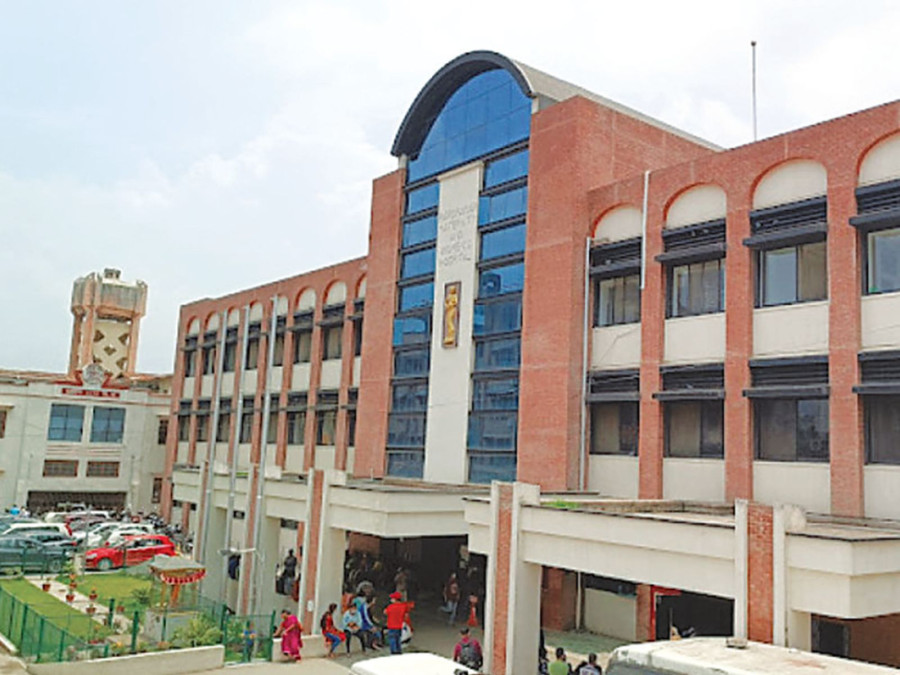
Officials say existing banks at Thapathali maternity hospital and Dharan’s BPKIHS have saved many vulnerable newborns. Paropakar Maternity and Women’s Hospital at Thapathali, Kathmandu, in this undated photo. POST FILE PHOTO
In a bid to provide breast milk to vulnerable newborns, the Ministry of Health and Population is working to set up human breast milk banks in all seven provinces. The United States government will provide the required funds, officials say.
“We have started the necessary preparations,” said Lila Bikram Thapa, chief of the Nutrition Section at the Family Welfare Division under the Department of Health Services. “We hope that setting up one breast milk bank in every province will help save newborn lives and also promote exclusive breastfeeding practices.”
Currently, the Thapathali-based Paropakar Maternity and Women’s Hospital, and BP Koirala Institute of Health Sciences (BPKIHS), Dharan have been running human breast milk banks. The hospitals have also been supplying the milk to vulnerable infants born in other hospitals.
Doctors say that human breast milk is required for high-risk newborns—those whose mothers died during or after giving birth, critically ill newborns in neonatal intensive care units, and premature babies with low birth weights.
The Thapathali hospital has been supplying breast milk to such infants in other hospitals, including Tribhuvan University Teaching Hospital, Patan Hospital, Norvic Hospital, and B&B Hospital, among others.
Doctors say the milk is collected mostly from mothers of ailing babies admitted to the intensive care units and cannot feed directly from the breast. The hospital provides milk only to infants weighing less than 1 kg.
According to doctors, human breast milk contains the best source of nutrition and ensures the survival and healthy growth of babies. It bolsters brain development and has lifelong benefits for both the baby and the mother. They say that human milk helps in reducing necrotising enterocolitis (NEC), a serious gastrointestinal problem that mostly affects premature babies.
The human milk bank collects milk directly from mothers of hospitalised babies. It also collects surplus milk from other lactating mothers. The milk is then tested, pasteurised and stored at minus 40 degrees Celsius.
The human milk bank, launched some three years ago at the hospital, aims to reduce neonatal deaths, which remains constantly high. Since 2016, neonatal deaths have not declined in Nepal despite various measures implemented by health authorities.
According to a recent report of the Nepal Multiple Indicator Survey 2024-025 carried out by the National Statistics Office in partnership with UNICEF from December to March shows, 17 neonates die in every 1,000 live births.
The government’s target for Sustainable Development Goals is to reduce neonatal mortality to 12 deaths per every 1,000 live births by 2030.
The SDGs, a follow-up on the Millennium Development Goals (MDGs), aim to end poverty, hunger, and all forms of inequality in the world by 2030. Nepal has committed to meeting the goals. The 16th five-year periodic plan, which ends in 2029, aims to reduce neonatal deaths to 13 from 21 per 1,000 live births.
The Ministry of Health and Population has launched various programmes, including hiring staff nurses to promote exclusive breastfeeding. Exclusive breastfeeding has the potential to prevent 13 percent of under-five deaths.
The Nepal Multiple Indicator Survey 2024-025 report shows that Nepal's exclusive breastfeeding rate is only 69.7 percent—urban areas 65.3 percent and rural 78.4 percent. It stated that 14.2 percent of children born in a health facility receive mixed milk feeding (breast milk and fresh, packaged, or powdered animal milk or infant formula).
Bottle feeding is not recommended, as the nipple on a feeding bottle is prone to contamination and increases the risk of diseases in children, according to the World Health Organisation.
Health officials are concerned that more educated and well-off mothers are less likely to breastfeed their babies, as studies show.
The report shows that the proportion of children who are exclusively breastfeed declines with mothers’ education—from 86.1 percent among mothers with no education to 65.6 percent among mothers with education up to grade 11-12.
Among the seven provinces of Nepal, exclusive breastfeeding rates are the highest in Lumbini Province 81.5 percent followed by Sudurpaschim 76.6 percent, Madhesh 72.3 percent, Karnali 71.6 percent, Koshi 66.1 percent, Bagmati 57.8 percent and Gandaki 56.3 percent.
Doctors recommend breastfeeding for the first two years of a baby’s life or longer, as breast milk lowers the risk of illness in children, promotes their recovery during illness, and provides important nutrients for healthy growth and development.
According to them, longer durations of breastfeeding have many health benefits for women, including reduced risks of certain breast and ovarian cancers and diabetes.
Nepal had committed to increasing the exclusive breastfeeding rate to more than 90 percent by 2030, but the rate declined from 70 percent in 2011 to 66 percent in 2016 and to 56 percent in 2022.




 19.72°C Kathmandu