



 14.81°C Kathmandu

Sat, Oct 24, 2026
Money
Adverse weather adds to informal workers’ stress in Kathmandu
New study warns extreme heat is worsening health risks, wage losses and food insecurity for migrant and informal workers in Nepal’s capital.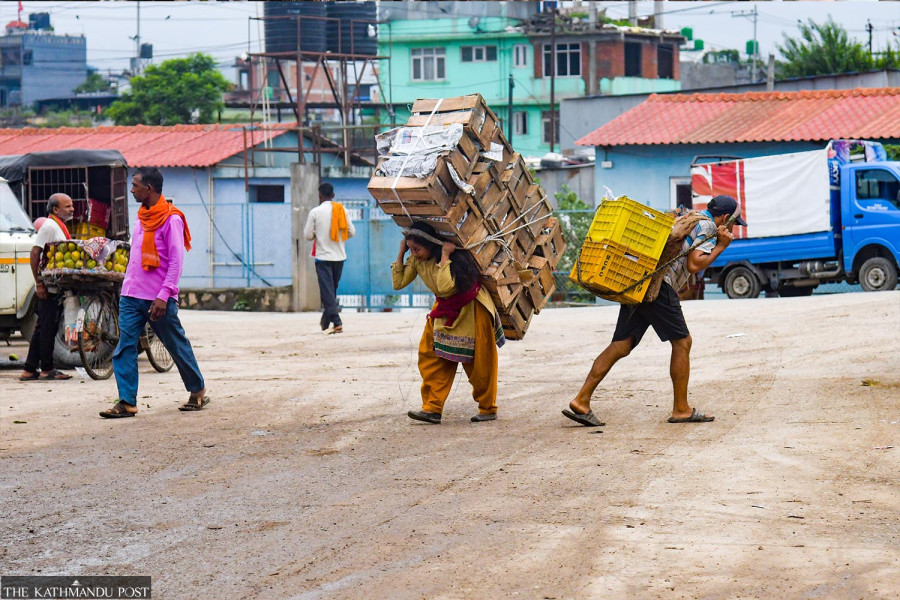
bookmark
Krishana Prasain
Published at : May 28, 2026
Updated at : May 29, 2026 07:01
Kathmandu
Suraj Thakuri, 55, was laying tiles on the top floor of a three-storey building in Tinthana, Kalanki, on Wednesday afternoon. Under the scorching sun, sweat poured down his face as he paused repeatedly to catch his breath.
For workers like Thakuri, extreme heat is becoming more than just seasonal discomfort. As temperatures rise and climate patterns shift, many informal workers in Kathmandu say they are struggling to cope with worsening working conditions.
Scientists warn that the return of El Niño could trigger extreme weather events across many parts of the world, leading to severe heatwaves, crop failures and food insecurity. In cities like Kathmandu, outdoor workers such as construction labourers, street vendors, delivery riders and farmers are among the most vulnerable.
“I used to work continuously for hours a few years ago,” said Thakuri, who came to Kathmandu from Rautahat three decades ago. “Now I need frequent breaks because I cannot stay under direct sunlight for long. It becomes too hot, I feel dizzy and I often get headaches.”
Thakuri, who supports a family of seven back in his village, says working conditions have become harsher every new season. “Even winters are difficult now, especially while plastering walls in the cold. I am getting older, and the weather feels increasingly extreme for construction work.”
Madhav Jogi, 45, who works at a scrap collection centre in Sana Gau, Lalitpur, says summer months have become unbearable inside the tin-roofed structure where he both works and sleeps.
“In summer the heat inside the hut becomes suffocating,” said Jogi, who migrated from Sarlahi to Kathmandu 15 years ago after floods swept away his land. “Some nights I cannot sleep inside because too many people stay there.”
Jogi previously spent seven years working in Kuwait but returned to Nepal due to health complications. He now earns a living sorting scrap materials.
For street vendors, rising temperatures are also directly affecting earnings.
Shanti Maya Rai, 37, who sells seasonal fruits, cucumbers and roasted corn on the cob around Lagankhel, says she can no longer work during the hottest hours of the day.
“I have been selling chopped fruits on the streets for 11 years,” said Rai, who moved to Kathmandu from Dhading 15 years ago. “But for the past two years, I have avoided working during midday because the heat has become unbearable, even though demand for fruits is highest at that time.”
“My income has dropped,” she added.
Rai also contracted dengue last year, which she blames on poor drainage and unmanaged waste in the city.
A recent study found that 46 percent of surveyed internal migrant and informal workers in Kathmandu reported being negatively affected by extreme heat.
The report, titled Hot Cities Make Hard Work Harder: Strengthening Health and Livelihood Resilience for Informal Workers in South and Southeast Asian Cities, was jointly published by People’s Courage International and the US-based non-profit Institute for Social and Environmental Transition-International.
The study surveyed 305 migrant workers in Kathmandu and conducted focus group discussions with 47 participants working in sectors including construction, transport, domestic work, home-based industries and street vending.
According to the report, workers in Kathmandu said they were increasingly affected by heatwaves and other extreme weather events that disrupted both health and livelihoods.
Daytime temperatures have exceeded 40 degrees Celsius in several places of Nepal, particularly the Tarai region, in recent days.
Environmental campaigner Bhusan Tuladhar warned that the situation could worsen in the coming years.
“I do not think Kathmandu Valley has yet crossed the 40 degrees Celsius [threshold], but the temperatures have certainly risen,” Tuladhar said. “Outdoor workers can reduce health risks by drinking water frequently and taking short breaks every half an hour.”
The report identified food insecurity as the most common household impact experienced by migrant workers during extreme weather events in Kathmandu, followed by loss of household assets and health-related problems.
It also found that wage loss was the most significant work-related impact, followed by wage cuts and job losses.
The study examined heat vulnerability and resilience among informal workers across five South and Southeast Asian cities—Delhi, Kathmandu, Dhaka, Jakarta and Quezon City. Researchers conducted 25 focus group discussions, 50 in-depth interviews and 50 key informant interviews alongside desk reviews and earlier worker surveys.
According to the report, 84.6 percent of Nepal’s workforce—nearly six million people—is employed in the informal sector. Many are rural-to-urban migrants who moved to cities seeking economic opportunities as rural livelihoods became increasingly unreliable.
The report warns that informal workers already living in precarious conditions face growing threats as rising temperatures push cities into unprecedented extremes. Despite forming a major labour force that drives urban growth and development, these workers often lack social protection, legal safeguards and access to healthcare.
The study highlights a major policy gap, noting the absence of legally binding protections and heat action plans targeted at informal workers.
“Without urgent action, informal workers already living on the fringes of society will continue to be pushed to the brink of survival by extreme heat,” the report states.
Among surveyed Nepali migrant workers, 56 percent said they received no assistance during extreme weather events in Kathmandu. Around 37 percent said they received emergency relief, while 23 percent said they had been forced to seek alternative jobs.
Researchers also warned that rising urban heat—made worse by hotter nights and the urban heat island effect—is reducing recovery time for vulnerable communities and intensifying health risks.
Unplanned urban growth, overcrowded housing, poorly ventilated workplaces and limited public services further amplify the impact of extreme heat on low-income populations in South and Southeast Asian cities.
The report notes that informal workers are on the frontlines of the climate crisis, particularly those employed in heat-exposed sectors such as waste collection, construction, manufacturing, street vending and digital platform work.
Unlike sudden disasters such as floods or landslides, dangerous heat is a slow-moving hazard that builds gradually and often remains invisible until it reaches catastrophic levels, the report says.
Researchers noted that 2024, an El Niño year, witnessed unprecedented global temperatures and warned that such extreme heat events are likely to become increasingly common in the future.
El Niño is a naturally occurring climate phenomenon characterised by warmer-than-average sea surface temperatures in the central and eastern tropical Pacific Ocean.
Forecasts from the National Oceanic and Atmospheric Administration indicate an 80 to 98 percent chance of a strong El Niño developing, with the possibility of a historically intense “Super El Niño” by late 2026.
Krishana Prasain
Krishana Prasain is a business reporter for The Kathmandu Post covering markets. Before joining The Kathmandu Post in 2018, she spent 3 years in New Business Age magazine covering business.




Most Read from Money

Why does an hour long flight to Dhangadhi cost more than a flight to New Delhi?
Nepal travel agents threaten to stop selling Thailand trips over visa rules
Malaysia rejects Nepal’s demand to open recruitment to all manpower agencies
No school, but a graduation cap for women dairy farmers
Nepal arrests four medical service providers as Malaysia recruitment row deepens
Editor's Picks




E-PAPER | October 24, 2026

×