Rupandehi’s continued urban sprawl comes at a cost for agriculture in the periphery
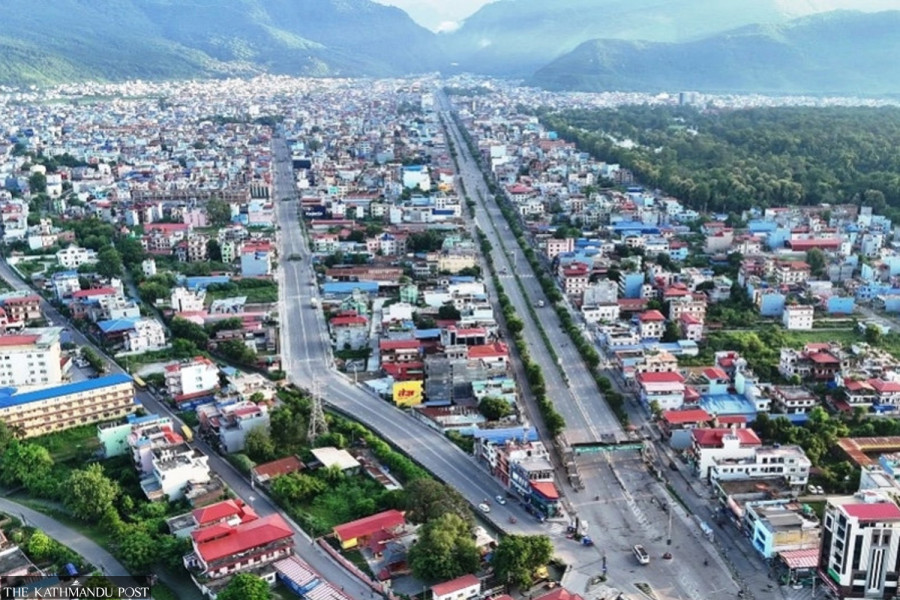
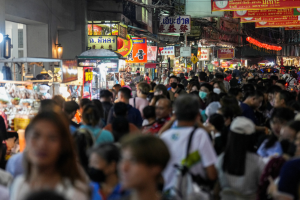
Expansion of roads, bridges and services has transformed farmland into an economic corridor, luring thousands of families from hill districts with jobs and opportunities.Rupandehi has seen rapid urban transformation over the past two decades. Ghanashyam Gautam/TKP
Two decades ago, much of the land that now hosts bustling markets, concrete homes and educational institutions in Rupandehi was fertile farmland. Today, that same stretch has emerged as a major centre of economic activity, reflecting the rapid urban transformation of the Butwal–Tilottama corridor in Lumbini Province.
What was once primarily agricultural terrain has gradually evolved into a hub of industry, trade, education and healthcare. In the past 15 years, the skyline has changed dramatically, with new residential buildings, private schools, hospitals and commercial complexes redefining the landscape. Urban expansion has steadily converted arable land into housing plots, industrial estates and service centres, signalling a structural shift in the local economy.
Rupandehi, home to Butwal and Tilottama municipalities, has positioned itself as a key economic base of Lumbini Province. Improved connectivity and expanding infrastructure have made the district a magnet for internal migration, particularly from the hill districts of Lumbini, Gandaki, Karnali and Sudurpaschim provinces. Families seeking employment, business opportunities and better access to education and healthcare have steadily moved to the plains.
Over the past decade, more than 21,000 families from hill regions have relocated to various parts of Rupandehi, according to local officials. In the last fiscal year alone, Tilottama Municipality recorded the settlement of over 1,000 new families. The 2021 national census also showed a significant rise in population density in Rupandehi, making it one of the fastest-growing districts in the country. The influx has been driven largely by economic prospects and expanding small and medium enterprises.
Infrastructure development has been central to this transformation. Roads, bridges, electricity supply, drinking water networks, irrigation systems, health institutions, schools and air connectivity have all improved markedly over the past 15 years. These investments have not only eased daily life for residents but have also accelerated commercial growth and real estate expansion.
Fifteen years ago, settlements such as Motipur and Semlar were considered remote extensions of Butwal. Residents depended on the East-West Highway and the Tinau bridge to reach the main market area. Motipur and Semlar were once jokingly referred to as “the shadow under the lamp” of Butwal, indicating their neglect despite being geographically close.
In the southern belt of Rupandehi, infrastructure was even more limited. There was only one bridge connecting Farsatikar to Butwal. During the monsoon, the Danav river would overflow, cutting off Tamnagar and surrounding settlements. Locals from Semlar had to travel long distances through Tamnagar to reach Butwal, as the absence of bridges over the Danav river posed regular obstacles.
Similarly, Manigram and Thutipipal residents relied heavily on the Tinau bridge as the only reliable crossing point. Today, however, the situation has changed dramatically. Motipur and Semlar residents now describe the Tinau bridge as merely an alternative route. Dozens of new bridges have been constructed over the Tinau, Danav and Rohini rivers, in some cases at intervals of less than a kilometre. What was once a logistical challenge has become a network of interconnected roads and crossings.
Kaziman Thapa, 72, of Buddhanagar in Butwal Sub-Metropolitan City–11 recalls the hardship of earlier years. Settled in Buddhanagar for over two decades, he says reaching central Butwal used to require a detour via the Mahendra Highway bridge.
“When the Tinau swelled during monsoon, we had no option but to take the highway bridge. It would take half an hour or more,” he said. “Only after the Devinagar bridge was built did Buddhanagar feel truly connected to Butwal.”
The Belbas–Bethari road project is now in its final stage of construction, further boosting east-west connectivity for the district. According to the Road Division Office, around 20 bridges have been constructed over the Tinau, Danav and Rohini rivers in the past 15 years alone. These bridges have reduced travel times, cut transportation costs and opened up previously isolated areas for residential and commercial development.
Improved connectivity has directly benefited farmers as well. Agricultural producers in Manpakadi, Farsatikar and Chapiya can now transport fresh vegetables to Butwal’s markets early in the morning and return home within hours. What once required navigating muddy roads and uncertain river crossings has become a daily commute. Faster access to markets has encouraged commercial vegetable farming and increased household incomes in peri-urban areas.
The growth of small industries and tourism-related businesses has also contributed to employment generation. Butwal’s strategic location along the East-West Highway and its proximity to the Indian border have made it a trading gateway. Warehouses, agro-processing units, construction material suppliers and educational consultancies have flourished. Private hospitals and colleges have expanded their operations, attracting students and patients from neighbouring districts.
However, this rapid urbanisation has come at a cost. Large swathes of fertile agricultural land have been fragmented into housing plots. Land prices have surged, pushing farming further away from the urban core. While economic opportunities have expanded, concerns about unmanaged urban sprawl and declining agricultural production persist among planners and environmentalists.
Nevertheless, the overall trajectory of Rupandehi points toward continued growth. With expanding road networks, multiple river bridges and growing municipal revenues, the district is consolidating its role as an economic engine of western Nepal. The transformation from farmland to urban centre illustrates both the promise and the pressure of Nepal’s internal migration and infrastructure-driven development model.
For long-time residents like Thapa, the change is tangible. Areas once considered peripheral are now integral parts of a rapidly expanding city. What used to be a half-hour detour across a single bridge has been replaced by multiple routes and seamless travel. As new families continue to settle and businesses multiply, Rupandehi’s evolution from agricultural hinterland to urban opportunity hub appears set to continue.




 17.57°C Kathmandu