



 21.44°C Kathmandu

Fri, Oct 23, 2026
Money
Call to scrap faulty railway tracks at Birgunj dry port
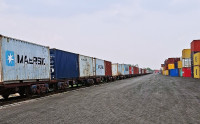
Two out of the 12 railway tracks at Sirsiya dry port in Birgunj have become useless because of an alleged design fault that was overlooked during their construction.
bookmark
Shankar Acharya
Published at : April 4, 2016
Updated at : April 4, 2016 08:41
Parsa
Two out of the 12 railway tracks at Sirsiya dry port in Birgunj have become useless because of an alleged design fault that was overlooked during their construction.
The two tracks are mostly used for parking freight cars while the others are operational. Freight trains running on these tracks cannot be reached by road, making it costly and time consuming to load and unload cargo.
Scrapping the idle tracks and building a road will decrease the time and cost of hauling freight and increase the total utility, stakeholders said. “The idle tracks must be replaced by a concrete road to decrease the time taken to unload freight,” said Ashok Kumar Temani, central executive member of the Federation of Nepalese Chambers of Commerce and Industry (FNCCI). “Both the dry port operator and importers would benefit from the resulting trouble-free operations.” Temani has claimed that adding two new tracks will double the total capacity.
Built with a $802-million loan from the World Bank, Sirsiya dry port is the country’s first and only port with railway connectivity. It is operated by Himalayan Terminal, a Nepal-India joint venture company. The dry port is directly connected to the sea port at Kolkata. In spite of a loading and unloading capacity of 70,000 containers annually, only 18,000 to 20,000 containers arrive here annually.
Nearly 650 factories in the Birgunj-Pathlaiya Industrial Corridor import 50 percent of their raw material requirement through this port. Cargo from third countries also come through here.
“It is surprising that the port with the country’s best infrastructure has been in operation for more than a decade but the problems have still not been addressed.” said Pradip Kedia, president of the Birgunj Chamber of Commerce and Industry.
Shyam Babu Patel, vice president of the Federation of Customs Agents, has blamed faulty design for the inability to operate the port at its full capacity. “This is a loss to the nation and corrections should be made post-haste,” he said.
Information Officer at the Dry Port Customs Office Harihar Poudel said, “Importers complain about the difficulties created by faulty lines time and again, however, the technical aspects of the railroad fall under the purview of the Intermodal Transportation Development Committee.”
Shankar Acharya
Shankar Acharya is the Parsa correspondent for Kantipur Publications.



Most Read from Money

Nepal travel agents threaten to stop selling Thailand trips over visa rules

Why does an hour long flight to Dhangadhi cost more than a flight to New Delhi?
Malaysia rejects Nepal’s demand to open recruitment to all manpower agencies

No school, but a graduation cap for women dairy farmers
Nepal arrests four medical service providers as Malaysia recruitment row deepens
Editor's Picks




E-PAPER | October 23, 2026

×