Why did Nepal’s mountain agenda stall at COP31? A delegation insider explains
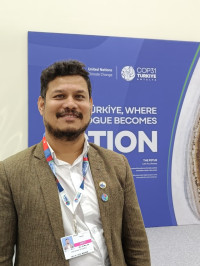
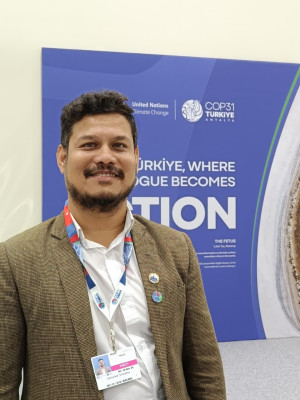
Environment Minister’s adviser says the real contest at COP31 is now over the wording of the cover decision. Avishek Shrestha, adviser to Minister for Agriculture Photo: Courtesy of Avishek Shrestha
Nepal went to COP31 with theBhotekoshi–Trishuli floods behind it and a plain ask: give mountains a permanent place in the UN climate talks. On October 29, Nepal and Bhutanjointly proposed a COP31 agenda item on “1.5°C warming in mountains”. It did not make the formal agenda.
With negotiators now bargaining over the wording of the conference’s cover decision, Nepal is pressing for a dedicated mountain work programme with a defined scope, an annual high-level dialogue, and finance that arrives on time.
Avishek Shrestha, adviser to Minister for Agriculture, Forests and Environment Gita Chaudhary, is inside that process. Chaudhary now leads the delegation. Shrestha spoke toThe Post’s Biken K Dawadi from the negotiations, to explain why the proposal stalled, why consensus politics cuts against small mountain countries, what $20 million from theLoss and Damage Fund can and cannot do, and what Nepal would count as a win.
Reports say the mountain proposal was dropped from the official negotiating papers. What happened?
It was not dropped. Let me start from the beginning. On October 29, Nepal and Bhutan jointly submitted a mountain agenda item titled “1.5°C warming in mountains.” Countries usually submit agenda items so that a subject can be discussed in depth at the COP. This year Nepal and Bhutan did, as did other countries. In the last five or six years, no such specific agenda item has been approved.
What did the submission ask for?
Four things. First, a work programme on mountains. Second, an annual high-level dialogue on mountains and climate change. Third, scientific understanding and research on 1.5°C warming in mountains. Fourth, mountain-specific priorities: an adaptation framework, climate finance under the New Collective Quantified Goal, and loss and damage.
What happened after the submission?
The submissions came together as a provisional agenda. On November 8, the day before the plenary, the presidency called all the parties in. Kyrgyzstan had made its own submission on a mountain-related dialogue, and it was almost the same as ours. Kyrgyzstan also leads the Mountain Group, about sixteen countries, which Nepal has joined. So we merged. Kyrgyzstan added its submission to ours, and we pushed together.
How hard did Nepal push?
Our political leadership told us to fight for this agenda, and Minister Chaudhary led that fight. There are two presidencies this time, for the first time. Australia leads the negotiations, and Türkiye handles the logistics and engagement with participants. We told them plainly that if the agenda was not endorsed, we would raise a point of order.
Why does a point of order matter?
Under the UNFCCC, decisions are consensus-based, unlike the UN General Assembly, where voting is the norm. Any single country that objects can stop a session. A point of order from us would have halted the plenary on the ninth. The message was that this issue matters to us. After the Bhotekoshi flood, the world saw what climate change can do, including the loss of lives, among them people from countries other than Nepal. That event drew global attention, and it is why a formal mountain agenda should exist.
Whom did you have to convince?
Everyone. Negotiations here happen through blocs, and there are around sixteen. We negotiate mainly through the Least Developed Countries and the G77 and China, and we spoke to the Arab Group, the African Group and the Latin American bloc, AILAC. The European Union and other developed-country groups, including the Environmental Integrity Group with Switzerland, are also in the room. Then there is the LMDC, the Like-Minded Developing Countries, where India and China sit together.
So where did it land?
It did not become a formal agenda item, but we did not walk away empty. The title was a sticking point. “1.5°C warming in mountains” made some countries uncomfortable, because they read it as heavier obligations for themselves. Nepal, Bhutan and Kyrgyzstan agreed to revise it to “matters relating to mountains and climate change.” It is broader, and it is easier for other groups to join.
An agenda item cannot happen now, but we agreed on how to bring it to the next COP. It will be discussed in the COP presidency’s consultations, which took place in the first week and continue next week.
And the annual dialogue?
We were told it would be taken up at the subsidiary bodies, SB66 and SB68, which meet in Bonn, where the UNFCCC secretariat is headquartered, every June. That means June 2027 and June 2028. That is what was offered to us.
Bonn in 2028 sounds like a long wait. Is this a defeat dressed up as continuity?
I would not call it that. The process runs in parallel, and we are still fighting for the agenda. Remember, we asked for more than consultations. A presidency consultation alone is not enough, because the real weight lies in the cover decision. That is the high-level political decision the COP endorses. We have repeatedly asked that our asks appear there as outcome text, and not only in the presidency’s consultations.
What does the draft cover decision say?
A draft came out yesterday. It acknowledges the impacts on mountains. It also calls for a dedicated mountain work programme on finance and capacity-building gaps. But that falls short of what we asked for.
So Nepal, Bhutan and Kyrgyzstan made another submission. We want the text to say explicitly what the scope and modalities of the mountain work programme are. We want the annual mountain dialogue linked to that programme and guided by its framework. Nepal made a separate submission calling for a high-level political dialogue on mountains and climate change every year.
Did the presidencies hear you?
Minister Chaudhary met Chris Bowen, Australia’s lead negotiator, and Murat Kurum, a minister from Türkiye, who is both head of delegation and chief negotiator. The first meeting was at 9:30 pm, and we sat with the Turkish side from about 10:30 until nearly midnight. We told them this is an event the world has not seen before, that there is global sympathy, that our people expect results, and that the Prime Minister raised it at the UN General Assembly. We also said the mountain agenda is not confined to mountains. It connects to coastal regions and the seas.
Both gave us assurances of support. They said they would consider how to reflect our concerns. Next week the minister meets ministers from the EU, the big developing countries, the developed countries and the small island states. The process runs through next week.
Foreign Minister Shisir Khanal has returned home, and Minister Chaudhary now leads the delegation. Does that change anything?
Technically, a country can have two heads of delegation. Minister Khanal led the whole team until the 13th, and the handover has been made. Minister Chaudhary now leads the delegation through the end of the first week and the second. It changes nothing in the leadership.
Nepal’s climate diplomats have been busy with side events, including the cryosphere event with Bhutan, Kyrgyzstan, Tajikistan and Pakistan. Yet the negotiating room does not seem to convert that into support. Why?
Because voting is not the practice. Article 18 of the Convention gives each party one vote, but in practice decisions have always been made by consensus. If any country is unhappy, it can object, so everything goes through consensus.
Developed countries have their own interests. We have not yet found the support and solidarity we wanted. But a dedicated mountain work programme has come, and the agenda will still be discussed in the presidency’s consultations.
Minister Khanal said in an interview that big negotiators and blocs blocked it. Are they the same people you meet on the sidelines?
The discomfort I described over the 1.5°C title is part of it. We have been meeting ministers one-on-one, including from developed countries. They know the gravity of the issue, and many have diplomatic offices in our countries. That has to be reflected in actual climate diplomacy. Next week we have more homework. The meetings so far have been positive, but in the end we have to go home with something substantial. The damage is irreversible, and the cost of rebuilding is enormous.
The Loss and Damage Fund has allocated $20 million for Nepal, yet nothing has been disbursed, and Kathmandu has not sent a formal proposal. Why is Nepal struggling on this front?
It is $21.6 million: $20 million for the work and $1.6 million for operational costs. It came from the first-ever extraordinary meeting of the fund. The government has started a process, and we are discussing it. In a day or two, the proposal work will begin in earnest.
The question is how to use the money most effectively. $20 million is not a lot, but I think it can become a global case study. If we use it well, other countries can receive money this way too, and we could draw in more resources.
The board meets in the Philippines around December 10 to 12, and we want clarity before then. In the coming days, we will consult ministries and other stakeholders on the financing mechanism and the kinds of projects. By the end of the week, we should have something we can share with the media.
As you said, $20 million is meagre against the cost of reconstruction. I understand about 119 countries have applied to the fund, and the applications total many times its money.
The need is far greater than the money. The fund pledged about $800 million, and barely $400 million has come in. Minister Chaudhary raised this at the fund’s high-level event, and we sit with its board again next week.
For a country like Nepal, the rebuilding bill runs to around 20 percent of GDP. The figure so far is about $4.7 billion. That is why the fund must grow substantially. We are pressing, politically and diplomatically, for money that is accessible, timely and affordable. If the $20 million had come a little earlier, or later, the question of how to use it would have been different. We told Türkiye and Australia that it is not only about the mountain agenda. It is also about resources.
The United States is absent from COP31, and Australia has not put forward new multi-year climate finance. Traditional donors are stepping back. How is Nepal adjusting its finance diplomacy?
On finance, honestly, there is very little. Even the money that was pledged has not arrived, and the fund’s shortfall shows it. Countries have also backed out of decisions they already agreed to. The Baku goal calls for $300 billion a year by 2035, and tripling adaptation finance was also agreed. Neither is being delivered.
Meanwhile, huge sums go into fossil fuel subsidies and into war. Taken together, it is something like three to four trillion dollars globally. Climate change has become tied to geopolitics. Countries are fuelling the crisis, which began mainly with historical emitters, and people are dying.
Our position is clear. The government’s priority is grant-based finance, and in every country statement and intervention we say “grant-based.” We work through the G77 and China to strengthen the finance negotiation, and the minister is holding bilateral meetings with other developing countries on how to hold this ground. Money for fossil fuel subsidies and military wars has to come to save humanity, and the people who have done nothing to cause this crisis.
The delegation also met UN Secretary-General António Guterres on the sidelines. What can Nepal expect from him?
He has been a big ambassador for the mountains. When he came to Nepal a few years ago, what he said about the Himalaya sensitised people globally. He is a true advocate.
In our meeting, we spoke with respect for what he has already said. After this disaster, he spoke at an overarching level. A person of his stature who has seen the gravity and the first-hand experience himself strengthens our position. We have felt that.
Nepal’s diplomats keep talking about cross-border early-warning cooperation with China and India. The Prime Minister raised it at the UN General Assembly. Is there progress?
We had a bilateral meeting with the Chinese delegation. We discussed how to take forward what the Prime Minister proposed on a Nepal–India–China initiative, and said it could start with research institutions in China and Nepal. China has supported Nepal on the mountain agenda, and that support has been immense. It came up in our bilateral meeting. We are working on how to move a trilateral forward, and we raised this on the sidelines. We are also meeting the Indian minister, and we will build on the support we have.
Eventually Nepal has to justify COP31 to the public. What would you count as a success?
Three things in the cover decision’s text. The language on the dedicated mountain work programme should explicitly define its scope and modalities. The two agreed mountain dialogues should sit under that programme. And the high-level political dialogue on mountains and climate change should be established, so the political discourse has a place to continue. The agenda stays under discussion in the presidency’s consultations. If these elements are reflected, it would be a major win for Nepal, and it would become institutionalised.
COP28, 29, 30 and now 31: Nepal keeps pushing a stand-alone mountain agenda and hits the same wall. Does the playbook need a fundamental change?
Look at history. Andorra submitted a mountain agenda at COP28, and it ended up confined to an annual dialogue. This time, against the backdrop of Bhotekoshi, with global gravity behind it, we submitted on the eve of COP31, and it has gone much further. The agenda is alive and has not been dropped.
Of our four elements, the cover decision already has a dedicated mountain work programme on finance and capacity-building gaps. It is less than we asked for, which is why we keep stressing scope and modalities, a dialogue guided by the work programme’s framework, and a high-level political dialogue. The agenda is what we discuss, and we are pushing its three major elements through the cover decision.
The political leadership has taken a stand, and people expect it, because this has touched so many lives and livelihoods. Nepal was ready to stop that plenary with a point of order. We have our own lived experience, and we do not want to go home with nothing. This is a fight, and we are fighting it.




 10.12°C Kathmandu