What procedures do FIFA and AFC follow before suspending a member association?
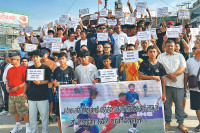
With Nepali football at a standstill following NSC’s suspension of ANFA, the threat of a FIFA suspension looms large. But how do international bodies actually decide when to act?
The Nepali squad to face Laos in the 2027 AFC Asian Cup Qualifiers-Third Round on March 31 left for the Land of a Million Elephants on Saturday, the All Nepal Football Association revealed via Facebook on Saturday evening.
The match against Laos appeared uncertain after the National Sports Council suspended ANFA on Wednesday.
The Nepali squad left for Laos in secrecy, with the complete list of players and officials unknown, a step that sheds light on the difficult times ahead for Nepali football.
Officials say that ANFA also risks suspension from the Federation Internationale de Football Association (FIFA), the global football governing body, over ‘third-party interference’. The fears are not unjustified as FIFA and the Asian Football Confederation (AFC) invoke ‘third-party interference’ every now and then.
In international football, there is a clear line that governments cannot cross when it comes to a national football association’s authority.
In many instances, the international bodies have had member associations across the globe suspended and even expelled for third-party interference.
Did the National Sports Council, the governing body of Nepali sports, cross the Rubicon, by suspending ANFA?
The suspension resulted from ANFA’s decision to call an early election. ANFA had scheduled the polls in Jhapa on Friday but postponed it after the suspension.
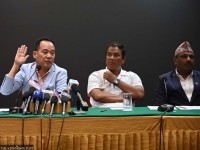
The majority of the voting representatives in ANFA’s election had reached Jhapa by Thursday and Friday’s scheduled electoral congress turned into a normal gathering. During the gathering, ANFA President Pankaj Bikram Nembang and General Secretary Kiran Rai warned of suspension from FIFA and AFC.
The NSC’s suspension of ANFA is clearly a third-party interference for FIFA and AFC. However, FIFA and AFC do not suspend a Member Association (MA) as soon as they find out about third-party interference.
There is a certain procedure that is followed before a FIFA/AFC suspension of an MA.
Let’s take a look at those procedures.
What is third-party interference?
FIFA and AFC accept that collaboration between member associations and their respective governments is “paramount” for the sport to prosper.
“For the avoidance of doubt, the AFC is not against Governments assisting the MAs and Regional Associations, nor are we encouraging the MAs and Regional Associations to stand in opposition to their respective Governments,” reads AFC’sInformative Note on Third-Party Interference in Football Organisations. “On the contrary, the AFC encourages its 47 MAs and five Regional Associations to collaborate and work hand-in-hand with the respective Governments, in order to establish a meaningful and trustworthy working relationship.”
Similarly, the governing bodies of international football also state that the associations should comply with the local laws applicable in their respective countries as long as the ‘applicable local laws are not in contradiction with the principles of good governance and the FIFA and the AFC Statutes’.
“We acknowledge the importance and value of third-party entities to a certain extent, particularly the role of Governments in the development of the game,” Hachem Haidar, chairperson at the AFC Associations Committee, writes in his message on the informative note on third-party interference. “[But] they should be discouraged from interfering in the internal affairs of the MAs and Regional Associations.”
Likewise, AFC President Shaikh Salman bin Ebrahim Al Khalifa writes that “we must continue to stand together against third-party interference and defend the principles of autonomy.”
“This Informative Note on Third-Party Interference reinforces our position that we cannot allow anyone to destroy what we have worked so hard to build together,” he writes.
Examples of government interference
When the government and/or political parties use the success of the national team to boost their political influence and/or individual careers, it amounts to interference, according to the note.
When a government removes the MA’s President and replaces him/her with a candidate based on political affiliation, it is said to be interference. Similarly, it is also interference when governments revise the country’s laws in order to take control over the footballing associations.
From a government interfering in an MA’s decision-making process to taking action against an executive body for bad performance, FIFA and AFC are seriously concerned.
“Governments may sometimes take action against the respective MA when the MA is not within its ‘control’ (for example, if it does not follow the Government’s instructions or does not share the same position/opinion as the Government),” reads an example of government interference by the AFC. It is the example that is closest to the case of NSC’s suspension of ANFA.
What next after government interference?
Unlike the rumours of FIFA and AFC suspension on ANFA coming soon, AFC’s procedures suggest it will take time.
There are three steps that FIFA and the AFC follow after they are made aware of third-party/government interference in an MA.
FIFA and AFC are said to have been reported by ANFA on the ongoing conflict with the NSC after the election was postponed.
FIFA and the AFC first assess the situation by conducting a general probe in the respective country.
Secondly, a negotiation is sought. “Meetings will be organised with different stakeholders (including the Government) to discuss the prevention of interference as well as the potentially damaging consequences to the MA if the interference persists,” reads the informative note.
And if the negotiation does not bear fruit, either a normalisation committee is formed, or the MA is suspended.
The formation of a normalisation committee, which includes members who pass the FIFA Eligibility Test, suggests that FIFA wants to solve the issue of government interference.
But if the circumstances get serious, an MA is suspended, which is worse than a normalisation committee.
“If a Normalisation Committee is appointed, day-to-day football activities, both on and off the field, may continue,” the AFC warns. “However, if a suspension is pronounced against an MA, it puts that MA in a standstill state.”
“Such a suspension will undoubtedly have a negative impact on football in general in an MA,” the AFC states. “A suspension affects the football development of the MA in question, and it takes a significant amount of time to recover.”
Citing that MAs can face sanctions even if the third-party influence is not their fault, AFC suggests all stakeholders act in accordance with the principles of good governance set out in the FIFA, AFC and MAs’ Statutes and do not interfere with the operations and activities of MAs.
The NSC have suspended ANFA, citing that it was not ‘interference’ when a government agency asks an organisation registered with it to follow the law of the land.
But how FIFA and the AFC will take account of the matter will be known in due course. For now, there is no active footballing body in the country.
The Post has sought a response from the Member Association Division of the AFC regarding their stance in Nepal’s case.




 15.26°C Kathmandu