Decision for early election abides by the statute: ANFA
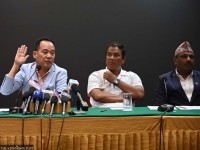
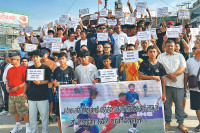
While presenting ANFA’s position, Rai laid out five main arguments. ANFA General Secretary Kiran Rai (right) speaks to the media during a press conference at the ANFA Complex in Satdobato, Lalitpur on Saturday. Nayak Paudel/TKP
Amid mounting controversy and uncertainty following its decision to shorten its tenure and go for an early election, the All Nepal Football Association on Saturday defended its move, saying the decision was legitimate.
Organising a press conference at their building in Satdobato, ANFA General Secretary Kiran Rai said the decision to hold an electoral general assembly on February 11 was in line with the statute and that there was no need for confusion regarding the matter.
A meeting of the ANFA executive committee held last Wednesday had decided to convene the electoral general assembly. The four-year term of the executive committee led by President Pankaj Bikram Nembang is set to end on June 18. However, the committee decided—by majority vote—to hold an early election in Jhapa before the end of its tenure. Football stakeholders in Nepal have opposed the decision and have already stated they will challenge it.
“We have taken this decision strictly in accordance with the ANFA Statute,” Rai said at the press conference. “What I want to request everyone now is that ANFA has moved towards an election, so let us participate in it and practice democracy.”
While presenting ANFA’s position, Rai laid out five main arguments. His first argument was that the authority to interpret ANFA’s statute lies solely with the organisation’s executive committee and not with any other entity.
“I was the coordinator of the ANFA Statute drafting committee, so I believe I can interpret it better,” Rai said. “The early election has been decided under the second point of Article 30 and Article 31’s 2(P). These are the only provisions in the statute under which the elections can be called.”
His second argument was that the decision to hold an early election was made based on a majority, making it lawful and a normal procedural outcome.
The third argument was that while no institution is allowed to extend its tenure beyond the rules, it can shorten its term if it chooses to do so. Rai stressed that the decision was ANFA’s own and not taken at the behest of any external force, adding that forcing such a decision would indeed be wrong.
Rai’s fourth argument was that district football associations and clubs under ANFA are independent bodies and not formal organs of ANFA. Therefore, they are not required to hold their own elections during ANFA’s early election process.
However, if any district association or club chooses to conduct elections before ANFA’s election, there would be no objection, and the ANFA would view it as a normal process. Many stakeholders had earlier argued that district and province associations should obtain a fresh mandate before ANFA’s election.
The fifth and final argument was that if anyone challenges ANFA’s decision in court, or if Nepal’s apex sports body decides against it, such actions would be interference and contempt under ANFA’s statute.
Rai added that the representatives attending the upcoming ANFA election would be nominated by the executive committees of district associations and clubs, and therefore could be considered new representatives.
Rai said that, given the widespread criticism of the current ANFA executive committee, holding an early election was an appropriate decision at this stage and called on all stakeholders to participate.
“If anyone believes they can do good for Nepali football by entering ANFA, then an election is the right option,” Rai said. “We have already informed FIFA, AFC, the Ministry of Youth and Sports, the National Sports Council, and all other concerned bodies about this decision.”
Rai also called all interested and eligible individuals and football lovers to contest the election if they believed they could ‘do better’ in and for Nepali football.




 18.18°C Kathmandu