Every development in Nepal’s transitional justice process has been followed by different interventions from the Supreme Court: right from the formulation of the legislation to set up the transitional justice commissions to the annulment of the amnesty provisions in the law was carried out after the top court’s directives. It has made yet another intervention in favour of the victims of the Maoist insurgency and those from state atrocities in different periods. A division bench of the top court has asked the government to formulate a consolidated reparation policy. It has also asked the state authorities to amend different rules, directives and policies relating to the distribution of the relief and compensation that are discriminatory towards women.
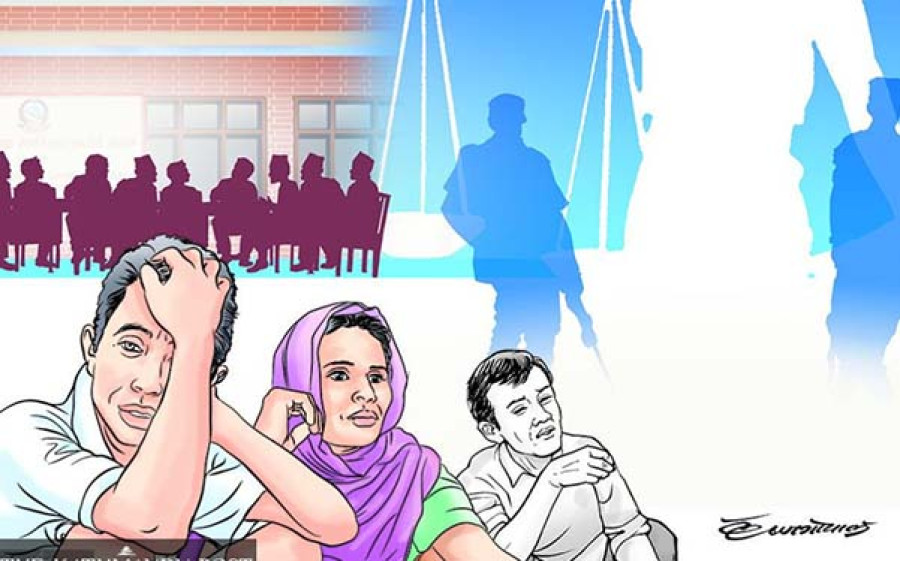
Even as two decades have passed since the Comprehensive Peace Accord, and 11 years since the transitional justice process formally commenced, no government has ever prepared a policy to guide the distribution of reparations. In the past, different governments have distributed cash compensations and other relief to the victims on an ad hoc basis. Such moves have been criticised on several occasions for favouritism, prompting the Supreme Court to stop some of them. Over the years, victims of the insurgency era and human rights activists have advocated for a reparations policy. In fact, a group of insurgency-era victims, in 2018, had submitted a draft reparation policy after broader consultations. However, successive governments paid little attention to this effect. As a result, the top court had to intervene in the matter.
Nepal’s history shows an unfortunate pattern: meaningful efforts to address the needs of victims of state atrocities have rarely emerged from political initiative. More often than not, they have come only after judicial intervention. What should be an exceptional act of judicial oversight has instead become routine, largely because those in power have repeatedly shown indifference to the suffering of ordinary citizens. The responsibility now rests with the newly formed government led by Balendra Shah to break this pattern. It must move decisively to formulate and implement a comprehensive reparations policy—one that recognises not only victims of the decade-long Maoist insurgency but also those harmed by state actions across different periods, including victims of the recent Gen Z protests.
Reparations are an integral part of justice. They go far beyond monetary compensation. Genuine reparative measures must include official acknowledgement of wrongdoing, public apologies from those responsible during the conflict era, and the preservation of collective memory. This can take the form of memorials, museums, parks, schools and public spaces dedicated to remembering victims at the federal, provincial and local levels.
Equally important is the provision of rehabilitation, psychosocial support and guarantees. Without these measures, financial assistance alone risks becoming a token gesture rather than a meaningful step toward justice and reconciliation. In line with the court’s directive, any reparations policy must be formulated through meaningful consultations with those directly affected. Policies drafted without broad participation not only lack the ownership of the very groups they seek to serve but also fail to capture the true spirit of justice.
The Shah administration must therefore move without further delay to enforce a comprehensive reparations policy. In doing so, it should ensure that victims are treated not just as recipients of state assistance but recognised as stakeholders in the process. At its core, the policy must uphold that reparations are not state charity but are the rights of victims.




 14.69°C Kathmandu