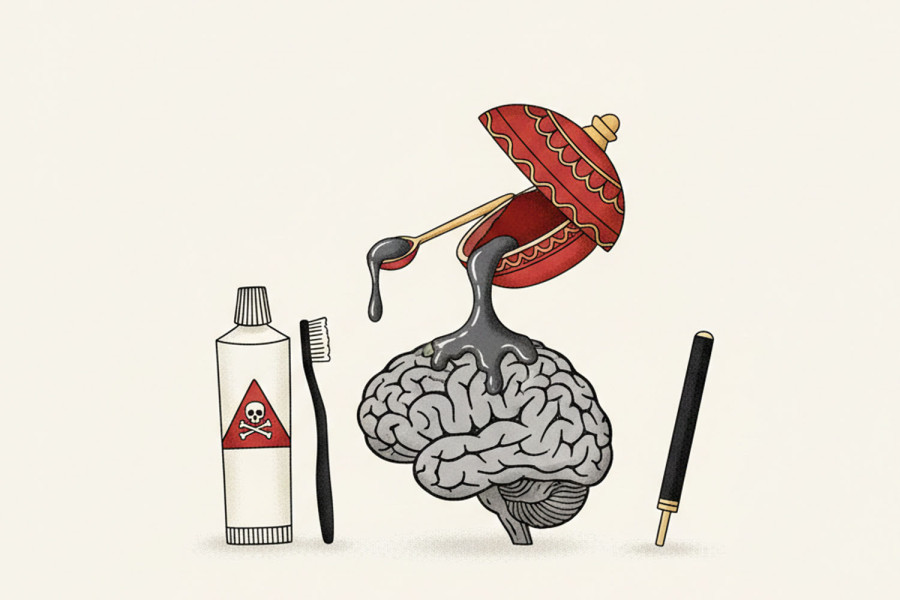
Nepali public health discourse has always downplayed heavy metal exposure and poisoning and treated it as a peripheral concern of the industrial sector. Yet, a recent study by the Centre for Public Health and Environmental Development (CEPHED) has revealed a terrifying reality: Millions of Nepalis are exposed to lead, a toxic heavy metal, through daily essentials such as toothpaste, sindoor and eyeliners. As per the report, 24 percent of tested samples exceeded international safety limits, and 16 percent even breached Nepal’s lenient guidelines. The regulatory bodies have seemingly entirely abandoned their duty.
The specifics of the contamination are uniquely horrifying due to the frequency of use of lead. Sindoor, a staple of daily ritual for millions of married women, emerged as the most contaminated item, with lead concentrations as high as 124.73 ppm in some samples. Specific brands, like Mamta Sindoor, carry concentrations over a hundred times the international safety threshold, rendering the daily act of applying vermilion a route for chronic health complications. The presence of lead in household toothpaste brands—including Colgate, Pepsodent, Dabur and Himalaya—presents an immediate threat to public health, including to the most vulnerable population: children.
Lead affects multiple body systems, distributing itself to the brain, liver, kidneys and bones, where it accumulates. Lead stored in the bones can be released into the blood during pregnancy, exposing the developing fetus to lifelong harm. Children often swallow toothpaste during brushing. In general, children absorb lead at four to five times the rate of adults; the negligence of exposure is an irreversible assault on their physical and cognitive development. Even minuscule concentrations are associated with decreased intelligence, behavioural difficulties and learning problems for children. The toxic metal can effectively stunt the nation’s collective human potential.
Lead exposure is a widespread yet preventable health threat globally, which results in approximately 1.5 million deaths annually. While many countries have made progress by banning the toxic metal in petrol and paint, its persistence in everyday materials in Nepal highlights a critical gap between international health warnings and local enforcement. The World Health Organisation (WHO) has been clear for years: Voluntary measures are not enough; punitive measures are needed to protect future generations.
Nepal’s failure to address this issue is symptomatic of a broader neglect of public health. The lack of a regulatory mechanism for products used by millions is a systemic failure. It allows for widespread labelling violations, with many products lacking ingredient lists or country-of-origin information despite legal requirements under Consumer Protection laws. Manufacturers are, therefore, permitted to profit from toxic products while the state lacks the political will to follow through on its own safety findings.
Ending lead poisoning is within reach if the state acts decisively. There is no biological need for lead in toothpaste or cosmetics, rendering it an entirely preventable health threat. The government must introduce mandatory lead limits below 1 ppm for all such products and strictly enforce the limits through regular market surveillance and third-party testing. High-risk imports must be banned immediately, and a dedicated regulatory authority assigned to oversee lead presence in consumer goods. The time for voluntary compliance is over.
Allowing millions to be poisoned by everyday items is a gamble with the nation’s cognitive future. If the state continues to ignore the lead in children’s toothbrushes and women’s daily rituals, it is essentially rigging the future against its own citizens. Every child, in every corner of the country, deserves a future free from the toxic metal.




 16.27°C Kathmandu