Tashi Gyeltshen on making films, finding freedom and embracing risk
The Bhutanese filmmaker talks about his journey from journalism to cinema, the influence of nature and personal memory on his films, and why being self-taught has given him the freedom to take risks.
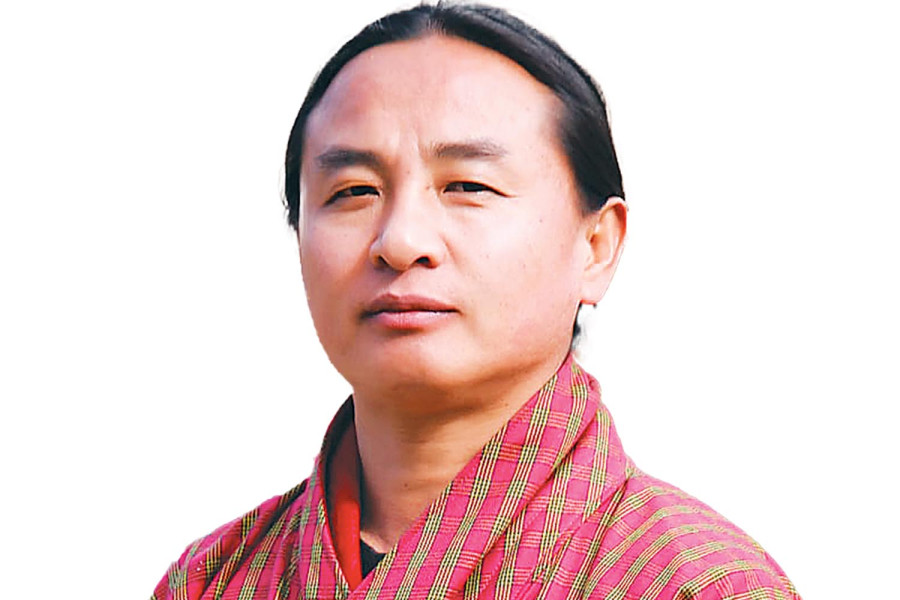
Bhutanese filmmaker Tashi Gyeltshen is known for telling powerful stories that depart from the traditional style of Bhutanese cinema. He began his journey into filmmaking after working in journalism. His debut feature film, ‘The Red Phallus’, won the prestigious FIPRESCI Award at the Busan International Film Festival in 2018. The film was also selected for the Generation 14plus section of the 69th Berlin International Film Festival.
Nepali producer Ram Krishna Pokharel also served as a producer on the film. ‘The Red Phallus’ followed Gyeltshen’s short films ‘Girl with a Red Sky’ (2009) and ‘The Red Door’ (2014), and was the final installment of his acclaimed ‘Red Trilogy’.
His films often portray rural Bhutan, gender-based violence, and the many facets of social transformation. Long takes, sparse dialogue and the artistic use of natural landscapes are among the defining features of his filmmaking. Tashi also shares a deep affinity with Nepal and Nepali cinema.
He recently visited Nepal to attend the Lichhavi Cinema Festival. On the occasion, Samarpan Shree of Kantipur spoke with him. An edited excerpt of the conversation follows.
You came to Nepal for the Lichhavi Cinema Festival, where your film ‘The Red Phallus’ was also screened. How did you find the atmosphere here?
I received a very positive response from audiences who watched my movie here. There is a strong desire among people in Nepal to make films. As a filmmaker, I feel more encouraged here than I do in Bhutan. People come up to me and ask, ‘What is your next film? I want to work with you too.’ There is a lot of excitement around filmmaking here. In Bhutan, there isn’t quite the same level of interest in films.
Recently, films such as Min Bahadur Bham’s ‘Shambhala’ and Abinash Bikram Shah’s ‘Elephants in the Fog’ have been released. When I watch films like these, I feel that Nepal is doing remarkable work in cinema.
That said, commercial films dominate Nepal’s film industry, with a strong influence from Bollywood and Hollywood. Bhutan’s film industry also began under the influence of Bollywood. In such an environment, it is difficult to make art-house films because audiences are not always sufficiently familiar with metaphors and the language of cinema. So, making art-house films is challenging here, just as it is in Bhutan.
There are long shots, sparse dialogue, and a strong presence of nature and the surrounding environment in ‘The Red Phallus’. Is there a particular philosophy behind this style?
There is a Japanese photographer whose philosophy has influenced me. In ‘The Red Phallus’, I wanted to show the beauty of Bhutan. But even within a beautiful landscape, people can feel trapped. When you are in pain, you don’t see beauty.
There is also a Bangladeshi filmmaker who uses a lot of close-ups. He grew up in Dhaka, where everything is close and crowded. In Bhutan, when you open a window, you see mountains—you naturally see things in wide shots. That is how I see things too.
There is intimacy in a close-up. As a director, when I put the camera close to someone’s face, I expect a reaction. I feel uncomfortable with that kind of intimacy. So I keep the camera at a distance and tell the story that way.
Nepali filmmaker Ram Krishna Pokharel is also a producer on the film. How was your experience working together?
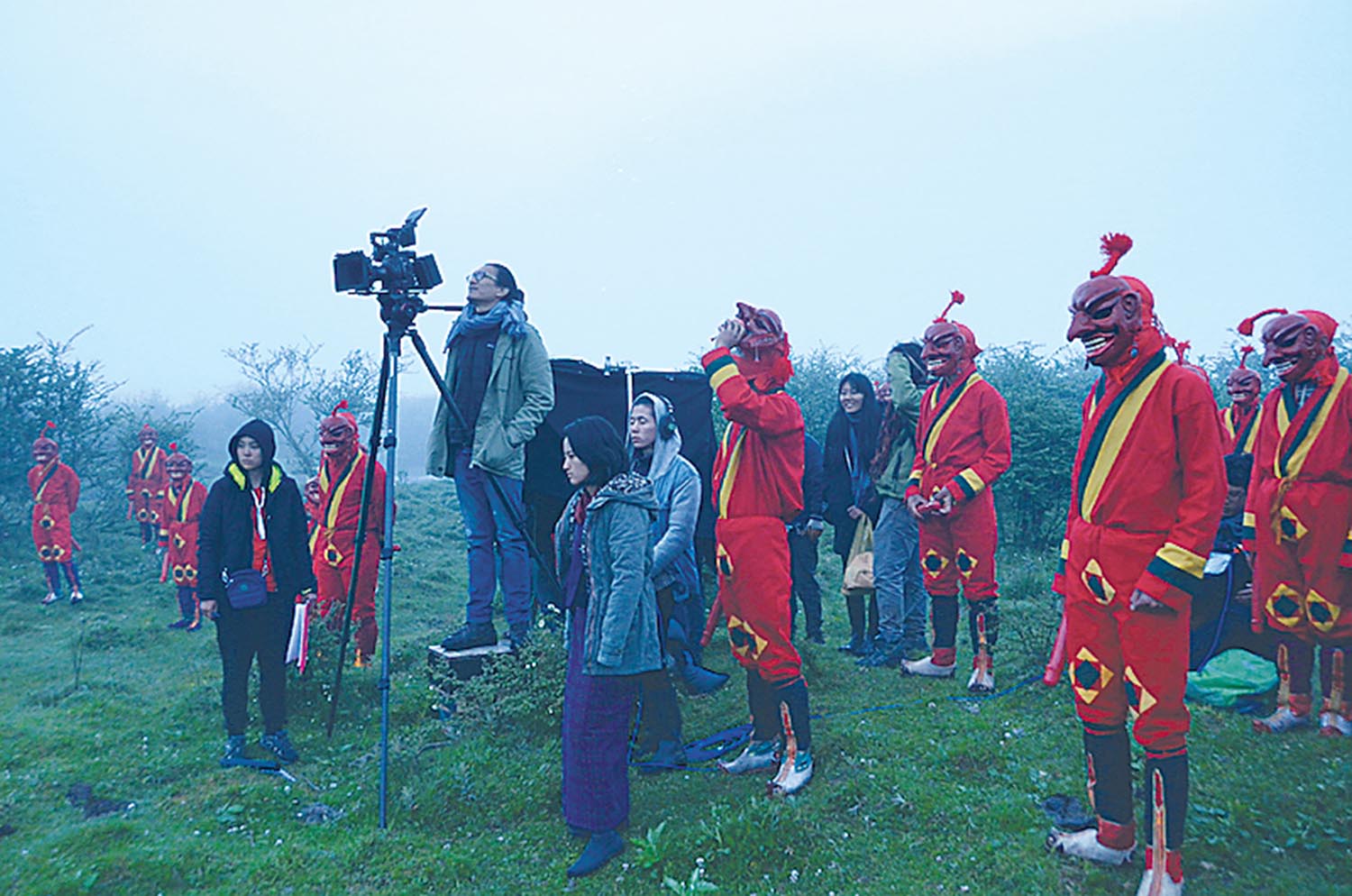
The making of ‘The Red Phallus’. Provided to the Post
Ram Krishna is a very good person. He has done a lot of good work for the Nepali film industry. We worked very well together. He never interfered with the film. I took care of the creative side, while he handled his responsibilities as a producer.
For an independent filmmaker, Ram is a good producer to work with. That is why he made an important contribution to the success of ‘The Red Phallus’.
The protagonist of your film ‘The Red Phallus’ is Sange. The film powerfully portrays how she suffocates in a village that appears peaceful on the surface. How did the character of Sange come about?
That is a difficult question to answer. The story did not begin at any particular point. First came a philosophical conflict, then a sense of injustice, followed by cultural questions. All of these came together and made me want to write a story. The character gradually developed from there. Decisions such as the character’s age and whether the character would be a girl or a boy emerged as I considered the circumstances.
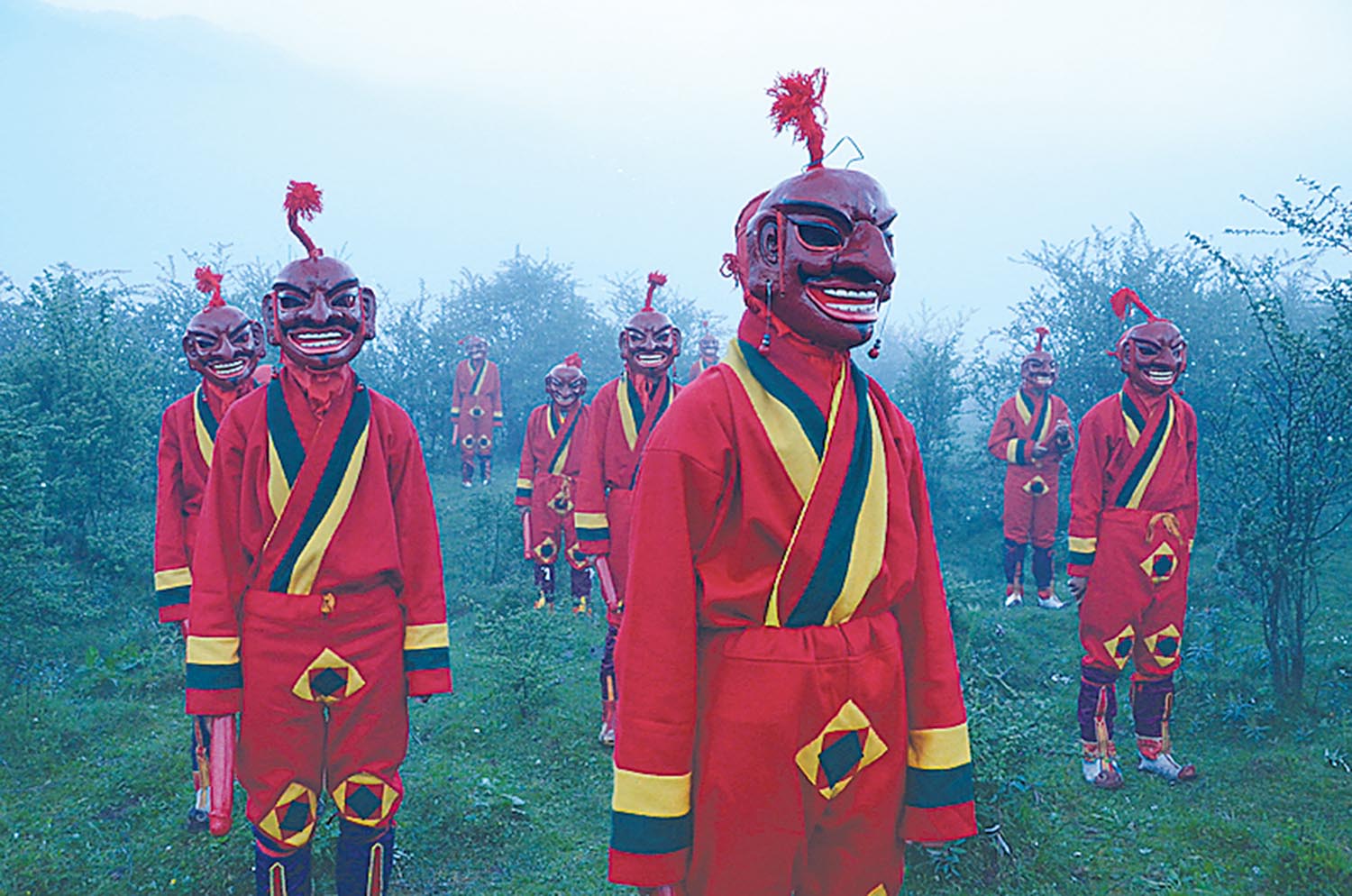
The story of my film began with the red phallus. In our culture, there are mask dances during festivals. The atsaras carry wooden phalluses and bless people. I wondered: What if the person behind that mask and costume is not a good person? What if he is a rapist or a murderer? That was where the story began.
It came from the violence of a patriarchal society. The character came later. I always begin with a philosophical conflict.
In Buddhism, every person has Buddha nature—the potential for pure awakening. But how does a person become a monster? How does someone become evil? That philosophical conflict is at the heart of my film.
You can never completely understand another person. A writer or filmmaker can portray only five or 10 percent of a character. So I place the character in a particular situation and use it to explore the philosophical conflict.
‘The Red Phallus’ found success at international festivals such as Busan and Berlin. But after Bhutan’s censor board asked you to cut 12 minutes from the film, you decided not to release it theatrically in your home country. How did it feel to make a film about your country and then have it inaccessible to audiences back home?
It is a sad situation. To be born and raised in Bhutan and try to tell stories from that place, only to have audiences in your own country unable to watch the film, is painful.
But in another way, it is also okay. There are always challenges in life and filmmaking. When everything becomes easy, people become comfortable, and art becomes weaker. You need suffering to write poetry and make films. You cannot write well without some kind of suffering.
Writing a story is simple: take a character, put them in a situation, and give them as much suffering as you can. That is the rule.
So I don't worry about it too much. I was able to screen my film at around 40 international festivals, including Busan and Berlin. I was satisfied with that.
Your two short films are ‘Girl with a Red Sky’ and ‘The Red Door’, while your feature film is ‘The Red Phallus’. The colour red appears repeatedly in all three films. What does the colour red mean in your films and why do you use it?
The colour red has its own meaning in films. But personally, when I was young, I once saw my mother in the bathroom. She was standing amid blood flowing across the floor and praying. That image stayed with me. At the time, I didn’t know whether she was ill or dying. But there was something beautiful about the scene.
That image is what led me to start using the colour red. In my films, red symbolises blood and life. But at its core, it comes from a personal memory.
You spent a long time working in journalism. What inspired you to move from journalism into filmmaking?
After leaving journalism, I didn’t know what to do. I wanted to become a poet, but I knew that it was not possible to make a living as a professional poet. I didn’t want to return to journalism either.
One day, I watched a film called ‘Travellers and Magicians’. After watching it, I thought, ‘Why not become a filmmaker?’ It was the first Bhutanese film I had seen that I could culturally relate to. Bollywood films have songs and dances and are made mainly for commercial purposes, so it can be difficult to connect with them culturally.
After watching that film, I felt that I could still write and make films with artistic ambition. That is what led me into filmmaking.
Before that, I had never planned to make films. It was only after watching that film that I thought, ‘I can become a filmmaker too.’ I then started watching and reading about films.
I never went to film school. I am a self-taught filmmaker. Learning on your own takes time, but I also didn’t have to be bound by anyone else’s limitations. I have the freedom to imagine independently.
You never went to film school. What are some of the difficulties you have faced learning filmmaking without formal film education?
There are both advantages and disadvantages. The disadvantage is that you don’t have a circle of friends with whom you can discuss films. You don’t get to watch art-house films on the big screen, and it is difficult to exchange knowledge.
But there are advantages too. As I said earlier, I didn’t have to be bound by someone else’s way of teaching. A teacher can only teach what they know. I am learning independently. There are no limits to my imagination. I make mistakes, but that freedom allows me to take risks. Being able to take risks without even knowing that they are risks—that is the beauty of art.
The source of all art is life. You have to live and experience life. Then you have to learn the craft of filmmaking. Inspiration and material come from life itself. No matter how much technical skill you have or how good a film school you attend, you cannot make a great film without life experience. That is my view.
How are preparations for your second feature film going?
I’m currently working on a film trilogy. I’m planning to shoot the second feature next February or March. Ram Krishna from Nepal will also be the producer on this film.
This time, I’m making a love story. It will be inspired by Wong Kar-wai’s ‘In the Mood for Love’.




 18.54°C Kathmandu