



 20.98°C Kathmandu

Tue, Oct 13, 2026
Culture & Lifestyle
Can Nepal protect Yomari?
Why does the country have no legal claim to its own most valuable heritage, and what will it take to build one.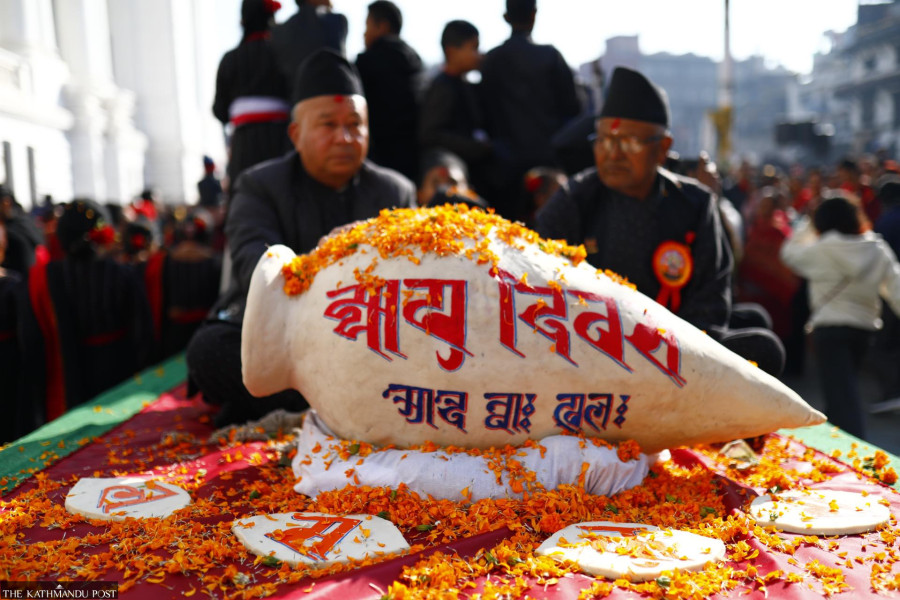
bookmark![]()
Post file photo ![]()
Every community has its own identity, not only in its language and clothing but also in the way it grows its food, prepares its meals, weaves, carves, and heals. Their identity is inseparable from their products. ![]()
Sabina Acharya
Published at : September 19, 2026
Updated at : September 19, 2026 13:05
Every year, as the month of November-December arrives, the sweet fragrance of steamed rice flour and warm chaku or khuwa fill drifts through the narrow lanes of Bhaktapur, Kathmandu and Lalitpur.
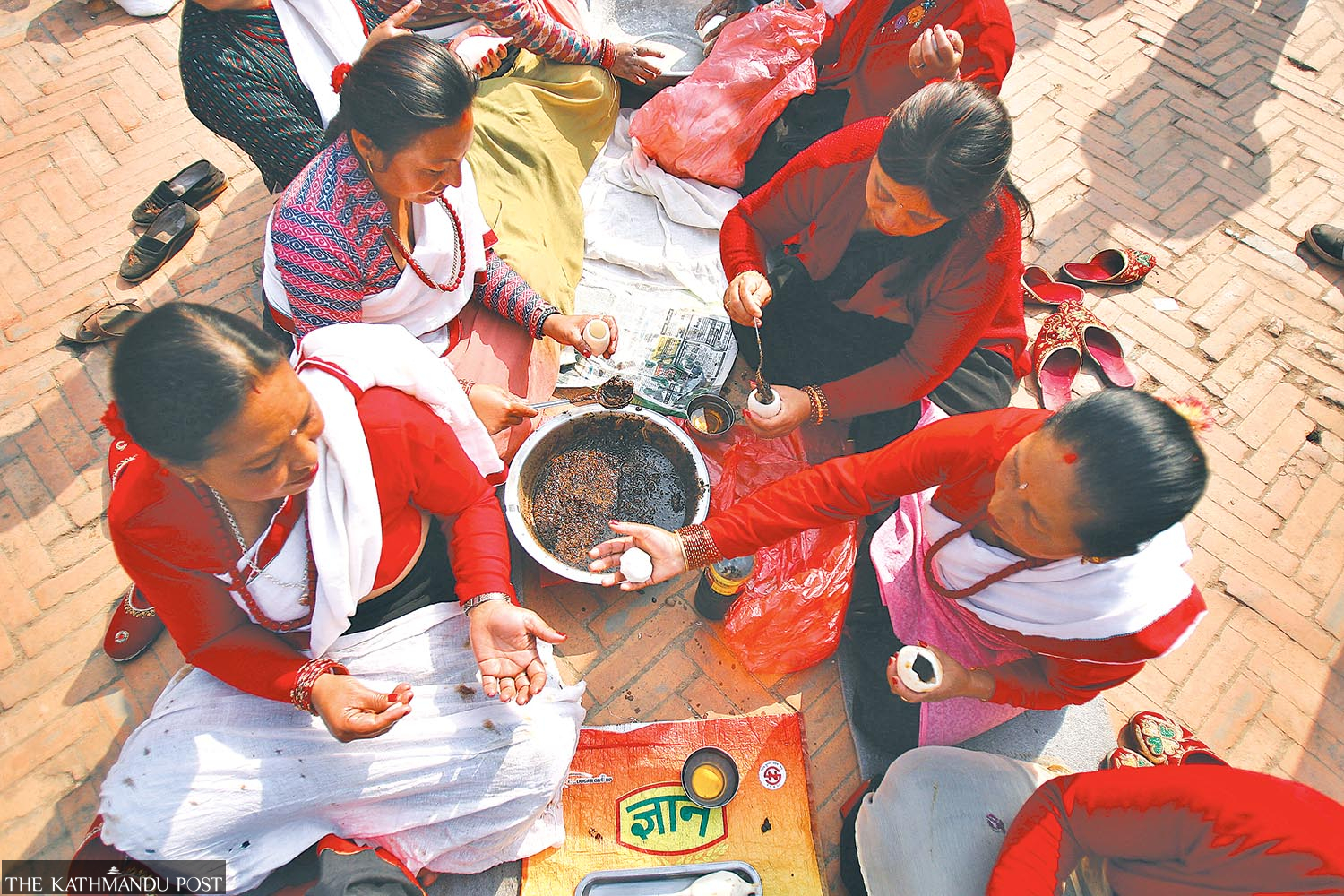
Newa families come together to form small fish-shaped dumplings, known as Yomari, from freshly harvested rice, filled with sesame seeds, coconuts, chaku or khuwa, prepared in a ritual that dates back centuries.
The festival for this food, called Yomari Punhi, is not just a cultural celebration; it is the embodiment of an agricultural knowledge system, linking a particular community, a particular crop, and a particular season.
However, if any foreign food company started producing Yomari today and began labeling it in a supermarket in another country, Nepal would have no legal means to prevent it, as there is no law, no registry, and no enforcement mechanism.
Nepal has 59 officially recognised indigenous nationalities called Adivasi Janajati, comprising around 35 percent of the total population. These span all the ecological zones.
Every community has its own identity, not only in its language and clothing but also in the way it grows its food, prepares its meals, weaves, carves, and heals. Their identity is inseparable from their products.
And yet, while Nepal has precise data on the number of its indigenous communities, it has almost no systematic data on what those communities actually produce.
There is no comprehensive national registry of traditional foods, no catalogue of indigenous medicinal herbs and their community custodians, and no documented inventory of craft techniques and their geographic distribution. Nepal knows it has 59 indigenous nationalities, but it does not know, in any legally useful sense, what those nationalities make, how they make it, or what makes it irreplaceable. A country cannot protect what it has not documented.
Researchers and institutions have identified over 100 agricultural products and 87 potential products that would qualify for international protection as Geographical Indications, a form of intellectual property that protects products whose quality or reputation is tied to a specific geographic origin.

But identification is not documentation. Information about Ilam Tea does not carry the same value as having a legally binding record of its growing altitude, the soil’s characteristics that affect its muscatel taste, and the traditional tea-making processes of the communities who grow it in Ilam. That documentation is required for registration.
For example, compare Yomari with Rasgulla, a centerpiece of one of India’s most famous Geographical Indication disputes, the syrup-soaked cottage cheese ball. The origin of Rasgulla has been disputed for years between West Bengal and Odisha. In 2017, West Bengal was awarded the Geographical Indications status for Banglar Rosogolla, and in 2019, Odisha was awarded the status of GI for Odisha Rasgola, acknowledging the two as separate products from different traditions. Each state’s producers were legally recognised, allowing them to mark their products as authentic, prevent imitations, and establish a market identity tied to their provenance.
Yomari is Nepal’s Rasgulla.
It has a specific community origin, a geographic tie, a centuries-old preparation tradition, and an international diaspora market that already recognises and values it. The difference is that West Bengal and Odisha had a legal system in which to file their claims. Nepal does not.
The same logic applies across Nepal’s entire indigenous product landscape, like Juju Dhau, the King of Yogurt, made in Bhaktapur.
Jumli Marshi rice is grown in Jumla, at an altitude of 2,000-2,900 metres, and depends on the unique flavour and nutritional characteristics of the extreme temperature variations and soil conditions provided by the Karnali region to make it the world’s tallest rice. The weaving density and pattern combinations of Palpali Dhaka fabric are linked to the weaving knowledge tradition practiced by the artisans of Palpa.
Khukuri knives, made by the blacksmith communities in Bhojpur, are known worldwide as a symbol of Nepali craftsmanship due to their curved shape and the steel tempering they undergo. Sherpa, Tamang, and Tibetan Buddhist communities use mineral pigments in a hand-ground technique and iconometric precision to create thangka paintings that are available in international art markets at prices that reflect centuries of value. All these products are potential GI products but are not registered due to the absence of law.
Geographical Indication is the most appropriate legal tool for addressing this. Unlike a patent, it does not require novelty, nor does it require individual authorship as copyright does, nor can it be sold away from the community that owns it, as with a trademark. A GI belongs to all qualified producers in a defined geographic area who meet the production standards.
It is the only form of intellectual property designed for knowledge that is communal, intergenerational, and geographically rooted. And it is the only instrument that connects indigenous communities directly to international markets based on authenticated origin.
The market argument is not abstract. Across international commodity markets, GI-registered products consistently command price premiums over comparable non-registered alternatives. Darjeeling Tea, India’s first GI registration in 2004, commands a price of five to twelve times that of generic Indian black tea in European and Japanese specialty markets.
The Tea Board of India has registered the Darjeeling certification mark in roughly 30 countries. Ilam Tea, grown in ecologically comparable conditions sixty kilometers across the border, is exported to the same markets at a fraction of the price because Nepal has no equivalent certification system.
The farmers of Ilam are not producing an inferior product. They are producing an uncertified one. Nepal’s National Pashmina Sector Export Strategy aims to achieve an export volume of USD75 million in Pashmina by 2026, up from USD15 million in 2023-24.
The goal cannot be accomplished by marketing alone, once the term ‘Pashmina’ has become a generic name for machine-spun blended fiber available in airport stores in Asia and Europe. The only instrument that can restore the word to its authentic meaning and protect that meaning in law is GI registration backed by active enforcement.
This is why the Industrial Property Bill, 2082, introduced to the House of Representatives by the Ministry of Industry, Commerce and Supplies, represents the most significant step Nepal has taken on this issue in its legislative history.
For the first time, the Bill formally recognises Geographical Indications as a distinct and independent category of intellectual property, separated from trademarks, patents, and copyrights. It defines a geographical indication as a sign or geographical name that identifies goods originating from a particular region, where a specific quality, reputation, or characteristic is essentially attributable to that geographical origin.

That definition aligns Nepal, for the first time, with the international standard set by the TRIPS Agreement and with the domestic frameworks of countries that have used GI law to transform indigenous heritage into protected and profitable market assets. The Bill also proposes establishing an Industrial Property Office to administer GI registration and includes provisions to prevent unfair competition and the deceptive use of geographical names.
But the government cannot afford to wait for enactment before beginning the preparatory work that will determine whether the new law has anything meaningful to protect. The most urgent task Nepal faces right now is not legislative. It is documentary. Before a single GI application can be filed, before a single product can be examined and registered, the evidence base must exist.
Geographic boundaries must be mapped. Traditional production methods must be recorded. Community histories of origin must be compiled. Product quality standards must be defined. This work must begin immediately, in parallel with the Bill's parliamentary passage, so that the moment the law creates a registration mechanism, Nepal's producers are ready to use it.
The government must launch a National Traditional Knowledge Documentation Initiative without delay, coordinated across the Ministry of Culture, Tourism and Civil Aviation, the Ministry of Industry Commerce and Supplies, the Ministry of Agriculture, Forest and Environment, the Indigenous Nationalities Commission, and the National Foundation for Development of Indigenous Nationalities and Local Governments. This cannot be the work of one ministry acting alone. It requires field research, community consultation, geographic mapping, agricultural science, and legal analysis to work together systematically across all 59 indigenous nationalities and all ecological zones.
Non-governmental organisations and international NGOs working across Nepal's communities are essential partners in this effort and must be actively mobilised. They are already present in the villages where Dhaka is woven, in the tea gardens where Ilam farmers work, in the high-altitude communities where Yarsagumba is harvested, and in the community where Yomari is traditionally made.
Their field presence, community relationships, and research capacity can reach where government agencies cannot. WIPO’s traditional knowledge documentation guidelines provide a ready methodological framework that NGOs and research institutions can apply immediately. Local governments, empowered under Nepal’s federal structure, must also be formally directed and adequately resourced to participate.
What is needed now is the urgency to act, the coordination to document, and the institutional commitment to implement before the opportunity closes.
The question is not whether Nepal can protect Yomari. It never was. The question is whether Nepal will choose to protect it while there is still time.
Sabina Acharya
Acharya holds an LL.M. in Intellectual Property Law and Management from National Law University, Delhi.




Most Read from Culture & Lifestyle

It’s a bird … it’s a plane … it’s the Indian ambassador’s farewell tweets

How should Nepal navigate a world in reorder? Rajib Upadhya on geopolitics and foreign policy

How Anup Poudel took Nepali cinema to Cannes

A Nepali photographer rediscovers Calcutta after decades

Facebook friends: What do cross-gender friendships look like in Nepal?
Editor's Picks

Constitutional Bench caught in seniority, ‘pick and choose’ dispute

A Dom boy’s long road to becoming a doctor

From blankets to handmade dolls, two foreign women bring comfort to flood survivors

News Analysis: When institutional defence exposes institutional fault lines
It’s a bird … it’s a plane … it’s the Indian ambassador’s farewell tweets
E-PAPER | October 13, 2026

×