Movie review: ‘Masterni’ answers the mystery but forgets the suspense
The film has an intriguing premise and an unconventional narrative, but its reliance on exposition keeps it from developing genuine anticipation. Photos: Screengrab via YouTube
‘Masterni’ is a crime thriller without the thrill.
Notably, the film experiments with unorthodox narrative patterns in a murder mystery, yet ends up tangled in its own genre, failing to give its suspense room to breathe.
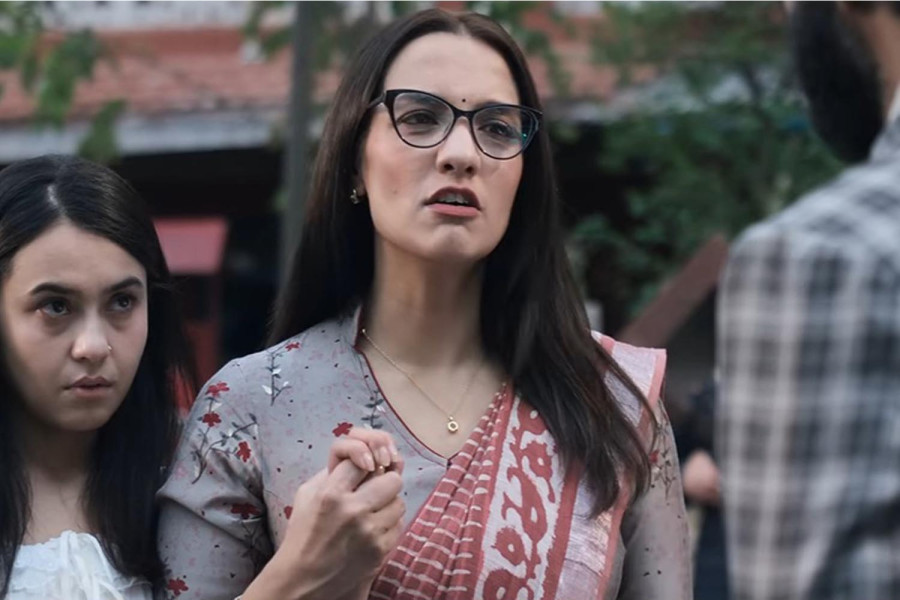
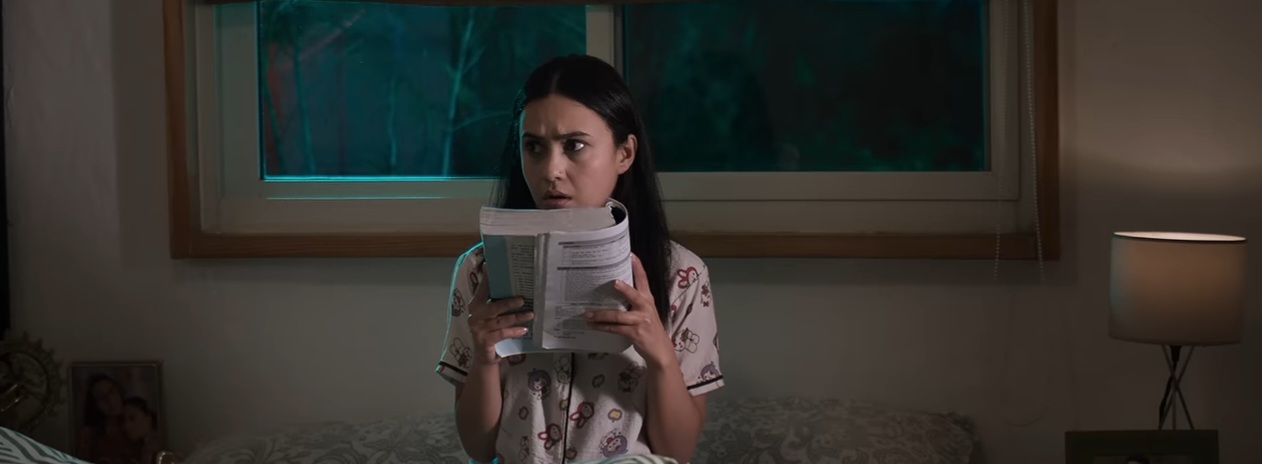
The film follows Tulsi (Priyanka Karki), a science teacher, and her daughter Ankita (Simran Khadka), an aspiring Loksewa attendee. ‘Masterni’ begins with an exaggerated introduction of the characters, then shows how their ordinary lives change when an incident draws them into a murder investigation.
Tulsi, a seemingly bold and analytical teacher, has been separated from her husband, Abhinav, who is a surgeon in Pokhara. However, they are both equally committed to Ankita’s upbringing. Tides turn when Tulsi encounters Cecelia (Rakshya Thapa) arguing with her girlfriend in a club.
‘Masterni’ makes an unconventional choice by revealing the perpetrators at the outset. But this progression is frequently interrupted by its own lengthy exposition. The irony is that the film tells us the answer before asking the question, but still takes too long to make the question interesting.
The opening scene, for instance, stretches itself for minutes to describe a scorpion bite. A lingering close-up of Cecelia reminds us of the 2019 Cannes Film Festival, where a cameraman holds the frame on Margot Robbie, Leonardo D Caprio, and Brad Pitt for more than a minute.
Mahesh, a politician in the film, delivers his entire speech to an audience, word for word, saying, “The country is in your hands.”
And the film almost takes until the intermission to establish itself as a crime thriller.
Followed by its controversial marketing song, which offended the Nepali teaching community, the film had already invited scepticism among viewers.
However, to my surprise, it established Tulsi as a convincing science teacher (Masterni), making her knowledge a recurring motif throughout the scenes. Yet in the counterpart, it failed to give her character the depth and moral dilemma as a mother.
In between, we are asked, “To what extent can a parent go to save their child?”
Tulsi, shown as analytical initially, isn’t given the space to introspect her own morality when she encounters the climax. She does not sit back, reflect, plan, and decide. Neither does she question whether what she’s doing is the right thing. Her character moves from one straight line to another without an arc that would justify the transition.
The film therefore introduces an ethical question but does not allow its protagonist to wrestle with it.
The mother-daughter dynamics, in contrast, are the only compelling thread the film could pull. Yet, within it, it falls short due to unconvincing acting.
By watching the characters’ flawed decisions, the audience is meant to be overwhelmed by thrill, guilt, or desperation. However, the acting in ‘Masterni’ fails to convey this essence. It lacks the emotional escalation and vulnerability to set the mood even without dialogue.
During a scene in which Ankita expresses her fear to her mother, her emotional catharsis falls short of being convincing. When Cecelia’s parents argue about their daughter’s safety, the dispute simply lacks remorse.
The role of DSP Durgesh Thapa (Aryan Sigdel) should ideally create dramatic suspense in the narrative. Yet this becomes the film’s biggest weakness. Hovering around multiple suspects, it struggles to stick to the basics of investigations, with the police trafficking the CCTV footage only days after a murder case is filed.
This would have, however, become more convincing if the film’s visual language had created the paranoia or unease that the genre demands. Scenes of dispute are punctuated by abrupt zooms, which would have intensified the tension if the dialogue had been guaranteed to surprise the audience.
The background score, too, does little to compensate. Where the visual language fails to build dread, a sharper, more restrained score might have carried the tension the images could not. Instead, the music underlines emotions that are already over-explained by the dialogue, and abrupt cinematography.
Beginning as a domestic drama, the film gradually transitions into a thriller, already answering the mystery of ‘who’, but fails to replace it with a compelling thrill of ‘why’, ‘how’, and ‘what now?’




 23.05°C Kathmandu