Extreme poverty has nearly disappeared in Nepal, but half remain economically vulnerable
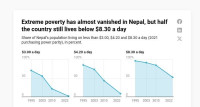
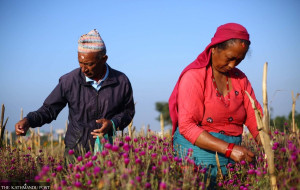
World Bank data show that just 2.4 percent of Nepalis lived below the extreme poverty line in 2022, while 52.7 percent remained below the $8.30 poverty line. Tufan Neupane/TKP
Nepal has made substantial progress in reducing poverty over the past three decades. In 1995, nearly three in four Nepalis lived on less than $3 a day, measured by per capita consumption. By 2022, that share had fallen to just 2.4 percent, according to the World Bank’s Nepal Poverty and Equity Brief, released in October 2026. The figures measure extreme poverty, using the World Bank’s international poverty line of $3 per person per day. But escaping extreme poverty does not necessarily mean achieving economic security.
Poverty can also be measured using higher daily consumption levels. The World Bank sets the poverty line at $4.20 a day for lower-middle-income countries, and $8.30 a day for upper-middle-income countries. These figures are adjusted for differences in purchasing power between countries, using 2021 prices. In 1995, 86 percent of Nepalis were unable to meet the $4.20-a-day consumption threshold. By 2022, that share had dropped to 9.1 percent. But the proportion unable to meet the $8.30 threshold remains above half the population, at 52.7 percent.
The figures suggest that although extreme poverty has declined sharply, a large share of Nepal’s still struggles to meet higher daily consumption levels.
Nepal also has its own national poverty line. Under the government’s revised measure, people whose annual per capita consumption falls below Rs72,908 are classified as poor. Based on this threshold, nearly one in five Nepalis were living in poverty.
The World Bank says Nepal has achieved “remarkable poverty reduction over the past decade”. But it warns that the gains remain vulnerable to political uncertainty, economic shocks and climate-related disasters.
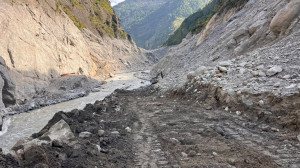
The August 2026 Bhotekoshi floods could further undermine livelihoods in affected areas. The impact could be particularly severe for communities dependent on agriculture, which accounts for 63 percent of economic activity in the flood-affected areas. Disruptions to farming and agricultural production could have lasting consequences for household incomes and livelihoods.
The Bank warns that millions of people could fall back into poverty as a result of these ongoing risks. It says reducing inequality and strengthening resilience to disasters are essential to sustaining development gains.




 13.46°C Kathmandu