Belarus frees Nobel winner Bialiatski, opposition figure Kalesnikava as US eases sanctions
In return, the United States agreed to lift sanctions on Belarusian potash.Belarusian President Alexander Lukashenko attends a meeting with John Coale, the special envoy of US President Donald Trump, in Minsk, Belarus, December 13, 2025. Reuters
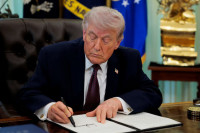
Belarusian President Alexander Lukashenko freed 123 prisoners on Saturday including Nobel Peace Prize winner Ales Bialiatski and leading opposition figure Maria Kalesnikava after two days of talks with an envoy for President Donald Trump, a US statement said.
In return, the United States agreed to lift sanctions on Belarusian potash. Potash is a key component in fertilisers, and the former Soviet state is a leading global producer.
The prisoner release was by far the biggest by Lukashenko since Trump's administration opened talks this year with the veteran authoritarian leader, a close ally of Russian President Vladimir Putin.
Western governments had previously shunned him because of his crushing of dissent and backing for Russia's war in Ukraine.
KALESNIKAVA 'THANKFUL TO USA AND TRUMP'
Bialiatski, co-winner of the 2022 Nobel Peace Prize, is a human rights campaigner who fought for years on behalf of political prisoners before becoming one himself. He had been in jail since July 2021.
Also freed were Kalesnikava, a leader of mass protests against Lukashenko in 2020, and Viktar Babaryka, who was arrested that year while preparing to run against the president in an election.
Tatsiana Khomich, Kalesnikava's sister, told Reuters she had spoken to her by phone.
"She told me she is very happy to be freed, that she is thankful to the USA and Trump for their efforts in leading the process, and to all countries involved."
It was not immediately clear where the freed prisoners were heading after their release. On previous occasions, those released have left Belarus via Lithuania.
US officials have told Reuters that engaging with Lukashenko is part of an effort to peel him away from Putin's influence, at least to a degree - an effort that the Belarus opposition, until now, has viewed with extreme scepticism.
Trump's envoy, John Coale, had earlier told reporters in Minsk: "Per the instructions of President Trump, we, the United States, will be lifting sanctions on potash."
The US and the European Union imposed wide-ranging sanctions on Belarus after Minsk launched a violent crackdown on protesters following a disputed election in 2020, jailing nearly all opponents of Lukashenko who did not flee abroad.
Sanctions were tightened after Lukashenko allowed Belarus to serve as a staging ground for Russia's invasion of Ukraine in 2022.
SANCTIONS EASING ON POTASH IS BOOST FOR BELARUSIAN ECONOMY
The exiled Belarusian opposition expressed gratitude to Trump and said the fact that Lukashenko had agreed to release prisoners in return for the concessions on potash was proof of the effectiveness of sanctions.
The opposition has consistently said it sees Trump's outreach to Lukashenko as a humanitarian effort, but that EU sanctions should stay in place.
"US sanctions are about people. EU sanctions are about systemic change — stopping the war, enabling democratic transition, and ensuring accountability. These approaches do not contradict each other; they complement each other," exiled opposition leader Sviatlana Tsikhanouskaya said in a statement.
Lukashenko has previously denied there are political prisoners in Belarus and described the people in question as "bandits". As recently as August, he asked why he should free people he sees as opponents of the state who might "again wage war against us".
Trump has publicly described Lukashenko as "the highly respected president of Belarus", a description that jars with the opposition who see him as a dictator. He has urged him to free up to 1,300 or 1,400 prisoners whom Trump has described as "hostages".
"The United States stands ready for additional engagement with Belarus that advances US interests and will continue to pursue diplomatic efforts to free remaining political prisoners in Belarus," the US embassy in Lithuania said.
Belarusian human rights group Viasna - which is designated by Minsk as an extremist organisation - put the number of political prisoners at 1,227 on the eve of Saturday's releases.
COALE DISCUSSES UKRAINE AND VENEZUELA WITH LUKASHENKO
State news agency Belta quoted Coale as saying he had discussed a wide range of issues with Lukashenko, including Russia's war in Ukraine and the situation in Venezuela.
Lukashenko has held two recent meetings with a top Venezuelan diplomat and said that Venezuelan President Nicolas Maduro, whom Trump is pressing to leave office, would be welcome to come to Belarus.
Coale said he believed Lukashenko's closeness to Putin could be useful in the context of efforts to end the war in Ukraine.
"Your president has a long history with President Putin and has the ability to advise him. This is very useful in this situation. They are longtime friends and have the necessary level of relationship to discuss such issues," Coale said, according to state news agency Belta.
"Naturally, President Putin may accept some advice and not others. This is a way to facilitate the process."




 27.12°C Kathmandu