China's parliament re-elects Xi Jinping as president
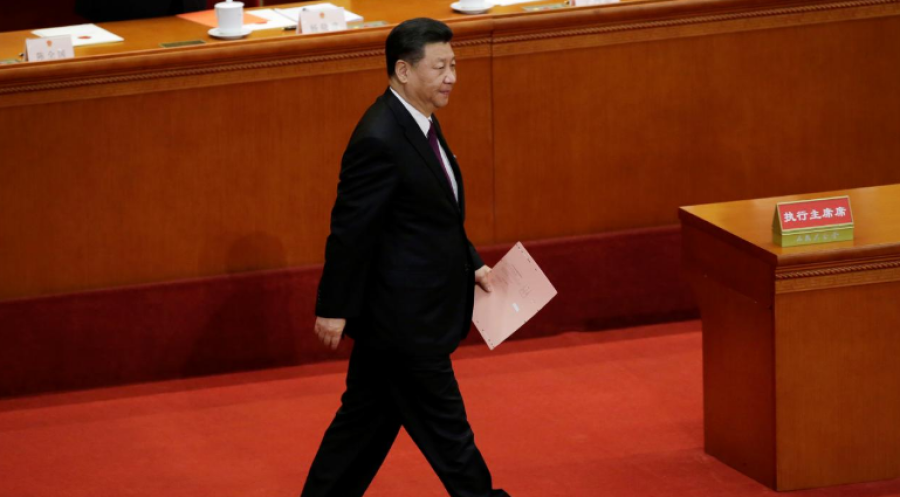
China’s top legislature—National People’s Congress (NPC)—unanimously re-elected Xi Jinping as the president of People’s Republic of China for the second term on Saturday.
China’s top legislature—National People’s Congress (NPC)—unanimously re-elected Xi Jinping as the president of People’s Republic of China for the second term on Saturday. Xi was first elected the country’s president in March 2013.
The 64-year-old general secretary of the Communist Party of China (CPC) was also elected the Chairman of the Central Military Commission (CMC) in the ongoing session of 13th NPC in Beijing.
Following the unanimous victory from 2970-member strong NPC, a supreme organ of the state power, President Xi took the oath of office vowing allegiance to the Constitution at the Great Hall of the People at west of Tiananmen Square, Beijing.
"[I pledge to] be loyal to the country and the people, be committed and honest in my duty, accept the people's supervision and work for a great modern socialist country that is prosperous, strong, democratic, culturally advanced, harmonious, and beautiful," said the president.
This is the first time the Chinese president took the oath as just recently the NPC had added oaths of allegiance into the newly-amended Constitution on Sunday. The amendment had also scrapped the term limits for the president and vice president paving the way for the executives to assume office indefinitely. Chinese officials however have stated that the president without term limit does not mean everlasting.
Xi had joined the central leadership as a member of the Standing Committee of the Political Bureau of the CPC Central Committee in 2007.He was first elected general secretary of the CPC Central Committee in late 2012.
Likewise, the 2976 lawmakers also voted Wang Qishan as the vice president of China. One lawmaker voted against Wang. Wang is attributed as a top graft-buster, whose anti-graft efforts have seen the elimination of many government officials including those at the top positions.
Furthermore, the NPC session also elected Li Zhanshu the chairman of the 13th National People's Congress (NPC) Standing Committee and 14 vice chairpersons of the NPC Standing Committee.
Xi, as the new president of the PRC, has not been contested by Chinese people at the grassroots level as his social and economic reforms, fight against corruption, strong foreign policy, Belt and Road Initiatives, and Xi’s Thought on Socialism with Chinese Characteristics for a New Era, have vested him with the unofficial title of the most influential leader of China after Mao Zedong.
“As a Chinese citizen, I’m always for the governance to go well. The president election has been executed in a democratic way by the NPC, so we are under the sunshine. I personally welcome the elected leadership of Chinese government,” said Zhe Chen, a citizen of Beijing.
In Chinese governance, Communist Party of China (CPC) is regarded as the state institution rather than a party. The president serves at the pleasure of the National People’s Congress, the legislature, and cannot take sole decisions based on his own choices. Local People’s Congress are directly elected, who have to first become the CPC members to contest the elections. These local congresses further elect higher levels of People’s Congresses and finally the NPC is formed.




 14.24°C Kathmandu