Sagar Dhakal is out of Nepal’s squad, but not out of the fight
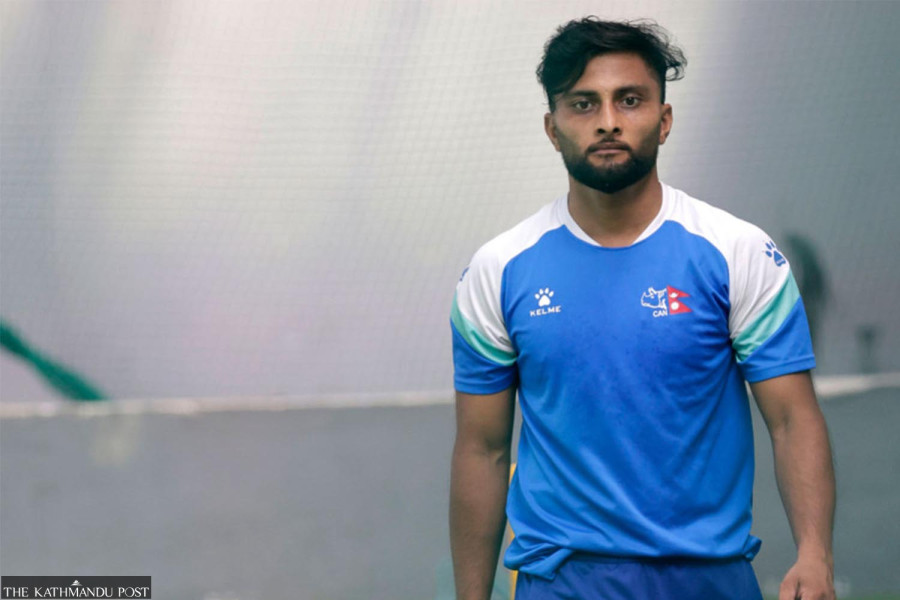
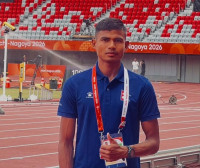
After a surprise appearance at the 2024 T20 World Cup, the left-arm spinner is battling back from a wrist injury, banking on domestic form to reclaim his national spot. Nepali cricketer Sagar Dhakal during a practice session at the indoor facility of the TU International Cricket Stadium in Kirtipur. The left-arm spinner has been putting in extra hours in the nets to recover from a wrist injury and force his way back into the national team. Hemanta Shrestha/TKP
Nepal’s national cricket team is in Malaysia for the ACC Premier Cup, while the 'A' team competes in Australia's Top End T20 Series. The men’s squad for the 20th Asian Games is also set. Yet Sagar Dhakal—a player who has recently featured in all three arenas—is noticeably absent.
Just two years ago, Dhakal orchestrated a remarkable comeback to play in the 2024 T20 World Cup in the United States. Since then, his momentum has stalled. A wrist injury sustained during last year’s Nepal Premier League (NPL) derailed his season, keeping him largely out of competitive cricket.
But he hasn’t surrendered.
Throughout the monsoon season, Dhakal has been a fixture at the TU International Cricket Stadium’s indoor facility in Kirtipur, quietly putting in the hours.
“I’m not going anywhere. I’m working hard every day,” Dhakal says. “The injury meant I missed a lot of cricket, but I believe in God’s plan, and I’m just focused on doing my part.” He remains convinced he can force his way back into the national setup, even if the timeline remains uncertain.
The NPL wrist injury left a bone dislocated. Playing through the pain was an option, but the risks outweighed the rewards.
“The physiotherapists did everything they could to get me fit enough to play, but I was still struggling. In the end, I decided to take some time off,” he recalls.
Now hyper-focused on fitness, he hopes consistent performances in the upcoming NPL, Prime Minister Cup, and Jay Trophy will pave his road back to the national side.
“It hurts whenever I’m left out of the team, because I still believe I have a future with Nepal,” Dhakal admits. “As long as I feel I can play for my country, being left out will bother me.”
Yet, he remains realistic about his current standing: “I haven’t done enough lately to expect a place in the team. I need to perform better and add more to my game.”
During Dhakal's absence, Nepal has also battled inconsistency. Their spin attack, historically a reliable match-winning weapon, has lost some of its bite. Watching from the sidelines, Dhakal notes that Nepal’s primary hurdle in one-day cricket is rapid adaptation.
“We haven’t played as well as we’d have liked in one-day cricket. We’ve struggled to adjust to conditions quickly enough,” he says. “Once we learn to adapt better and play according to the conditions, I think we can perform much better.”
How long until he reclaims his World Cup form? “Not much longer. It’s only a matter of time,” Dhakal asserts. “The injury set me back, but I’m bowling well and training regularly. I’m also in touch with most of my former coaches.”
Dhakal still views his 2024 T20 World Cup selection as a fortunate twist of fate. Having spent the previous year travelling as a reserve, he capitalised on a rare opening.
“Monty Desai sir and CAN gave everyone an opportunity, and I made the most of mine. It turned into the biggest opportunity of my career. Not everyone gets the chance to represent Nepal at a World Cup.”
The turning point arrived just before the tournament, during West Indies A’s five-match T20 tour of Kathmandu. Dhakal claimed a series-high six wickets for Nepal.
“Performing well against a strong side gave the team more confidence in me, and I think that played a big part in my World Cup selection,” he says.
Earning praise from the West Indies' coach and captain, Dhakal used the series as a masterclass, even seeking advice from Caribbean left-arm spinner Gudakesh Motie.
“He told me to look at where I could still improve. We usually get spin-friendly pitches in Nepal, but he explained how to bowl on flatter surfaces, vary pace, and think more tactically. The West Indies players were very open.”
For now, patience is his anchor. “I’m not trying to force things according to my own plan. I’m leaving that to God.”
Breaking back into the squad won't be easy. He faces stiff competition from established left-arm spinners Lalit Rajbanshi and Shahab Alam, alongside a crop of emerging talents. Dhakal, however, views this depth as an asset rather than a roadblock.
“Competition is tough, but that’s part of the game. I don’t want to focus on who I’m competing against; I’d rather focus on improving my own game and figuring out how I can contribute to the team.”
To Dhakal, left-arm spin has long been the bedrock of Nepali cricket.
“Growing up, the bowlers who won matches for Nepal were often left-arm spinners. We watched Basant Regmi and Shakti Gauchan and wanted to be like them.” He notes that Regmi still calls him occasionally to offer guidance.
Dhakal’s own journey traces back to Khaireni, Gulmi, where his earliest role in informal matches with his uncles was simply chasing the ball across the hillsides. That fielding chore gradually blossomed into a passion for the game.
After moving to Kathmandu, he enrolled at the Great Himalaya Cricket Academy, dreaming of becoming a batsman. It was academy coaches Naresh Budhayer and Rupesh Shrivastava who recognised his bowling potential and urged him to pivot.
Bowling quickly became his calling. The batsman in him, however, never quite went away.




 26.19°C Kathmandu