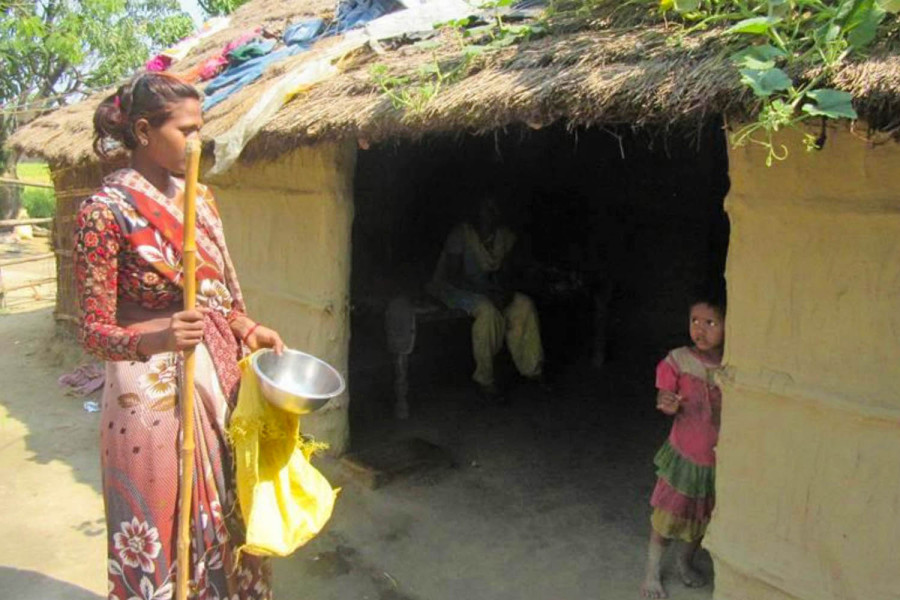
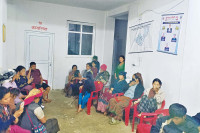
Although constitution promises social security and allowances for endangered groups, Kapilvastu’s Netuwas remain excluded from state support. A Netuwa woman begs for alms at a hut in Bisunpur in Shivaraj Municipality in Kapilvastu, in this recent photo. Photo: Courtesy of Sanjaya Pasi
Shubhawati Netuwa, 50, from Dhupahi in Mayadevi Rural Municipality, spends her days moving from one settlement to another, collecting food to survive. With no land of her own to cultivate, begging has remained her only option. “We cannot go hungry. What we gather from villages is what keeps us alive,” she said.
Shubhawati’s son Hiru, 30, works as a daily wage labourer, and his earnings help provide two meals a day for the family. But it is not enough to sustain the seven-member household without her efforts. For generations, begging has been the family’s traditional occupation. The Netuwa family has relied on it to feed her children and grandchildren.
Until recently, the Shubhawati family lived under a plastic sheet on someone else’s land. After an Indian national vacated a tin-roof hut with rooms built on public land, local people decided to let her family move in. “It is better than before, but we still struggle every day,” she complained.
A similar story unfolds in Abhirawa, where Kamalawati Netuwa, 45, survives by going door to door. Her husband Bikram works as a labourer, and together they manage to feed their six-member family. They live on land owned by a local landlord. Although they received a two-room house under the government’s People’s Housing Programme, they lack a land ownership certificate, preventing them from getting an electricity connection.
“With no steady income, we cannot send our four children to school. We have to walk from village to village just to manage food,” said Kamalawati.
Across Kapilvastu, a Tarai district in Lumbini province, the endangered Netuwa community continues to live in extreme hardship. Most have never attended school, own no ancestral property, and depend on begging for survival. Apart from seeking alms, some rescue snakes, collect honey, and live a nomadic lifestyle, moving from place to place.
Despite being recognised as a minority group, members of the community say they have been unable to access social security allowances provided by the state. Nayataram Netuwa, chairman of the Netuwa Development Centre, an advocacy group, said it was deeply troubling that they still had to rely on begging in modern times. “Those who make policies are responsible for this situation. In this day and age, living by begging is unimaginable. If we are given alternatives, we are ready to leave this occupation,” he said.
According to the 2021 national census, the Netuwa population in Nepal stands at 2,896. However, community leaders argue that the actual number may be lower, as some people using the Netuwa surname in the eastern Tarai follow Islam and may not belong to the same group. “The original Netuwa community follows Hindu traditions,” said community leader Pandit Netuwa.
Government provisions classify ethnic groups with less than 0.5 percent of the total population as minorities. Since the fiscal year 2019-20, several endangered communities—including Kusunda, Raute, Hayu, Kisan, Meche, Bankariya, Surel, Raji, Lepcha and Kusbadia/Pattharkatta—have been receiving monthly social security allowances, currently set at Rs4,000. However, the Netuwa community remains excluded, despite similar or even smaller population size.
Article 43 of Nepal’s Constitution 2015 guarantees the right to social security for economically disadvantaged, disabled and helpless individuals, single women, children and endangered ethnic groups. Activists say the state has failed to implement these provisions effectively for the Netuwa.
“It is unfortunate that no programmes have been introduced to transform communities that depend on begging. People insult us, mock us and treat us badly when we ask for help. But without alternatives, we are forced to endure it just to survive,” said Sanjay Pasi, a rights activist.
Community members claim they have been living in the district for at least eight generations, mostly in public or unregistered land and informal settlements. In Kapilvastu alone, there are 113 households comprising around 530 individuals across six local units. In neighbouring Rupandehi, 33 households account for 219 people.
Most live in fragile huts made of straw, mud or brick walls with tin roofs. Only two houses have concrete structures. None own agricultural land, and their incomes are irregular. “We barely manage to eat. Buying new clothes or paying for medical treatment is extremely difficult. Building a proper house is just a dream,” said Prahlad Netuwa of Abhirawa.
Around 80 percent of the community still relies on begging as the primary source of income. Women and young daughters often face harassment while seeking alms. “People tease them, use abusive words and look at them with suspicion. But we have no choice,” Prahlad lamented.
Traditional occupations such as snake catching and honey collection have also become unreliable. “Snakes are not always available, and the work is risky. In the past 50 years, five members of our community have died while catching snakes,” said Chandrika Netuwa.
Education remains a major challenge. Only one or two individuals in the community have completed Grade 12. Although about 80 percent of children are now enrolled in school, only around 30 percent attend regularly. Poverty, migration and lack of awareness continue to hinder their education.
Social discrimination further compounds their hardship. “Sometimes so-called upper caste people treat us as untouchable. They refuse to eat or sit with us, which adds to our suffering,” said Bhuwar Netuwa.
In Abhirawa, five Netuwa households have been living on the same land for three generations, yet it is registered under someone else’s name. Without land ownership documents, they have been unable to install electricity despite repeated attempts.
Amid these challenges, younger members of the community are beginning to dream of a different future. Ravi Netuwa, a 17-year-old Grade 8 student, said he wants to study pharmacy. “Our traditional occupation is not good. Young people must come together and move forward with new ideas,” he said.
Similarly, Ashish Netuwa, 17, from Yashodhara Rural Municipality, hopes to secure a government job. “No one from our community has entered government service. I will complete Grade 12 and become employed, no matter what,” he said.
Despite having a distinct identity and cultural heritage, the Netuwa community remains socially, economically and politically marginalised. Categorised under Madhesi Dalits, they continue to face exclusion from basic state services. In response, community members have established the Netuwa Development Centre to raise their voices and demand change.




 15.33°C Kathmandu