Issues of nature and conservation take a back seat in election campaigns
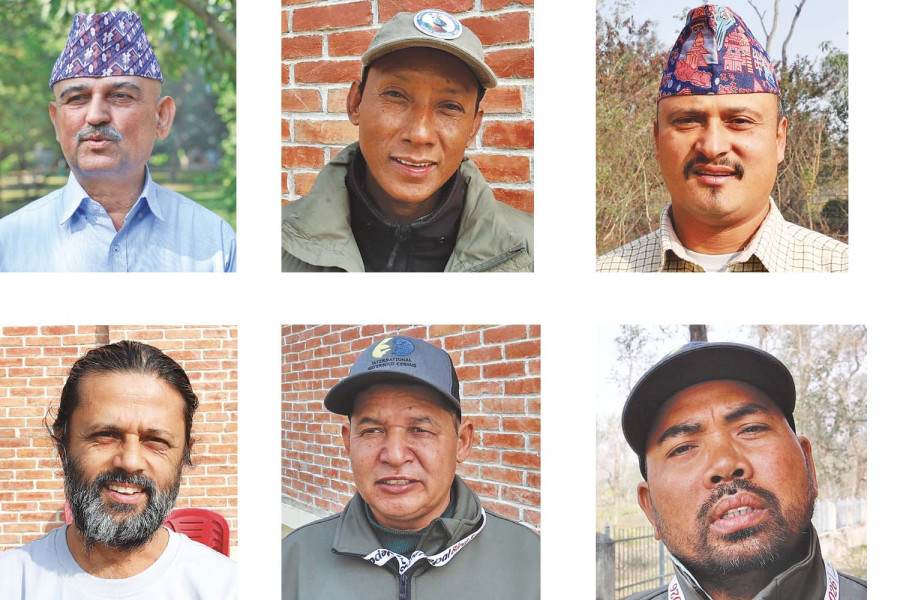
Conservationists say parties prioritise vote-winning projects and ignore the long-term benefits of conserving biodiversity. (From top) Hemsagar Baral, DB Chaudhary, Manashanta Ghimire, Raju Acharya, Ram Shahi and Hirulal Dagaura. Post Photos
As political parties intensify their campaigns ahead of the March 5 elections, infrastructure development dominates speeches and poll manifestos while issues of nature conservation, eco-tourism and climate resilience remain largely overlooked.
Although eco-tourism is widely recognised as a vital pillar of national development, economic growth, cultural preservation and job creation, electoral pledges continue to prioritise physical infrastructure over environmental sustainability. Conservationists and stakeholders warn that in the rush to unveil vote-winning projects, long-term ecological concerns are being ignored.
“Nepal holds immense potential as one of the world’s finest eco-tourism destinations,” said Raju Acharya, Nepal representative of the World Owl Trust and a recipient of the famed Whitley Award. “Our geographical diversity—from the high Himalaya to the Tarai—our globally renowned natural beauty, birdlife, wildlife, cultural heritage and spiritual traditions place us in a unique position. But political parties lack adequate understanding of the importance of conservation areas. Without that awareness, suitable policies cannot be formulated,” he lamented.
Acharya said many leaders hesitate to speak strongly about environmental safeguards, fearing they may be perceived as obstructing development. “There is a mindset that roads and concrete structures alone define progress. Yet the very air we breathe and the forests that sustain us are equally vital. When that awareness is missing, conservation is pushed aside,” he said.
Nepal is considered a global biodiversity hotspot despite its small size. Around 350 plant species and 160 animal species found in the country are endemic. Nearly nine percent of the world’s bird species and about two percent of flowering plant species are recorded in the country. The country is home to 903 bird species and more than 695 butterfly species, reflecting remarkable ecological variation from the plains to the high mountains.
However, conservation advocates argue that such natural wealth rarely features prominently in the elections campaigns. Ram Shahi, former president of the Bardiya Nature Guide Association, said investments in conservation do not yield immediate political dividends. “The returns from conservation take time. That is why parties focus on projects that quickly influence voters. But without protecting nature, tourism cannot flourish and prosperity will remain elusive,” said Shahi.
Various reports show that more than 60 percent of foreign visitors to Nepal include national parks and protected areas in their itineraries. Wildlife reserves and conservation areas remain key attractions, yet policy clarity, improved infrastructure within protected zones and stronger local participation are often missing.
Community leaders echo similar concerns. DB Chaudhary, coordinator of the management committee of the world’s first community-run Jatayu (vulture) Restaurant in Nawalpur, said political parties have failed to treat conservation as a shared responsibility. “We survive because of nature. We know we cannot live without it, yet we fail to translate that knowledge into policy and planning,” he said. “Without clear policies, sustainable conservation cannot be achieved.”
Environmental experts also highlight the growing toll of pollution and climate change. Air pollution is estimated to cause around 42,000 premature deaths annually in Nepal. Melting glaciers, erratic rainfall and extreme weather events linked to climate change are already affecting mountain communities and downstream populations. Despite this, parties rarely foreground mitigation or adaptation strategies in their manifestos.
Hem Sagar Baral, senior ornithologist and wildlife expert, said leaders appear to have forgotten that environmental degradation directly affects public health. “Issues like clean air and biodiversity conservation have immediate impacts on people’s wellbeing. Whichever party presents credible plans for birds, wildlife and conservation naturally earns our attention,” said Baral.
According to conservationists, while the benefits of conservation investment may take 10 to 20 years to materialise, infrastructure projects can be showcased instantly. “That is why political parties and their leaders gravitate towards roads and buildings. But long-term national interest lies in safeguarding natural resources,” said Hirulal Dagaura, a Kailali-based ornithologist.
Conservationists argue that reducing pollution, protecting biodiversity and ensuring that eco-tourism benefits reach rural communities must become central policy priorities. Expanding eco-tourism infrastructure in remote areas and promoting sustainable use of natural resources could significantly enhance local incomes.
Manashant Ghimire, former president of Pokhara Bird Society, said eco-tourism is currently one of the fastest-growing segments of global tourism due to increasing public interest in nature-friendly travel. “Nepal’s tourism industry’s soul is eco-tourism. Political commitment alone is not enough. We need clear action plans, assured budgets and accountability,” said Ghimire.
Nepal received around one million foreign tourists annually, a figure stakeholders believe could be doubled or tripled with coherent conservation-focused policies. Without integrating environmental priorities into electoral agendas, they warn, the country risks undermining the very assets that draw visitors and sustain livelihoods. So why, conservation advocates urge to incorporate the issues of nature and nature conservation as top-priority election agenda.




 14.82°C Kathmandu