Speaker urges government to make laws through Parliament, not ordinances
DP Aryal says legislation should undergo wider debate and public scrutiny, as the government considers introducing more ordinances before the next parliamentary session.RSS
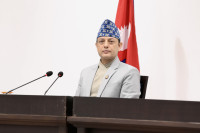
Speaker DP Aryal has asked the government to make laws through Parliament rather than relying on ordinances, saying the public should know what laws are being drafted and have an opportunity to contribute to the process.
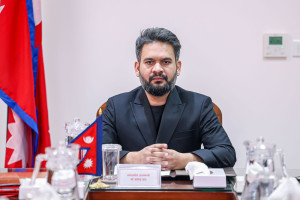
Saying Parliament is ready to enact legislation, Aryal argued that wider debate and scrutiny in the House would also benefit Prime Minister Balendra Shah and his government.
The remarks come amid growing discussion about the government issuing more ordinances before the next parliamentary session. The government has already introduced nearly half a dozen ordinances since the end of the federal Parliament’s budget session.
On October 12, President Ramchandra Paudel issued the Ordinance to Amend Certain Nepal Acts Relating to Disasters, 2026 on the recommendation of the Council of Ministers. On October 13, he issued two more ordinances to amend laws relating to forests and land. On October 16, he issued the Nepal Academy of Science, Technology and Innovation Ordinance, 2026 and the Science, Technology and Innovation Ordinance, 2026.
There is also speculation that the government may introduce an ordinance to amend the Civil Service Act before the next session, when Parliament is expected to take up bills. The prospect of changes to civil servants’ retirement provisions has caused unease within the bureaucracy.
The government has already registered a bill to amend the Civil Service Act in Parliament. Ministers have said that issuing an ordinance is still under discussion and that no decision has been made.
The government is also preparing to introduce ordinances before the next parliamentary session on the Banks and Financial Institutions Act (BAFIA), on the recommendation of the Finance Ministry, and on the Press Council, on the recommendation of the Ministry of Information and Communication. Similarly, officials from the ministry concerned informed that preparations are also underway to bring laws related to the Ministry of Women, Children, Gender and Sexual Minorities, and Social Security through an ordinance.
Aryal said Parliament should be given the opportunity to debate legislation in detail before it is passed. Speaking to Kantipur on Friday, he said lawmakers should be able to express their views and that stakeholders and the public should be informed about proposed laws.
“My clear position is that laws should be made after as much dialogue and discussion as possible, with every member of parliament given an opportunity to put forward their views. Stakeholders and the public must also know what laws are being drafted,” he said. “I have always held this position, still do, and will continue to do so.”
Aryal said he was ready to convene Parliament to facilitate the legislative process. Making laws through parliamentary debate would also serve the prime minister and his Cabinet better, he argued.
“We are ready to convene the House, and everyone is prepared to sit. Making laws through as much debate and discussion in Parliament as possible would be better for the state, the Cabinet and the prime minister,” he said.
He said laws passed through Parliament would command greater public and international confidence because of the debate and scrutiny involved in their making.
“Making laws through Parliament benefits all state institutions. It is important for the judiciary, executive, legislature, the public and the international community to see how laws are made in Nepal and how actively lawmakers and citizens engage in the process,” he said.
Asked whether the Rastriya Swatantra Party-led government was seeking to bypass Parliament by issuing ordinances, Aryal said he did not think so. He said he was aware of concerns within the civil service that the government might amend the Civil Service Act through an ordinance.
The speaker said every citizen had the right to know what laws were being made and how they would affect them. He stressed that people and other stakeholders should have sufficient opportunity to discuss proposed legislation concerning them.
Aryal, however, acknowledged that the Constitution gives the government the authority to issue ordinances when necessary. He said the use of that provision should not automatically be viewed negatively if circumstances warrant it.
“We should not object to the use of the constitutional power to issue ordinances. The state can exercise that authority when necessary for governance, and such action should be respected,” he said.




 15.53°C Kathmandu