



 19.83°C Kathmandu
Sat, Oct 10, 2026
Politics
Congress reins pass to Gagan Thapa and Bishwa Prakash Sharma
Thapa’s election as president and Sharma’s unopposed rise as senior vice-president mark a generational shift, but the pair inherit a party still divided by factional rivalries and an entrenched political culture.
bookmark
Kul Chandra Neupane
Published at : October 10, 2026
Updated at : October 10, 2026 12:18
Kathmandu
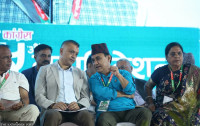
Gagan Thapa has won the Nepali Congress presidency with 93.88 percent of the vote, while Bishwa Prakash Sharma has been elected senior vice-president unopposed, placing the party’s leadership firmly in the hands of two politicians once described as a “pair of oxen” pulling the Congress plough together.
Thapa secured 6,584 votes against 375 for rival Shyam Krishna Khadgi, winning by a margin of 6,209 votes. Kishor Singh Rathore, who had also filed a nomination against Thapa, withdrew his candidacy. Sharma was the sole candidate for senior vice-president, while Pushpa Bhusal was the only candidate for women’s vice-president. Both were elected unopposed.
The pairing has a history. In December 2021, ahead of the Congress’s 14th general convention, the late Congress leader Pradip Giri described Thapa and Sharma as a “pair of oxen” who should pull the party forward together.
“Two young men, truly young in age, in their speech, in their qualifications and in their emotions,” Giri said at the time. “Just as two oxen are yoked together to plough a field, the two of you should pull the Congress plough forward.”
Five years on, Giri’s metaphor has taken on a political life of its own. Thapa is now the party president and Sharma his senior vice-president.
Giri had also warned the two against repeating Congress’s long history of leadership rivalries, pointing to the disputes between Ramchandra Poudel and Sher Bahadur Deuba and earlier between Girija Prasad Koirala and Krishna Prasad Bhattarai. His message was simple: they should work together.
The two have travelled a long way together, although they were not on the same factional ticket at the 14th general convention. Thapa was elected general secretary from Shekhar Koirala’s panel, while Sharma won the same post from Prakash Man Singh’s camp.
Their political relationship dates back even further. When Sharma was president of the Nepal Students Union in 2000, Thapa served as his vice-president. Now they are responsible for steering the country’s oldest democratic party.
Their partnership became particularly close after the Gen Z movement and the political upheaval that followed.
Thapa took over the party presidency at a special general convention in January, attended by about 54 percent of the party’s representatives. The Election Commission recognised the leadership elected by that convention, while a legal dispute over the process continues.
The relationship between the two leaders also survived a moment when Thapa had considered a different arrangement. According to people familiar with the discussions, Thapa had suggested that Sharma take the party presidency while he pursued the prime ministership. Sharma declined.
“You become president. I have an urge to become prime minister and do something,” Thapa told Sharma, according to the account.
Sharma’s response was immediate: “The country needs you. You should be both president and prime minister.”
At the special convention, Sharma backed Thapa’s bid for the presidency, and the convention also endorsed Thapa as the party’s prospective prime ministerial candidate. The Congress subsequently suffered a heavy defeat in the March election, with Thapa himself losing his parliamentary seat.
Thapa offered to resign and proposed that Sharma take over as acting president. Sharma opposed the move, and Thapa remained in office.
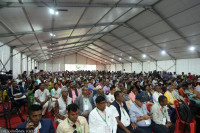
Now, after months of political upheaval and factional realignment, the two are once again at the centre of the party. The 15th general convention is the first full-scale national gathering since Thapa assumed the presidency and is reshaping the Congress’s organisational structure, including greater representation for younger members. The new structure reserves 21 central working committee seats for people under 35.
Thapa’s rise to the top, however, does not mean the Congress has put its old factional rivalries behind it.
Former president Sher Bahadur Deuba remains outside the Thapa-led mainstream and is pursuing a separate convention process. More than 30 leaders previously aligned with Deuba have, however, moved towards the Thapa-led structure, while other senior leaders have also shifted position.
Political analyst Bishnu Sapkota believes Thapa’s arrival at the top of the party came four or five years later than it should have.
“The political disenchantment among general public increased after the promulgation of the constitution in 2015. The votes received by Balendra Shah and the Rastriya Swatantra Party were a response to that,” Sapkota said. “One reason was also that Gagan Thapa could not come to the party leadership earlier. The positive aspect of the Gen Z movement was that it led to the special convention and brought Gagan Thapa to the leadership.”
Sapkota believes Thapa’s rise could also put pressure on other parties to change.
“For the Congress, his arrival in the leadership was necessary, but once he comes, there will be pressure on other parties as well to undertake serious reforms within their own organisations,” he said.
But Sapkota cautions against assuming that a change at the top will immediately transform the party.
“It's difficult to say that everything will change as soon as Gagan Thapa arrives. Leaders who entered politics over the past 20 years hoping that being close to powerful figures would bring opportunities are still in the party,” he said. “They have a hold over the structures at the lower levels and carry the baggage of the old politics.”
That tension between generational change and an entrenched political culture will be one of Thapa’s biggest challenges. His political rise was built partly on questioning those in power and challenging his own party’s established leadership. He must now show that the same politics can shape the party when he is the one making decisions.
The ideological direction of that new Congress is another unresolved question. The former Deuba camp has accused the new leadership of moving away from the Congress’s socialist tradition. Thapa has rejected that interpretation, arguing that the party’s economic policies will remain grounded in democracy, nationalism and socialism while adapting those principles to contemporary conditions.
Political analyst Lok Raj Baral sees that adaptation as inevitable.
“Marxism is no longer what it was in its old form. The CPN-UML calls itself Marxist-Leninist, but in practice it talks about liberal democracy and a mixed economy,” Baral said. “I don't think the Gagan-led Congress has abandoned socialism. It is trying to reinterpret its principles according to the times. That needs to be done.”
Baral also sees value in Thapa’s willingness to acknowledge the party’s failures.
“For me, the biggest strength is that he is trying to move forward by acknowledging mistakes,” he said.
Professor Krishna Khanal, another political analyst, says the bigger question is whether those ideas will translate into policy and a different relationship between the party and the public.
“The question is how that is translated into policy. What will the economic policy be? What will the social policy be? What kind of relationship will there be between the state and citizens? The Congress needs to be clear on these issues, and Gagan has been trying to clarify them,” Khanal said.
The organisational changes announced at the convention are part of that effort, but Khanal says structure alone will not change the party.
“In the age of technology, information and communication, such a large structure was not necessary. It is not enough to say that our structure is large and inclusive. The central issue is connecting with the people,” he said. “The biggest challenge is political culture. The Congress has to understand its history, its path and its ideas. Even that will not be enough unless it demonstrates them in practice.”
The Congress has expanded its office-bearer structure from 14 to 25 positions, with five vice-presidents, three general secretaries and 15 joint general secretaries. The new central working committee also reserves 21 seats for members below 35. The changes are intended to broaden representation, but they will also require Thapa to manage a larger and potentially more demanding leadership structure.
That challenge has become more pressing since last year’s Gen Z movement, whose anger over corruption, poor governance and established political parties implicated the Congress as part of the political system it had helped shape. Thapa has acknowledged that failure and promised to rebuild the party around political values, organisational reform and a renewed connection with voters.
Former UML leader Ram Kumari Jhakri, a contemporary of Thapa, says the real test now lies in whether he can live by the standards he once demanded of others.
“The question today is not how far Gaganji has come or where he has reached. It is what he does after reaching there,” Jhakri said. “Can he now practise in his own behaviour the lessons on democracy, accountability, generational change and political culture that he demanded from others? Time will answer that.”
Khanal makes a similar point about Thapa’s promises.
“Thapa does not need to make many promises. He needs to demonstrate what he has said,” Khanal said. “It is not enough to bring young people into the party structure. The leader himself has to connect with the people.”
The next local and provincial elections will provide the first major electoral test of whether Thapa can translate his political message into an organisational and electoral revival.
His own political career has been defined by risk, from his involvement in the student movement and his opposition to the monarchy to his challenge to the party’s established leadership. But the nature of that risk has now changed. He no longer has the luxury of simply questioning those who make decisions. He has the authority to make them and must also carry responsibility for their consequences.
Asked by Kantipur what kind of Congress he wants to see after four years as president, Thapa said his central goal was to restore value-based politics.
“We want to bring back the politics of values. Some things cannot be changed immediately; they take time,” he said. “But we want to advance certain values. We did not come here because someone told us to. There is a long history and a legacy behind this.”
He also said he wanted to listen to the younger generation that had taken to the streets.
“If I don't like it, I can leave. But I want to listen to why the young people rebelled and engage in dialogue with them,” Thapa said. “I want to understand what they are trying to do, in our language and in theirs, and then work accordingly. I want to build a Congress that can regain the trust it has lost.”

Most Read from Politics
In New York, Foreign Minister Khanal introduces Nepal’s new political order
Home Minister Sudan Gurung to visit India next week
Nepal’s climate diplomacy faces a test of delivery
From the Himalayas to the islands, Nepal calls for a united climate response
Uproar in Nepal parliament over former chief justice’s unexplained detention
Editor's Picks

Constitutional Bench caught in seniority, ‘pick and choose’ dispute

A Dom boy’s long road to becoming a doctor

From blankets to handmade dolls, two foreign women bring comfort to flood survivors

News Analysis: When institutional defence exposes institutional fault lines

It’s a bird … it’s a plane … it’s the Indian ambassador’s farewell tweets
E-PAPER | October 10, 2026

×