Floods push back Siddhababa tunnel opening to mid-January
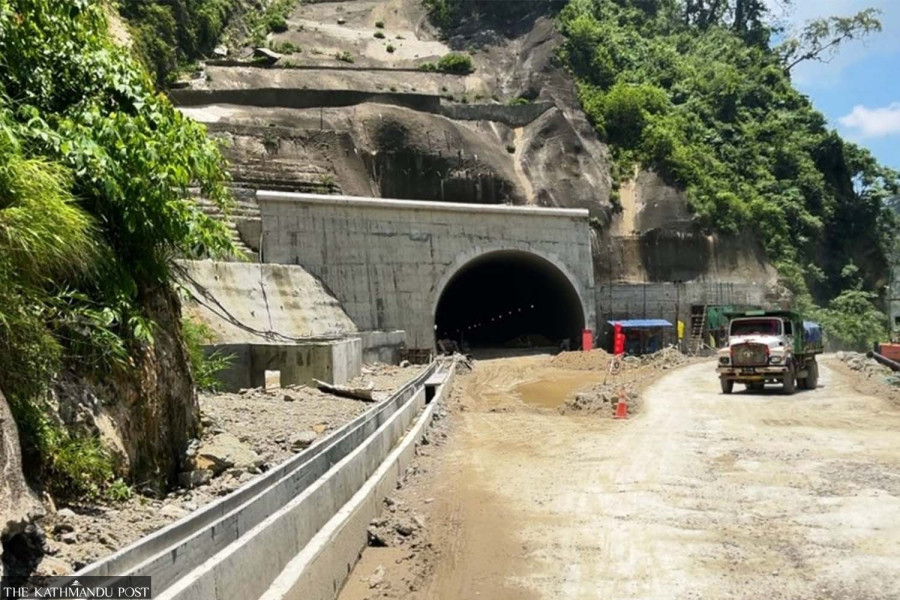
The Bhotekoshi and Kaligandaki floods disrupted the delivery of electrical and safety equipment, delaying plans to open the tunnel to traffic. Structures at the Butwal entrance of the Siddhababa tunnel are ready. Ghanashyam Gautam/TKP
Plans to open the Siddhababa tunnel to traffic have been pushed back until mid-January after floods in the Bhotekoshi and Kaligandaki rivers disrupted the delivery of equipment needed to operate the tunnel.
The project had aimed to allow vehicles through the tunnel before the Dashain festival. But the installation of electrical equipment and safety systems remains incomplete. The project office now expects to open it by mid-January.
China State Construction Engineering Corporation, the contractor, has been importing most of the construction materials from China. Equipment needed to operate the tunnel, including electrical components and safety systems, was also due to arrive through the Rasuwa border point. But floods in the Bhotekoshi blocked the route, forcing the consignment to be rerouted through the Korala border point in Mustang.
The delivery was further delayed when floods in the Kaligandaki washed away concrete bridges along the corridor, disrupting transport through the alternative route.
Soumya Anand, information officer and engineer at the Siddhababa Tunnel Project Office in Butwal, said construction materials had been arriving through Rasuwa until August 26. The contractor had planned to use the same route to bring in the remaining electrical and safety equipment, but the floods left the consignment stranded along the way.
“The equipment that was due to arrive through Rasuwa has been rerouted through Korala and is now on its way here. The contractor expects it to arrive in the next few days,” Anand said. “Once the equipment reaches the construction site, installation will take another one and a half to two months. We are preparing to open the tunnel to traffic after that.”
Representatives of the construction company have travelled to Korala to coordinate the delivery. Anand said the floods had disrupted the plan to open the tunnel before festivals.
According to the project office, physical progress stands at 70.26 percent, while financial progress has reached 63.55 percent. Most of the structural work inside the tunnel has been completed, as has the connection to the control room.
However, the installation of lighting, ventilation, sound-control systems and emergency telephones is still pending. Some other safety-related works and painting of the tunnel walls up to a height of four feet also remain unfinished.
China State Construction Engineering Corporation signed a contract to build the tunnel in February 2022 and began construction towards the end of 2022-23. The contract is worth Rs7.34 billion, of which the company has received 63.55 percent. The contractual deadline for completing the project is mid-April 2027.
The contractor completed the tunnel breakthrough on January 24, 2025, and has been working to finish the remaining construction ahead of schedule. Concrete work on the tunnel floor and walls, along with the lining, has been completed. Technical buildings at both entrances have also been built, with finishing work, electrical installations and network connections underway.
The installation of lights, fans and ventilation systems, part of the tunnel’s electromechanical works, is in its final stages.
Three bypass tunnels, measuring 151 metres, 161 metres and 130 metres, have been built to serve as emergency exits. The main tunnel, all three bypass tunnels, 14 culverts and the pavement inside the tunnel have been completed, Anand said.
“We are also preparing to begin concreting the approach roads as required under the contract,” she said.
The project includes concreting 900 metres of road south of the tunnel towards Chidiya Khola and another 550 metres to the north, from Dam Side to Nagnath. Work on both sections began but was suspended because it disrupted traffic.
The paving of the existing road outside the tunnel, along with measures to improve its safety, will begin only after vehicles start using the tunnel, the project office said.
Several safety structures are also planned to protect the road outside the tunnel from recurring landslides and falling rocks. These include rockfall barriers, rock sheds and slope protection works.
The project office says the structures, which are being introduced in Nepal for the first time, will make nearly 900 metres of the road outside the tunnel as safe as a mini-tunnel.
Project chief and Senior Divisional Engineer Nawaraj Bastola said nearly 71 percent of the 1,126-metre tunnel had been completed. By the time it opens to traffic, construction progress is expected to reach 85 percent.
“We are working to complete the project ahead of the contractual deadline,” Bastola said. “Vehicles will be able to use the tunnel within the next two months at the latest.”
He said five months remained before the contractual deadline.
Under the agreement, the contractor is also responsible for upgrading and securing sections of the Siddhartha Highway on the Palpa side that are prone to landslides and other hazards. The work covers 3.5 kilometres of road and includes upgrading a 780-metre stretch to a double-lane concrete road, building bypass roads and installing rock nets, rock sheds and slope protection structures along the upper slopes.
Once operational, the Siddhababa tunnel is expected to make travel easier for vehicles heading from Butwal along the Siddhartha Highway to Palpa, Gulmi, Syangja, Pokhara, Parbat, Baglung, Myagdi and as far as Muktinath. About 3,000 vehicles use this route every day.




 20.02°C Kathmandu