Police hunt Nepali links to 21.75 kg gold smuggling racket
Investigators suspect gold entered through Kathmandu airport before being processed in Budhanilkantha and potentially transported to India. The three Chinese suspects have not cooperated much with the investigation, police say.
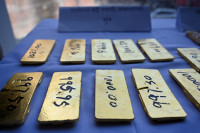
Police are searching for Nepali accomplices in a suspected gold smuggling network after recovering 21.75 kg of gold earlier this month from a house in Budhanilkantha, Kathmandu, where three Chinese nationals allegedly operated a processing unit.
The Kathmandu Valley Crime Investigation Office started its investigations regarding who helped store the gold, distribute it or transport it to India. Senior Superintendent of Police Santosh Khadka said investigators had yet to establish a Nepali connection.
“The three Chinese suspects have not cooperated much with the investigation, but we have sent the seized digital devices to a forensic laboratory, which may provide some information,” Khadka told Kantipur. “We are investigating other aspects as well.”
Police are questioning the suspects through an interpreter, but say they have answered a few questions. They are examining their contacts, devices, and CCTV footage, including airport parking footage. Police have not been able to identify the source of the gold or establish how it was brought into Nepal. Those questions remain central to the investigation.
Investigation officers believe that local contacts would be needed to store smuggled gold, distribute it, and send it across the border into India. Indian nationals may also have been involved.
Former Additional Inspector General of Police Basanta Lama, who served on a high-level gold investigation committee formed in 2017, said some Nepali involvement was likely. Even if the Chinese brought the gold into Nepal themselves, they could not take it to India without Nepali help,” said Lama.
Figures from the Federation of Nepal Gold and Silver Dealers’ Association indicate that Nepal consumes around 30 kg gold daily, while Nepal Rastra Bank releases only 25 kg a day to the market through Rastriya Banijya Bank. That leaves an apparent shortfall of five kilogrammes.
“That gap is filled by smuggled gold; the rest of the gold brought in illegally goes to India,” said Lama. Police have not found evidence that Nepalis helped bring the gold into the country or prepare it for sale. They are investigating whether local contacts helped move it onwards.
A police officer said the Department of Customs was leading the inquiry, while police examined Nepali links and the suspected route to India.
Police arrested Chinese nationals Zhou Langqin, 47, Han Fei, 37, and Wang Jianzheng, 36, on October 8 after raiding a rented house in Bhangal, Budhanilkantha. The property belonged to a person living in the US. The suspects had rented it from July 23 and paid Rs1.32 million in advance for four months.
Investigators suspect the men chose a house whose landlord lived elsewhere, believing it would attract little attention. “They appear to have thought that nobody would pay attention if they rented a house whose owner was away,” an officer said. “Gold was brought there in a semi-solid form, processed and turned into bars.”
Acting on specific information, police had kept the house under surveillance for more than 10 days. There was little movement until a car left at around 5am one morning. Officers stopped and searched it, finding two gold biscuits. A subsequent search uncovered more gold and equipment used to process it.
GPS records show that the vehicle visited Tribhuvan International Airport’s parking area at least six times. Police suspect the gold may have been taken out of the airport in a semi-solid form before being processed at the house. Han had hired the car at the airport soon after arriving in Nepal, for use from October 10 to 25.
Police say Han had previously visited Nepal with his family on August 4 to assess the gold market and prices, returning to China on August 29. Investigators suspect he may have contacted Nepalis during that visit, although this has not been established.
“We have not found Nepali involvement in bringing the gold in or preparing it for the market,” said Khadka. “We are checking whether there were contacts involved in sending it to the market.”
The case follows major investigations that have not stopped gold smuggling in the country. Police data show that 579.218 kg gold smuggled by air and land were seized between fiscal years 2016-17 and 2025-26. During that period, 768 people were arrested, and Rs5.618 billion was recovered in revenue from seized gold.
One of Nepal’s biggest gold smuggling investigations followed the 2017 murder of carrier Sanam Shakya. The case exposed a network that brought gold from the UAE through Tribhuvan International Airport and sent it to India. Shakya was killed while the group tried to find 33 kg of missing gold.
The Home Ministry formed a high-level investigation committee led by then joint-secretary Ishwar Raj Paudel. It found that the same group had smuggled 3.8 tonnes of gold over four years. Cases were filed against 63 people in 2018. Lama said the inquiry exposed a network involving police officers, airport employees, carriers and alleged ringleaders.
In 2023, authorities seized 60 kg of gold concealed inside motorcycle brake shoes after it had passed through customs at Tribhuvan International Airport. The gold had arrived from Hong Kong and was intended for transport to India by road, investigators found.
A Department of Revenue Investigation team later raided a prefabricated house in Tokha, Kathmandu, where it discovered a facility for melting, processing and reshaping gold.




 13.8°C Kathmandu