As old Dashain customs fade, the village swing holds high
In Ramechhap, traditional linge ping swings are reconnecting families, preserving festival traditions, and finding new life on social media. Post photo
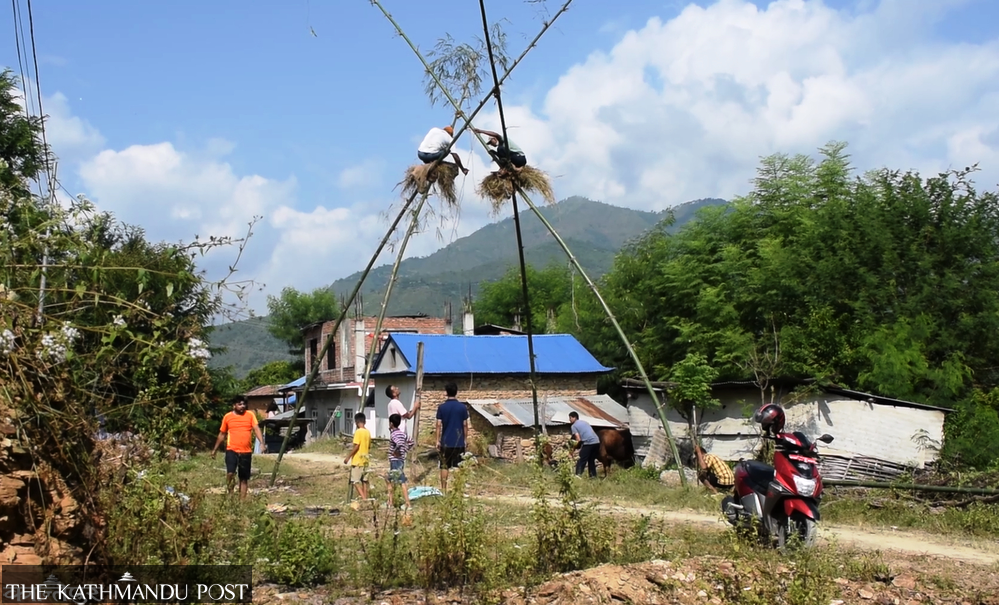
Dashain is often remembered through familiar sights and sounds: kites in the sky, villagers swinging high on traditional swings, folk songs echoing through settlements and relatives gathering after long periods apart. But as migration, overseas employment and changing lifestyles reshape village life, many of these old customs are gradually fading. One tradition, however, continues to draw crowds across Ramechhap, from rural settlements to urban centres: the linge ping, a traditional swing associated with Dashain.
Children and young people returning from cities to celebrate the festival in their ancestral villages have been flocking to the swings. Their laughter and excitement have brought fresh life to village squares, hilltops and other open spaces where the swings have been erected. For younger visitors, the swings offer a source of fun. For older generations, they evoke memories of childhood and Dashains past.
Himal Dhungel, from ward 5 of Khandadevi Rural Municipality, believes the traditional swing has become one of the main attractions keeping the spirit of Dashain alive in villages and towns alike.
In the past, he says, preparations for the festival could be seen throughout village life. Families whitewashed their houses with kamero, a traditional white clay, and decorated them with red earth and black pigment made from local plants. Village paths were cleaned, while traditional music filled the air. These activities helped announce the arrival of Dashain.
“People used to whitewash their houses, clean the paths and play traditional instruments before Dashain,” Dhungel said. “Those practices have gradually declined. They have not disappeared entirely, but they are much less visible than they used to be.”
Although many old customs have weakened, he said, the appeal of the swing has endured. For children growing up in cities, a linge ping in the village can be a novel experience. Some parents returning home for Dashain take their children considerable distances to let them try the swings and experience village traditions first-hand.
“That is also helping keep the tradition alive,” Dhungel said. “These days, the swing is carrying much of the festive spirit of Dashain.”
More than a source of entertainment
The significance of the linge ping extends beyond recreation. It also offers a place for people to gather, renew friendships and sustain the sense of community that can be weakened by migration and changing patterns of social interaction.
Pradeepraj Subedi, from ward 1 of Manthali Municipality, said the growing use of digital technology has increasingly kept people indoors and reduced opportunities for face-to-face interaction. The swings, he said, give people a reason to leave their homes and come together in a shared space.
“We cannot put all the blame on the younger generation. We, too, have reached a point where we sit in separate rooms and talk to one another on Messenger,” Subedi said. “At a time like this, the swing plays an important role in strengthening our community and social relationships.”
Post photo
The decline in the number of young people in remote villages has also affected collective activities, he said. In some settlements, older people are increasingly left behind, with fewer people available to help one another through everyday difficulties.
Subedi believes festivals such as Dashain should therefore be used as opportunities to renew a sense of shared responsibility towards village life.
For him, erecting a swing is not simply about creating a festive attraction. It is also a small but meaningful way of preserving the social ties that bind a community together.
Tradition finds a new audience online
Technology, meanwhile, is giving the traditional swing a new lease of life.
Sagarhari Adhikari, from Gelu in ward 12 of Manthali Municipality, said young people returning to their villages for Dashain are not only enjoying the swings but also recording and sharing their experiences through photographs, videos, Instagram Reels and TikTok.
The sight of children swinging fills the younger generation with festival excitement while bringing back childhood memories for their elders. Sharing images and videos of village swings and Dashain celebrations also allows people to introduce their home villages, culture and traditions to wider audiences, Adhikari said.
“I see the swing and Dashain as inseparable,” he said. “More people are now making Reels and TikTok videos and sharing them on social media. By posting these moments, they can show others that their villages, too, have swings, a living culture and traditions that have been followed for generations.”
Digital technology, he added, does not necessarily have to displace traditional practices. Used well, it can help introduce local culture and festivals to a new generation and make them visible to people far beyond the villages where they originated.
The linge ping has thus become more than a traditional form of entertainment. It is also a way for villagers to share their identity with the outside world.
As kite-flying, folk singing, traditional music and collective efforts to decorate villages become less common, the swing continues to connect older traditions with modern life. The laughter of children, the enthusiasm of young people returning home and the collective effort involved in putting up the swings are giving an old Dashain tradition a new expression, helping preserve some of the festival's familiar warmth even as village life changes.




 21.66°C Kathmandu