Remembering Suresh Raj Sharma, doyen of Nepal’s modern education
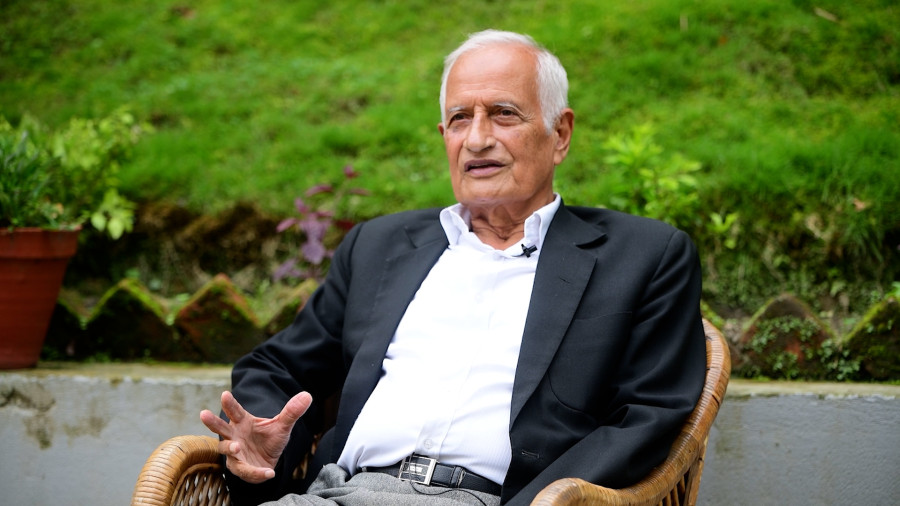
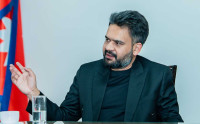
As the founder of Nepal’s most agile and cosmopolitan university, Sharma commanded an enviable moral authority. Suresh Raj Sharma, Kathmandu University's longest serving vice-chancellor, died at 86 on September 23. Kathmandu University Archives
In the mid-1980s, as he hit his mid-40s, Professor Suresh Raj Sharma found himself questioning what exactly he was doing with his life. He had enjoyed opportunities rare even for a hill high-caste man with a middle-class background: a PhD in Chemistry from the United Kingdom; a full professorship at a age of 38 at Tribhuvan University; an array of appointments at elite government institutions, including the Council for Technical Education and Vocational Training; and an enviable network of diplomats, bureaucrats and educationists in a country where being ‘aafno manchhe’ ensured upward mobility. He was at the prime of his career, but something was amiss.
What followed is a story of institution-building in the midst of a country in transition. Thirty-five years after its establishment, Kathmandu University, which tapped into the aspirations of middle-class Nepalis for quality education, remains arguably the most successful public academic institution in Nepal. This was made possible with the primary vision and grit of Sharma, the founding vice-chancellor, who passed away on September 23, at the age of 86.
Tribhuvan University, the only university at the time, was imploding under the weight of its enormous responsibility to educate an entire country, compounding its struggle to navigate internal and external political dynamics. The end of the Panchayat regime was imminent as the struggle to restore democracy escalated. For Sharma, it was time for reinvention. It was at this moment that he met Sitaram Adhikary, Bhadra Man Tuladhar and Ramesh Nath Dhungel, individuals who had built fairly successful careers on the foundation of the old system but had a ‘common desire’ to do something more than just a job. They ended up establishing the Kathmandu Valley Campus in 1985, with significant support from Tribhuvan University, which not only waived the affiliation fee but also provided classrooms at the Institute of Engineering. Valley Campus quickly became one of the most sought-after academic institutions of the time, giving Sharma and his friends the confidence to turn it into a university. Kathmandu University was established in Dhulikhel, Kavre, about 30 kilometres east of Kathmandu, in 1991, as the first non-governmental university of a redemocratised Nepal.
This new university would compensate for the inadequacies of Tribhuvan University, which had struggled to catch up with the changed socio-political context—marked by a liberalised market economy, a growing aspiration among the people to climb the social ladder—and limit the exodus of students for higher education amid a perpetual state of underdevelopment. The political instability that became a permanent national character further pushed the aspirational class abroad, as TU and its affiliated campuses became sites of political struggle. Students always seemed to be out on the streets fighting the government of the day; teachers were busy teaching extra classes in private colleges to meet their daily expenses.
Meanwhile, KU offered students the opportunity others often couldn’t: innovative programmes, updated curricula, regular classes and timely exams. It also offered teachers a competitive salary that enabled them to remain on campus to teach and conduct research. It had little internal bureaucracy to stop teachers from securing research funding and international mobility. KU quickly gained the reputation of a stable, agile and cosmopolitan institution in a country where the general sentiment is “nothing works in this country!”
As the new university grew in its size and public profile, Sharma, the avant-garde, began to be identified as the torch-bearer of quality higher education in Nepal. Despite the enormous burden of managing resources for an ever-burgeoning university, he continued to find his way into the classroom to teach chemistry. Sangeeta Shakya, a Valley Campus alum who joined in 1985, remembers Sharma as a motivated teacher who taught students beyond the immediate subject. Shakya, who is now a professor of biotechnology at KU, says, “He was deeply concerned that the careers of the people who worked with him should grow, too, along with the university itself.”
Faculty and staff members who joined KU in its early days remember seeing Sharma happiest as he returned from his classes, often wearing a white apron. But as the university grew, his presence in the classes grew thinner. The devotion with which the faculty, staff and students helped build the university had now begun seeking a greater say in how it functioned. Beyond the university campus in the hills of Dhulikhel, the country was undergoing a churning, which impacted all walks of national life: the Maoist insurgency and the politicisation of public institutions. The national became the institutional, despite KU’s valiant attempts at maintaining its autonomy.
Those who have worked with Sharma attribute his success partly to his acute awareness of political dynamics and his ability to work with people across the political spectrum. But his acuity didn’t always work in his favour.
Sijan Baral, who started his career as an English faculty member and worked alongside Sharma, said the founding vice-chancellor preferred to work with a small circle of people, which proved quite effective in delivering results. But not everyone was happy with such an arrangement anymore. What was earlier known as Sharma’s circle began to be identified as a coterie. Discontent brewed, leading to protests for establishing unions of professors, staff and students. The university that Sharma and his friends nurtured with great care had outgrown them.
“Professor Sharma and his friends were shocked, even embarrassed, by the protests,” Baral said. “This was the first time they were facing resistance from within.” The stalemate ended with a nominal acknowledgement of the professor, staff and student councils as apolitical formations, only to be officialised over a decade later.
As the country entered a protracted period of transition, the university remained a site of political contestation, culminating in Sharma’s abrupt exit just a year into his sixth term, thereby bringing an abrupt end to his 21-year stint as vice-chancellor in 2012. In the years since he gave up the executive role to continue serving as the chair of the Board of Trustees, the university expanded rapidly, a departure from his more conservative approach of maintaining ‘a boutique university’, but his primary vision of quality education persisted.
There is no dearth of critics who claim Sharma remained attached to the university long past his prime. Others specify how he could have run it differently. But few question his moral authority, with “What would Suresh Sir say?” serving as a common reference point in the university’s decision-making even today.
In his last years, though, the magic of his moral authority seemed to wane as the relationship between the university and the Dhulikhel Hospital, its teaching hospital, soured. As the two entities diverged from their common path, the patriarch kept urging them to make amends, reminding them, in long, rambling monologues, of the efforts put to bring them into existence, and how the separation of these inalienable entities would be an affront to the town of Dhulikhel, which had helped establish them outside the periphery of the capital city by giving them a home.
Dhulikhel had given Sharma himself a home too—a home away from his ancestral Sindhuli and acquired Kathmandu, a family beyond his legal heirs. The day Sharma passed away, I asked Ambika, my colleague at the university, who has an A4-sized portrait of him pasted on her office pinboard, who Sharma was for her.
She said Sharma was a father figure more than anything else. Long before she began her career at the university as a receptionist, she overheard her father tell the founding vice-chancellor, “My family of five brothers will donate five ropani of our land to the university.” Within years, she saw classrooms grow on the terraces where her family grew maize and sesame. One of her brothers studied here, and another teaches here now; her son studies here, and her daughter attends the university’s high school.
“How will you remember him?” I pressed.
“I’ll remember him as the man who turned our makaibariinto a global university,” she said.
(Kafle works at Kathmandu University. The views are his own and do not represent the institution.)




 15.89°C Kathmandu